
Outtasite (Outta Mind)

Hot Topic has frequently given credence and drawn attention to Oxfam’s reports on how climate change is already seriously affecting populations in developing countries.  (Some examples here and here and here.) It is therefore pleasing to see that a complaint to the UK Advertising Standards Authority (ASA) regarding an Oxfam poster has been rejected.

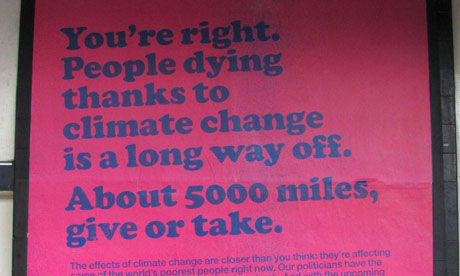
The poster stated “People dying thanks to climate change is a long way off. About 5000 miles, give or take… Our politicians have the power to help get a climate deal back on track… Let’s sort it here and now.” Four people challenged the poster on the grounds that it was misleading and could not be substantiated. They did not believe it had been proven that people were dying as a result of climate change.


Asked by the Authority to respond, Oxfam said research had been published by reputable organisations including the World Health Organisation (WHO), the Institute of Medicine (the health arm of the US National Academy of Sciences), the Lancet and University College London Institute for Global Health Commission that showed people had died, and were currently dying, as a result of climate change. In particular, they cited three WHO publications which they considered backed up Oxfam’s claim. In addition, they said Oxfam’s own experiences bore out ways in which climate change, manifesting as trends towards increased temperatures, disrupted seasons, droughts and intense rainfall events created additional health hazards for vulnerable populations in the countries in which Oxfam worked.

The ASA in its adjudication referred first to the IPCC and other national and international bodies with expertise in climate science and concluded there was a robust consensus amongst them that there was extremely strong evidence for human induced climate change. The ASA noted that the part of Oxfam’s claim that stated “Our politicians have the power to help get a climate deal back on track … let’s sort it here and now” made a link between human action and climate change.

The ASA then turned to the question of whether there was a similar consensus that people were now dying as a result of climate change. They referred to several WHO reports. One was the 2009 publication Global Health Risks – Mortality and burden of disease attributable to selected major risks [PDF], which stated “Climate change was estimated to be already responsible for 3% of diarrhoea, 3% of malaria and 3.8% of dengue fever deaths worldwide in 2004. Total attributable mortality was about 0.2% of deaths in 2004; of these, 85% were child deaths”.

Satisfied that there was a consensus that deaths were now being caused by climate change, the ASA finally noted that Oxfam’s claim was reasonably restrained in that it stated deaths were occurring at the present time as a result of climate change but that it did not claim specific numbers of deaths were attributable and it did not speculate about future numbers of deaths.

The ad was judged not misleading.  (The full text of the adjudication is on the ASA’s website.)

Oxfam is not pushing the envelope in its reports and claims of what climate change is already meaning for some populations in the developing world. It is well within the limits of the science. It may be a shock to some to realise that, and there are always those ready to discount it as alarmism aimed at increasing the organisation’s income.  But it is no more of an exaggeration to say that people are already dying as a result of climate change, than to say that people die as a result of tobacco smoking. Those of us who have lived long enough may remember how long and hard the latter conclusion was resisted by the counter-claims of the industry and the widespread public unwillingness to face the reality. Fifty years ago when as a young man I took up tobacco smoking for a period of some years I assumed the medical warnings which were beginning to be sounded were bound to be overstated. The very normalcy of smoking made it easy not to take them seriously. And there were plenty of assurances abroad that there was little to be concerned about. I shudder now to think how easily we blinded ourselves.

The analogies with the far greater issue of climate change are all too apparent. The efforts of Oxfam and others to puncture our complacency are justified and necessary. May they not have to wait decades to succeed.

[Wilco]

What a waste(land)

I was pleased to catch sight of the first two words of the headline on the Eco Issues page of the Waikato Times this week — “The Arctic”, it said, and I assumed thankfully that they were going to focus on the alarming developments there. And so they were, but not in the sense I presumed, for the headline continued “– site for an icy cold war?”  The article was all about the competition for seabed resources as the ice diminishes. Nothing at all about the threat to the global climate. The omission was compounded by another headline for an inset panel: “A frozen wasteland no more”. In other words, with the melting of the ice the Arctic is becoming useful.

Incidentally the word wasteland reminded of me how a few years ago the chairman of a local trust, a subsequent national president of the ACT party, opposed making a grant for wetlands restoration. “Wetlands are wastelands,” he said.


The terrible irony of referring to the Arctic as a wasteland is presumably lost on many Waikato Times readers. And not too many journalists are likely to question the focus on resource extraction. We can expect a plethora of journalistic analysis of the international tensions over the rights to natural resources from the Arctic as it moves inexorably to losing its sea ice. That appears much more likely to be the substance of reportage and discussion than the consequences for global warming. Political leaders will come alive on the issue. Indeed they already have. Vladimir Putin hosted an international conference last month on the future of the Arctic, and although he claimed development would be sensitive to the environment he also made it clear that he’s no believer in anthropogenic global warming, as reported in the Energy Tribune.  Expect much closer political attention to the exploitation of newly accessible mineral resources than to the implications for global warming.

It is obvious to anyone who follows climate science that a frozen Arctic is pretty well essential to the climate in which human civilisation has developed. The loss of Arctic sea ice and a diminishing Greenland ice sheet carry between them incalculable consequences for change which it is by no means clear we can manage.  That’s why apprehension is the most rational human response to what we are seeing, accompanied by a determination to stop making it even worse. But how much longer do we have to wait for apprehension to be manifest on a wider scale than is so far apparent?  Putin’s no help:

“Is it changing because of human influence or because of unavoidable changes in the planet’s development that humankind cannot prevent? Is it really disastrous for the planet? I don’t want to say that we should give up our efforts to combat global warming, but maybe it is happening regardless of our influence? It is most likely so.”

Nor is there any sign of awareness from the numerous Republican political candidates in the US who have become bogged in a mire of unreason as they variously deny the science altogether, or treat it as highly uncertain, or downplay it in favour of fossil fuel energy. It’s almost unbelievable to see the list of gubernatorial candidates, for instance, whose stances have been reported by the Wonk Room. There are many other articles in the Wonk Room climate section, by the way, reporting the sad story of a major political party’s descent into denial of the most pressing issue of our time.

Back here in Hamilton I shall write a letter to the editor pointing out that far from a wasteland the frozen Arctic is vital to life as we have known it since civilisation began.  I shall deplore the continuing failure of political leadership to come to terms with the reality of climate science, and urge readers to be concerned for their children and grandchildren in the world we are creating. A year ago I could have said this in a column, but the paper’s anxiety about ‘balance’ put an end to that. A letter will be better than nothing.

[I could be the ticket man at Fulham Broadway station…]

The Climate Show: Beta 1

[youtube]-9yr6L6tdDc[/youtube]

Introducing The Climate Show, the first (beta 1) stab at a web-based “radio with pictures” programme about climate news science, policy, politics and solutions. It’s the brainchild of KIWI FM’s Radio Wammo breakfast host Glenn Williams, one of the most innovative young broadcasters in New Zealand, and he’s roped me in to add, er, something or other… 😉

The show was recorded last week via Skype video conference, and we discussed new temperature records, the state of the Arctic, chatted with Kevin Cudby about his new book From Smoke To Mirrors, recommended the Skeptical Science web site and iPhone app, and then discussed some recent developments in solar photovoltaic technologies. It’s available at Youtube, as a podcast via iTunes, and will soon have its own site at theclimateshow.co.nz . You can follow the show on Twitter at @TheClimateShow. We’re aiming to record a programme every couple of weeks to begin with. All feedback welcome — what do you think of the show and what would you like us to cover? Any guests you’d particularly like us to feature (NZ and worldwide)? And if you like the show, tell your friends… Links to the stuff we talk about below the fold.

The Climate Show (audio)

Continue reading “The Climate Show: Beta 1”

Back in Judy’s jungle

Judith Curry is a climate scientist who in recent times has achieved prominence in accusing her colleagues of groupthink, criticising the IPCC process, and suggesting that scientists can gain from more tolerant engagement with the sceptics. She is not a sceptic of the science herself, but unsurprisingly she has been welcomed by many of the deniers and is frequently quoted as evidence of the soundness of their complaints. Michael Lemonick of Climate Central has written a lengthy article about her published today in the Scientific American. He is even-handed to a fault, but I found nothing to alter my perception of what has struck me as her opacity and naivety in the few pieces of her writing I have seen.


Lemonick’s article raises the question of uncertainty in the scientific predictions, something which Curry apparently feels is not sufficiently acknowledged.

“Curry asserts that scientists haven’t adequately dealt with the uncertainty in their calculations and don’t even know with precision what’s arguably the most basic number in the field: the climate forcing from CO2—that is, the amount of warming a doubling of CO2 alone would cause without any amplifying or mitigating effects from melting ice, increased water vapor or any of a dozen other factors.”

I’m not a scientist. I’ve enjoyed reading science books for the general reader over the years and tried to have a broad understanding of major scientific theories. All relatively gentle and interesting. When it came to climate science however there was a dimension of urgency which was not present when reading about evolution or trying to understand relativity. If the climate scientists were even partially right the human future was under an almost unimaginably severe threat, though one which could yet be avoided. It rapidly became apparent that this was a science where one couldn’t just be an interested observer, even though a non-scientist.

In this context I can’t say it bothers me that scientists don’t know with precision the warming resulting from a doubling of CO2. I’ve seen the range that is generally considered possible and that’s quite sufficient to alarm me given that its effect is likely to be amplified by accompanying feedbacks. Apparently Curry feels that the uncertainty of the feedbacks is also not sufficiently acknowledged, but nothing I’ve read from the scientists offers certainty in estimating feedbacks, and what we are actually observing in the melting of Arctic sea ice or the acceleration of Greenland and Antarctic ice sheet loss is quite enough evidence for me that the feedback amplification effect is a serious factor.

Similarly it doesn’t bother me if the IPCC reports are judged to have not always communicated the level of uncertainty as carefully as they might have done. “Sometimes they do it well, sometimes not so well,” said Harold Shapiro, the head of the InterAcademy Council which recently reported on the IPCC procedures. That’s fine by me. I can cope with uneven performance. It doesn’t lead me to think that the overall scientific picture is unreliable. And even Curry acknowledges that uncertainty works both ways and can be overstated as well as understated. Again, observations that some effects of warming are occurring well ahead of expectations illustrates that.

It’s the broad sweep of climate science that rivets my attention as a concerned human being. Curry seems to me to be magnifying comparative trifles. Which is precisely what many of the deniers and delayers depend on. I doubt that she’s right in the matters she alights on, but even if she were it doesn’t alter the overwhelming reality of human-caused climate change. There’s a coherence to the scientific picture which we would be utterly foolish to allow ourselves to be blinded to even by a practising scientist.

Curry may have a gripe with her colleagues, but it is neither here nor there in terms of what the science means for the actions we should be taking. I notice she seems to be keen on cost-benefit analysis. I don’t know how you sit down and do that sort of analysis in the face of the threat of climate change. When disaster looms you do everything in your power to avert it.

[Brian Eno]

How Kiwi know-how can save the world

This a guest post by Kevin Cudby, the author of From Smoke To Mirrors, reviewed earlier this week by Bryan.

I started researching my new book, From Smoke to Mirrors, back in 2007. I had been following alternative energy stories, and I was inundated with blogs and press releases from hucksters peddling silly ideas that would do nothing but separate investors from their savings.

So, in late 2007 I set out to document the strengths, weaknesses, and costs of all the options. I kept in mind that hydrocarbon liquid fuels (petrol, diesel, jet fuel, and fuel oil) underpin key elements of human civilisation, such as food production and distribution. Although the relative importance of cars, trucks, aircraft, and tractors might change over time, it will only be possible to eliminate liquid-fuel-related greenhouse emissions if we can find practical alternatives for every vehicle and machine. Forty percent of New Zealand’s liquid fuel is used on non-road applications, so it would be pointless to fix road transport and ignore agriculture, construction, aviation, and all the other non-road liquid fuel users.


My engineering background helped me sort the practical options from the vacuous nonsense. It had been a while since I’d worked with battery technology, and I enjoyed ferreting out detailed technical information about the latest rechargeable batteries, information their promoters would rather keep secret. I learned, for example, that battery-powered farm tractors would be about as practical as concrete helicopters. Then I moved on to hydrogen fuel cell vehicles—which, from the practical perspective, are looking pretty good. But hydrogen tractors are almost as impractical as battery-burners.

We know about practical processes for converting softwood chips into electricity, hydrogen, hydrocarbon fuels, and ethanol

It is clear that energy forestry is New Zealand’s most practical option for hydrogen, and for hydrocarbon fuels. New Zealand scientists knew about this possibility way back in the 1970s, though the technology for making trees into fuel was still being developed. Now, we know about practical processes for converting softwood chips into electricity, hydrogen, hydrocarbon fuels, and ethanol. No matter which technology New Zealand uses for road transport, our energy forests would occupy pretty-much the same amount of land. Researchers have calculated that the “energy profit” (or EROEI) of fuels made from wood chips will be better than that of our existing fossil fuels.

Perhaps the most exciting discovery, for me, was that radiata pine forests offer so many environmental side-benefits. I knew from personal observation that the native undergrowth in a 25-year-old radiata forest is far more luxuriant than the undergrowth in a 25-year-old stand of regenerating kanuka. But I am not a biologist, so I had to listen to the experts. I learned that converting steep low-quality grazing land into energy forests would improve biodiversity by creating habitat for a wide range of native species, from fungi to kiwis and falcons (the bird, that is). And I learned that foresters do not use fertiliser, and that third-generation radiata forests in the Central North Island are doing as well, or better, than the original plantings.

It seems New Zealand foresters have invented a biomass production process that can operate indefinitely. The technique has been thoroughly proven over many decades of real-world practice. We can share this expertise with other countries, which means Kiwi know-how can help knock a very large dent in anthropogenic greenhouse emissions.

There’s an excellent chance New Zealand will have the world’s cheapest renewable petrol and diesel

Even more exciting, there’s an excellent chance New Zealand will have the world’s cheapest renewable petrol and diesel. I’m guessing many New Zealanders will be very excited about that, especially considering what I learned about the future of conventional cars and trucks. Talking to overseas engineers, I learned about simple, practical engine and transmission systems capable of more than halving the fuel consumption of conventional road vehicles, without downsizing them, and without relying on battery hybrid systems.
So, although renewable petrol and diesel will be somewhat more expensive than today’s fuels, the improved efficiency of future vehicles will more than compensate.

We can be almost certain that sometime between now and 2030, the global economy will hit serious problems with the supply of liquid fuels. That is because fuel supplies will increasingly come from synthetic fuel factories. It can take up to six years to design, build, and fully commission a synthetic fuel factory, regardless of whether it makes climate-neutral fuel, or fossil fuel. Multi-national energy companies will be able to maximise their profits by delaying construction of synthetic fuel factories until prices begin to skyrocket. We know this will happen, but we cannot say exactly when it will start to affect global fuel prices. A growing number of analysts think it will happen before 2030, and the real pessimists think it will happen before 2020.

However, by 2040, if New Zealand gets stuck in and builds the necessary infrastructure, we can reasonably expect freight costs, and vehicle running costs, to consume a smaller fraction of the family budget than they do today.

There is no sign of any practical alternative for hydrocarbon liquid fuels for non-road applications. But these applications account for nearly half of New Zealand’s liquid fuel consumption.

So, while car and truck manufacturers are playing around with every technology that can turn a wheel, New Zealand should climate-neutralise its supply of essential, non-road fuels. This will keep us busy well into the 2020s. By then, thanks to advanced fuel injection and exhaust treatment systems, tailpipe emissions from conventional vehicles will be insignificant compared with pollution from tyre wear. All road vehicles have tyres, so environmental concerns will not influence our choice of cars and trucks. We’ll use whichever technology is the most practical.

From Smoke to Mirrors outlines a transition plan that takes account of these and other factors. I did not invent the transition plan. Associate Professor Susan Krumdieck did that, leaving it up to people like me to flesh it out and show why it is practical. Krumdieck proposed a direct attack on the problem’s fundamental origin. Fossil fuels cause greenhouse emissions, and greenhouse emissions cause climate change, so Krumdieck says we should simply ban fossil fuels. If you read From Smoke to Mirrors, you’ll see how simple and practical this would be.

New Zealand can do this. In fact, New Zealand should do this. We are a very small country, and if we cannot work together, how can we expect the rest of the world to do it?We need all our political parties to work out a multi-party agreement. This is about banning fossil fuels and developing the infrastructure to fully replace the billions of litres of fuel we’ll need by 2040. Left-right political questions, such as whether to build roads or railways, would be outside the scope of this agreement.

I’ve met young people who say: “We’re stuffed anyway, so I’m just gonna get as much as I can , while I can, and to hell with having kids.” That’s OK if there is no technical solution, or if the solution involves returning to medieval technology. But I’ve seen enough good technology to know the world will not go there. So, I hope my book will provide hope for those young people who have been led to believe there is no hope. My grandchildren’s generation will be the first to grow up knowing that we can solve this problem, because “From Smoke to Mirrors” makes the solutions readable and easily understood.

New Zealand can be self-sufficient for climate-neutral energy. Other countries can benefit from Kiwi expertise. This is a multi-decade project that could inspire every New Zealander. The question is whether our politicians are up to the challenge.