
Just as the tide was flowing

Two disparate news items in New Zealand newspapers highlight some of the problems facing any switch from fossil fuels to renewable energy sources. The first is the Environment Court’s welcome approval of Crest Energy’s application to sink 200 turbines to the sea bed of the Kaipara Harbour where the strong tidal flow will be used to generate electricity. The decision follows a 2008 appeal to the Court by Crest Energy against the Northland Regional Council’s decision to allow only 100 turbines. Environmental objection centred around the possible effect on the west coast snapper stocks and possible threats to the survival of the rare Maui’s dolphin. I wrote about the project and other NZ wave and tidal energy projects in a Hot Topic post a year or so ago.


The Environment Court approval is hedged with conditions. Crest can sink three turbines initially. If results with three turbines satisfy the Northland Regional Council, the company can add up to 17 more turbines, provided operation of the 20 turbines is monitored for a year to give sufficient information on the impact on fisheries. From there, the council will decide whether to allow turbines to be built up in further stages from 20 to 40, then 80 and then to a maximum of 200.

The director-general of conservation wanted the monitoring of the 20 turbines to last three years, not one. Another iwi-based objector wanted at least three years of monitoring after each stage. The environment court’s decision followed a year of mediation among four objectors.

It’s not my purpose to criticise the objections or the conditions imposed by the Court. Renewable energy development has environmental effects which must be taken into account and judgments made, and I’m certainly in no position to weigh the factors in specific cases. But one hopes that climate change carries very considerable weight in the process. I notice the judge is quoted as saying the proposal is very significant in terms of its contribution to power generation and the national economic interest. Maybe he also said something about the importance of renewable energy in combating climate change and it wasn’t reported. Maybe he linked the national economic interest to clean power and emissions reduction. But maybe that’s outside the Court’s scope.

Which brings me to the second news item where the Grey District mayor pleads for the Pike River mine to be turned into an opencast operation.  There’s billions of dollars’ worth of coal there and the mayor even goes so far as to say that the deceased miners would want to see mining continue. One has to sympathise with the anxieties of West Coast communities whose livelihoods are to a considerable extent bound up with mining. The mayor was explicit that the financial benefits of opencast mining outweigh environmental concerns. Unfortunately he’s wrong if environmental concerns include global warming. There are plenty of environmental concerns around opencast mining of any kind, but when the object is coal those concerns are far greater than the localised disruption and pollution caused by the mining. Climate change concerns overshadow all kinds of coal mining for that matter.

This is tricky territory. West Coast coal is generally of a quality which makes it suitable for steel making and as such is a valuable export product. The coal industry in New Zealand has been invigorated in recent years. Obviously for the time being steel-making is going to need coking coal. Why should New Zealand not benefit financially from supplying that need?

It’s a fair question. However it’s not apparent that anyone involved in the coal industry or in government for that matter thinks in terms of supplying an interim need while the world organises itself to live without coal. That’s not the impetus driving our coal industry. That doesn’t explain Solid Energy’s plans to exploit Southland lignite. The thinking behind the expansion of coal mining and exporting is that there is a lot of money to be made from exploiting our coal resources to their fullest extent. Any cautionary sentiments seem to be along the lines of making sure we don’t move too slowly and miss out on the bonanza.

What unites these two seemingly unrelated pieces of news? The need to give full weight to the enormous threat of climate change. In the one case it lends strong support to a new venture. In the other it warns that the days of coal mining must be considered near an end. At least that’s the logic of the situation we’re in. But apart from the Greens there’s hardly a politician in the country who seems willing to say just that. They seem to be overcome with a collective embarrassment at the thought of expressing deep concern at the prospect of climate change, let alone applying that concern to the coal industry. The embarrassment that appears to inhibit them is dwarfed by the embarrassment of watching them virtually ignore a matter of such consequence for the human future.

[Eliza Carthy]

The Climate Show #6: Monckton and the iron in the ocean

[youtube]5jxO2Up3Wyc[/youtube]

A very wide ranging Climate Show this week, with Dr Philip Boyd of NIWA and Otago University explaining why fertilising the oceans to soak up more carbon is not likely to be our “get out of jail free” card, John Cook of Skeptical Science introducing the new Monckton Myths section of the site, plus interesting new papers on Atlantic warming adding to the Arctic’s problems, an accurate prediction of last year’s Pakistan flooding, and the coolest 1970s Datsun on the planet.

Watch The Climate Show on our Youtube channel, subscribe to the podcast via iTunes, or listen direct/download here:

The Climate Show

Follow The Climate Show on Facebook and Twitter, and soon, with cool blue colour scheme, at The Climate Show web site.

Show notes below the fold.

Continue reading “The Climate Show #6: Monckton and the iron in the ocean”

The odds are much worse than 50-50

Nick Smith, NZ’s climate change minister, told the Bluegreens forum in Akaroa last weekend that the government was considering gazetting their “50 by 50” target for carbon emissions — a 50 percent cut in emissions by 2050. That target has been National Party policy since before the last election, so the only real news is that the government is considering making it “official”, in the terms of the Climate Change Response Act 2002. Smith continues to represent this target as challenging (which is true), and in line with other countries commitments (which is less so), but where it really falls down is by being completely out of line with what is actually required if we are to avoid the worst effects of climate change in the future.

The last time the government considered emissions targets was in the run up to the Copenhagen conference in 2009. At the time, I posted an analysis of global and national emissions targets — The First Cut Is The Deepest. It still remains valid today, made more piquant by the sense of impending changes of climate and the notable extreme weather events that have accumulated since. Here’s my simplified cheat sheet…

Continue reading “The odds are much worse than 50-50”

Singing in the rain

Climate scientists of any public prominence these days are likely to be on the receiving end of hate mail. When they are also activists, as James Hansen acknowledges himself to be, it’s no doubt worse. He has written on his website, under the intriguing title Singing in the Rain, of a recent “deluge of nasty-language messages saying that I should be fired, deported, run over, etc.”  He comments dryly that such a sudden burst of malice seems unlikely to be spontaneous, and wonders whether a couple of pieces of recent writing aimed at him may have provided the stimulation.

One is by Patrick Michaels in the Washington Times. He had caught up with what Hansen had to say about China, something I covered in Hot Topic last November. Michaels talks of anti-democracy rants, presumably referring to this sentence:

“Democracy of the sort intended in 1776 probably could have dealt with climate change, but not the fossil-money-’democracy’ that now rules the roost in Washington.”

Michaels goes on to accuse Hansen of advocating a ruinous boycott of the US economy, and adds for good measure the old and false accusations that Hansen was wrong in his 1988 climate predictions anyway.

The other piece is a blog by Richard S Courtney which includes the following relating to Hansen’s appearance as an expert witness in the Kingsnorth trial in the UK:

“So, as a result of Dr Hansen speaking to that law court, eco-terrorists have a legal right to attack power stations in the UK. And that right will remain unless and until the UK Parliament alters the law.

“Dr Hansen is an employee of US Government and the US is supposed to be an ally of the UK: n.b. he is de facto an agent of the US. Therefore, Dr Hansen’s actions in this UK legal case are tantamount to an act of war by the US on the UK. For this reason, if for no other, he should be sacked.”

Apart from noting that the Courtney statement mischaracterizes his testimony at the trial, Hansen doesn’t address it but instead uses it as an opportunity to elaborate on an issue which is very much on his mind these days: the intergenerational injustice of human-made climate change. He comments that his testimony at both the Kingsnorth trial and later the Ratcliffe-on-Soar trial (which incidentally, contrary to Courtney’s implication, was in his own time at his own expense) was given at the request of young people on trial. That’s a request he finds hard to decline, recognising himself as part of the generation causing the problem that the young people are beginning to recognize and protest against.

He considers the two different verdicts – acquittal of the Kingsnorth defendants, a guilty verdict for the Ratcliffe-on-Soar defendants.

“The Kingsnorth jury, nine women and three (some young) men were intently interested – you could have heard a pin drop during my testimony. I anticipated acquittal. Nottingham had a different feel…No doubt the jury in Nottingham was fair-minded, but they were more severe in their judgment about whether young people were justified in taking actions to draw attention to the urgency of the situation and its intergenerational injustice.”

He notes also that the Ratcliffe jury were older than the defendants, were members of the generation most responsible for creating the climate problem that young people will need to deal with. But that fact didn’t prevent their voting for conviction.

He considers that part of the reason may be change of public perception of this topic between the Kingsnorth and Ratcliffe trials.

“Media and governments allowed science and pseudo-science to have equal weight, ‘fair and balanced’. Relentless repetition of minor flaws in telephone-book-thick IPCC reports created the public impression that the science may be flawed, even while observations of climate change strengthened and the urgency of action increased.”

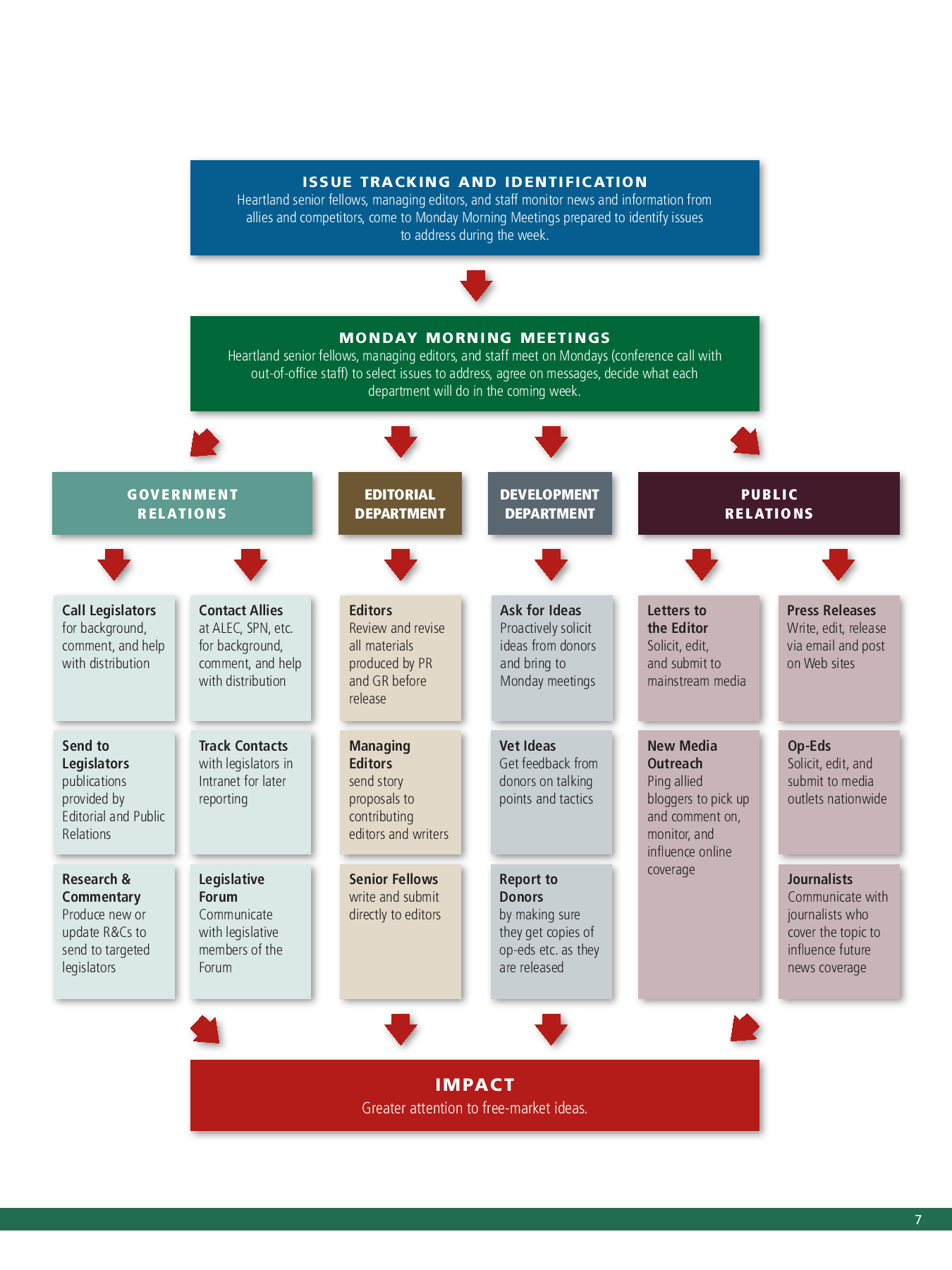
To the argument that young people are free to influence public opinion he offers a striking Heartland chart as an example of what they are up against.

“People carrying out these [Heartland] tasks are professional warriors for special interests, well-funded to make the case that global warming and climate disruption are a hoax. Their message is repeated relentlessly. Note that the ‘free market ideas’ phrase in the Heartland bottom line is Orwellian double-speak. They mean the opposite, they want business-as-usual, with fossil fuels subsidized and not required to pay their costs to society.”

His conclusion is tinged with resignation:

“Dear grandchild, this is a monster that you must face. You will need to figure it out. I am sorry. But it is the shape of our democracy today, which we bequeath to you.”

Nothing so far related to singing, but Hansen goes on to speak of Lester Brown putting him in touch with Canadian singer Raffi Cavoukian, suggesting that Raffi’s work on child honouring and Hansen’s book, Storms of My Grandchildren, share a common theme. Hansen recommends a recent essay Raffi has written, The Right to a Future. A shortened version of the essay has appeared on Huffington Post.

“The young have the strongest moral claim on climate action. It’s their future on the line. And they may hold the key to inspiring an emotional tipping point for critical mass.

“We urgently need to embrace social and economic systems that constitute a culture of respect for children and their planetary habitat.”

To finish, here’s Raffiâ’s global cooling song:

[Youtube]zSn9KrK0peM[/Youtube]

[And Gene Kelly]

Federated Farmers gullibility highest since records began

You may have noticed that New Zealand’s Federated Farmers organisation is capable of military grade climate change denial. I was going to write on the history of farming denial, but while looking for the 2006 and 2007 Federated Farmers presidential addresses from (then president) Charlie Pedersen (can’t find my copies) I found this wee gem (published two weeks ago) by Don Nicolson, the current president.
With deep snow in the USA, parts of Australia awash and mudslides in Brazil, it’s unsurprising we’re seeing professors of climate change pinning this “evidence” on the climate change donkey.

Sticking with mass media (because, as we shall see, Don Nicolson has great faith is them) I recall experts carefully and mildly saying things like:

Continue reading “Federated Farmers gullibility highest since records began”