
120% Pure Subsidy: Part 2

I have had some very good comments on my recent post, 120% Pure Subsidy, about the quantity of free emissions units that NZ Aluminium Smelters Limited (NZAS) has received under the NZ ETS in 2010. Enough good comments that they justify a second post on the subject.

Simon Terry of the Sustainability Council points out that we shouldn’t be surprised at the high level of free allocation of units to big emitters. Simon Terry documented this in June 2008, in the report Corporate Welfare Under the ETS, which looked at free allocation of units to eight energy intensive companies under the proposed NZ ETS.

Continue reading “120% Pure Subsidy: Part 2”

Health professionals call for action

The health and security implications of climate change were the subject of an interesting-looking conference hosted by the British Medical Journal in London on Monday.  Both medical and military speakers took part in the programme. The meeting produced a strong and succinct statement which underlined how widespread are the ramifications of climate change, in particular as they relate to human health and the security of populations.  I’m always cheered to see groups weighing in on climate change from the perspective of its impacts on human welfare, and thought it worth reproducing their statement here.

Continue reading “Health professionals call for action”

Trans-Tasman Emissions Trading Scheme Challenge: Part Two

With the passage of the Australian “Clean Energy Future” legislation, Simon Johnson (aka Mr February) makes another trans-tasman emissions trading scheme comparison.

Yesterday the Australian Parliament adopted legislation for its greenhouse gas emissions trading scheme. It’s time, therefore, for another post on the theme of the “Trans-Tasman Emissions Trading Scheme test series”, looking at the key differences between the New Zealand Emissions Trading Scheme and the Australian Emissions Trading Scheme. The number one key difference between the two emissions trading schemes is in how clearly each scheme sets the carbon price.

Continue reading “Trans-Tasman Emissions Trading Scheme Challenge: Part Two”

Climate Change and the End of Exponential Growth

An intriguing title for what promises to be an interesting seminar in Wellington later this month. Pieter Tans of NOAA’s Earth Systems Research Lab in Boulder — a carbon cycle specialist and winner of the Roger Revelle Medal at the 2010 Fall AGU — will be the guest of the NZ Climate Change Research Institute. Here’s a flavour of what he’ll be talking about:
Man-made climate change is a clear manifestation that we have reached limits of resource consumption by our species, and that continuing business‐as‐usual has a substantial chance of destroying civilization. It is also likely that fossil fuel resources will not remain cheap for much longer, with high energy prices becoming an impediment to development. Vigorous policies to decrease our dependence on fossil fuels are necessary to continue enabling development and to safeguard it by reducing the risk of catastrophic climate change.

Tans’ talk is scheduled for Wednesday 26 October at 6:00 pm in Lecture Theatre 1, Old Government Buildings. I’d be there, if I were in Wellington. I’m not, so I’d welcome first hand reports. For more information, contact Liz Thomas at the CCRI.

Geoengineering down under: Is Stratospheric Sulphate Injection Completely Reversible?

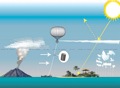
This guest post is by Simon Terry, Executive Director of the Sustainability Council of New Zealand. The risk rating on stratospheric sulphate injection went up another notch on the basis of material presented at a recent geoengineering symposium in Australia organised by the Australian Academy of Science, while the existing climate change risks did not get any better. The event made a useful contribution to the understanding down under of so called ‘geoengineering’ and delivered some perspectives that will be useful internationally, including a review of sulphate injection that raised a new issue: is it completely reversible? More on that below.

While not exactly the “southern hemisphere perspective” that was billed (as the contributors barely exceeded Australia’s borders), it nonetheless delivered strong presentations and discussion — partly as a result of most speakers being specialists in the field related to each technique reviewed but not technique proponents themselves.

Continue reading “Geoengineering down under: Is Stratospheric Sulphate Injection Completely Reversible?”