 Welcome to the eighth post in the Sustainable Energy without the Hot Air – A New Zealand Perspective series. Today we’re crunching the numbers on marine and waste incineration potential in New Zealand. For the background to the work please our introductory post here. Also check out our earlier posts on the potential of hydro power, geothermal and wind, and the summary on the big three. More recently we’ve dealt with solar and biofuels. Note: the units are in kWh/day/person – ie. if you ran a 40W lightbulb for 24 hours, it’d take ~1 kWh over the space of a day. We then divide it by person to give you a sense of the scale of the resource proportionate to the size of the population. Be sure to check out the methodology. For reference – we’re looking to replace around 55 kWh/d/p of energy currently generated by fossil fuels.
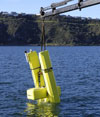
The marine environment offers several possible renewable energy sources, notably wave and tidal energy. Wave energy systems have been studied by the Electricity Authority, and data here comes from their report [yeqtogu]. Feasible wave energy plants need wave energy greater than 20kW/m “close” (say 6km) to coast. New Zealand has 2000+ km of coast-line fulfilling these parameters, mostly on the west coast. Wave derived energies in the far south can be 60 to 80kW/m, which is impressive. That is approximately 86kWh/d/p for a 50% efficient wave generator covering half our available coastline. However, a reality check indicates that no such mechanism exists (so far wave generators have been built for survivability rather than efficiency) and many factors would constrain where wave generators could be built.
A fairly detailed analysis based on currently available technology has identified sites offering perhaps 2kWh/d/p and a maximum potential for perhaps 27kWh/d/p. While a number of prototype and early commercial plants have been deployed worldwide since 2009, this realistically still is best be described as an emerging technology with very substantial environmental and economic barriers to deployment.
Continue reading “Sustainable Energy NZ #8 – The Tides They Are A-Changin’ – the marine and waste energy resource”

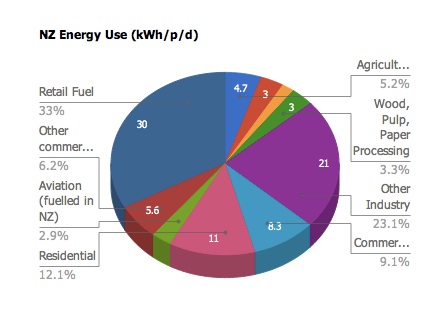
 Welcome to the ninth post in the Sustainable Energy without the Hot Air – A New Zealand Perspective series. Today we’re summarising the numbers on the various renewable energy options in New Zealand (and finding they’re more than sufficient!). For the background to the work please our introductory post
  Of all the consequences of human-caused global warming, sea level rise has always held special alarm for me in its inexorability, its extension into the future, and the enormous disruption it threatens to centres of high population and essential infrastructure. Scientist