

Sustainable Energy NZ #14 – how much energy hides in food and ‘stuff’

Welcome to the fourteenth post in the Sustainable Energy without the Hot Air – A New Zealand Perspective series. After our previous posts on hydro power, geothermal and wind (and a summary on the big three), solarbiofuelsmarine and waste energy, we’re now looking at answering the question:

How can we achieve a BIG reduction in our personal and national energy consumption?

Remember, as before, the units are in kWh/day/person – ie. if you ran a 40W lightbulb for 24 hours, it’d take ~1 kWh over the space of a day. We then divide it by person to give you a sense of the scale of the resource proportionate to the size of the population. Be sure to check out the methodology. For reference – we’ve been looking to replace around 55 kWh/d/p of energy currently generated by fossil fuels.

Food

Farming and food processing cost about 8kWh/d/p of the NZ energy bill, much of which is of course exported. This is only energy consumed in food production – a great deal more energy is directly incorporated into our food from the sun. When looking at land for either biofuel or solar production, energy production competes directly with food. We could grow a lot more biofuel if we produced a lot less milk, for instance. For the purposes of national energy supply, we doubt much can be gained in terms of energy efficiency to support current production.

New Zealanders eat more beef than the UK population, but we eat next to no grain-fed beef and barning is rare. Overall, the 15kWh/d/p for a UK person is probably pretty similar here. Reduce that to 10 for vegans, but remember that crops cannot be grown on much of the land that we graze (especially not continuously).

Continue reading “Sustainable Energy NZ #14 – how much energy hides in food and ‘stuff’”

Sustainable Energy NZ #13 – making light work of savings at home

Welcome to the thirteenth post in the Sustainable Energy without the Hot Air – A New Zealand Perspective series. After our previous posts on hydro power, geothermal and wind (and a summary on the big three), solarbiofuelsmarine and waste energy, we’re now looking at answering the question:

How can we achieve a BIG reduction in our personal and national energy consumption?

We covered the breakdown of where we use this energy in the last post. Today we’re dealing with commercial and residential building energy use. Be sure to check out our treatment on road and air transport from the last few days.

A few notes before we begin: as before, the units are in kWh/day/person – ie. if you ran a 40W lightbulb for 24 hours, it’d take ~1 kWh over the space of a day. We then divide it by person to give you a sense of the scale of the resource proportionate to the size of the population. Be sure to check out the methodology. For reference – we’ve been looking to replace around 55 kWh/d/p of energy currently generated by fossil fuels.

Commercial and Residential Energy Use

Making sense of the commercial and residential energy use in the Energy File is more complicated. All the commercial energy to light, heat, and power our gadgets both at home and at work amounts to 21.2kWh/d/p. Compare this with a UK usage of 37kWh/d/p for heating and cooling. A couple of caveats about these figures though. First, “industrial” energy use almost certainly includes some workplace heating, lighting and gadgets, so the real number is certainly higher. The number includes 5kWh/d/p of firewood but excludes firewood obtained from non-commercial sources. Using MacKay’s estimates as a rough guide, we would break this down as follows.

Continue reading “Sustainable Energy NZ #13 – making light work of savings at home”

Sustainable Energy NZ #12 – do Kiwis have to be flightless?

Welcome to the twelfth post in the Sustainable Energy without the Hot Air – A New Zealand Perspective series. We’ll be changing gears here from our previous posts on hydro power, geothermal and wind (and a summary on the big three), solarbiofuelsmarine and waste energy. From here on out we’ll be attempting to answer the question:

How can we achieve a BIG reduction in our personal and national energy consumption?

It’s a very important topic – and one prone to greenwashing and hype. Like McKay, we want to have informed discussion about the options available to us here in NZ, so we’ll be going through topic by topic and looking at energy use in each sector of our lives: transport, residential energy, the things we buy, and so on. We hope that you find it interesting and informative.

A few notes before we begin: as before, the units are in kWh/day/person – ie. if you ran a 40W lightbulb for 24 hours, it’d take ~1 kWh over the space of a day. We then divide it by person to give you a sense of the scale of the resource proportionate to the size of the population. Be sure to check out the methodology. For reference – we’re looking to replace around 55 kWh/d/p of energy currently generated by fossil fuels.

Planes

The 2.6kWh/d/p spend on aviation fuel, from the Energy Data File, is a very poor indicator of what New Zealanders actually spend on planes, because of airline fuelling regimes. For example, the return flight from London is included in the UK statistics. Data from the UN [o96d7t] and the International Civil Aviation Authority [8cc3859] gives an estimate of NZ passenger kilometres in 2004.  Dividing by 2004 population converts to 18kWh/d/p using MacKay’s estimate for fuel use. This includes energy spent overseas, and is a better indicator of New Zealanders’ actual energy use on air travel.

Continue reading “Sustainable Energy NZ #12 – do Kiwis have to be flightless?”

Sustainable Energy NZ #11: How can we make road transport more efficient?

Welcome to the eleventh post in the Sustainable Energy without the Hot Air – A New Zealand Perspective series. After our previous posts on hydro power, geothermal and wind (and a summary on the big three), solarbiofuelsmarine and waste energy, we’re now looking at answering the question:
How can we achieve a BIG reduction in our personal and national energy consumption?

We covered the breakdown of where we use this energy in the last post. Today we’re dealing with our biggest chunk of energy use: road transport.

A few notes before we begin: as before, the units are in kWh/day/person – ie. if you ran a 40W lightbulb for 24 hours, it’d take ~1 kWh over the space of a day. We then divide it by person to give you a sense of the scale of the resource proportionate to the size of the population. Be sure to check out the methodology. For reference – we’ve been looking to replace around 55 kWh/d/p of energy currently generated by fossil fuels.

Cars

About a third (31kWh/d/p) of our total energy use is spent on vehicle travel, which is high by international standards. (This figure also includes some diesel purchases by small farmers and transport operators that are not adequately captured by other statistics.) Incidentally, one litre of petrol contains ~10kWh of energy, so at a national scale, we’re all using around 3 litres of petrol/person/day. By comparison, the average UK citizen spends 14 – 16kWh/d/p on personal vehicle travel.  Consider that the average NZ car drives 18,000km in a year. If all were medium SUVs (0.9kWh/km) with 2 people in them, then this would translate into only 22kWh/d/p. It is clear then that we must make a lot of single-passenger trips in inefficient vehicles. Worse, this works out at a staggering 46kWh/d per vehicle (excluding mopeds, but including trucks)!

Continue reading “Sustainable Energy NZ #11: How can we make road transport more efficient?”

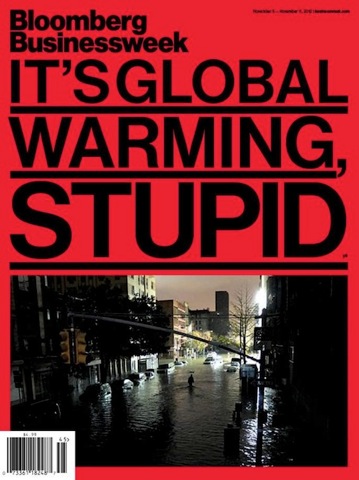
It’s Global Warming, Stupid: telling it like it is in post-Sandy USA

GlobalWarmingStupid

Sandy was an astonishing storm ((See Jeff Masters for some of the reasons why.)). Bloomberg Businessweek has taken the opportunity to state the obvious and create one of the great magazine covers to sell the story ((The ageing magazine editor in me doffs his hat.)). It’s worth reading the magazine’s coverage ((Or the parsing of it at Climate Progress.)) because the usual suspects are out there trying to deny the undeniable. Sandy was a storm made worse by the fact of climate change. We all have to live with that.

While the US mops up, and reinsurers check their cash reserves, we can be sure of one thing. The worst is yet to come — and that’s not being alarmist, just pointing out the consequences of unavoidable future warming. That’s truly alarming.