
100% useless: NZ government announces pathetic 5% emissions target

Climate change minister Tim Groser has finally got around to announcing that New Zealand’s emissions reduction target for 2020 will be a 5 percent reduction on 1990 levels — a significant step back from NZ’s previous conditional commitment to make cuts in the 10 to 20 percent range. Since the Key government refused to join the second commitment period of the Kyoto Protocol last year, this target is being adopted under the wider UN Framework Convention on Climate Change, and therefore has no penalties (or incentives) attached. Groser’s announcement claims:

The target is affordable and demonstrates that New Zealand is doing its fair share to address global climate change. In deciding this target, the Government has carefully balanced the cost to New Zealand households and businesses against taking ambitious action to tackle climate change.

This is an unconditional target to take responsibility for our emissions, and gives certainty to domestic stakeholders.

Groser also claims that the new target “compares favourably with our traditional partners’ actions” — but fails to note that it’s way out of line with UK and EU commitments to cuts of 30% and 20% over the same period.

The announcement will come as little surprise in the context of recent government actions — in particular Groser’s reckless mismanagement of the emissions trading scheme, which is now leading to huge and expensive dislocation in the forestry sector.

Further context for Groser’s approach to climate policy came in a reply to a series of questions from Green Party climate spokesman Kennedy Graham at Question Time on August 8th. Asked to reconcile sanctioning a new West Coast coal mine with climate action, Groser made himself completely clear:

We will not sacrifice everything to the altar of climate change.

Failing to take climate change seriously — by failing to cut emissions and doing nothing to encourage prudent adaptation — will sacrifice the entire country to the effects of climate change. By refusing to bite the bullet, Groser and his cabinet colleagues put easy money now ahead of our future wellbeing. Or, perhaps, any future worth having.

HARDtalk on thin ice in Alaska

Stephen Sackur took the BBC’s HARDtalk programme on the road in Alaska in a climate change episode screened a few days ago. It was the kind of aware and intelligent journalism one hopes to see on the topic, and deserves plaudits. Not that it exceeded what we have a right to expect from major mainstream television, but it was all the more welcome because the medium so rarely tackles the climate change question. It also represented a considerable advance on the Sackur interview I discussed on Hot Topic a couple of years ago when he attacked Rajendra Pachauri and the IPCC on spurious grounds.

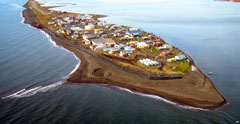
Sackur began in the coastal Inuit village of Kivalina, whose days are numbered as sea ice disappears and storm surges are unimpeded. (I reviewed Christine Shearer’s book on Kivalina in 2011.) The programme was stark in its Alaskan juxtapositions. On the one hand it detailed some of the impacts of climate change on Inuit communities. Kivalina is not alone. Retreating ice, slowly rising sea levels and increased coastal erosion have left three Inuit settlements facing imminent destruction, and at least eight more at serious risk. The town of Barrow depends on bowhead whale and seal hunting which is now affected very badly by the early breakup of sea ice.

Continue reading “HARDtalk on thin ice in Alaska”

New Zealand’s changing climate and oceans: new Gluckman report out today

The Prime Minister’s science advisor, Sir Peter Gluckman, today released a new report looking at the probable impacts of climate change in New Zealand over the next 40 years. The report, New Zealand’s Changing Climate and Oceans: The impact of human activity
and implications for the future
(pdf) is:

… intended to update the public on current scientific understandings of climate change and ocean acidification. In particular, it focuses on how these changes are likely to affect New Zealand’s climate and industries at a regional level over coming years.

The timing of the report — which appears at first glance to offer a reasonable overview of our current understanding of likely local climate changes — seems a trifle odd. In a matter of months the IPCC will release the first part of its Fifth Report, covering the underlying science, and while we’ll have to wait until March next year for the Working Group 2 report on regional impacts, Gluckman and his team would have had a firmer foundation for their report with only a modest delay.

I’ll be reading the report carefully over the next few days, and will have more to say in due course. I’m particularly interested in exploring how Gluckman approaches the risks associated with local climate changes, and his take on how the wider international context will impact New Zealand.

See also: Peter Griffin, NZ Herald.

Sea level rise and the Canterbury coastline

What are the prospects for the shorelines of Pegasus Bay as sea level rises, river flows change, and wave directions change? Someone who really knows her erosion from accretion is Sonny Whitelaw, the Hurunui Council’s biodiversity ambassador ((And SF author, writer, photojournalist, and Hot Topic reader.)). She’ll be talking to the Food For Thought Hurunui group on Monday night at the Memorial Library in Amberley, kicking off at 7-30pm. This is a presentation that Sonny has already given to the Waimakariri and Hurunui Councils, and comes highly recommended — especially if you live in or near a Canterbury coastal community.

NZ PM BP: John Key and the Fellowship of the Drill – beyond parody

The growing disconnect between the NZ government’s promotion of New Zealand as a 100% Pure tourist destination, and its desire to see more offshore oil and gas exploration and increased mining for coal and minerals is certainly attracting attention around the world. Graham Readfearn’s article New Zealand pushing plans to drill Middle-earth as Hobbit filming ends is top environment story on the Guardian web site today. Readfearn riffs on the completion of filming for the last part of the Hobbit trilogy, set against a frankly astonishing promotional video by PM John Key, in which he waxes lyrical about our beautiful country, and then describes how he’s committed to ruining it. Have a look: it is — as Greenpeace NZ noted — beyond parody.

[youtube http://www.youtube.com/watch?v=qQrBly7xMjs&w=480]

Readfearn’s not the only one to notice: climate campaigner Bill McKibben tweeted “NZ doing its best to become a junior league petrostate, talk about bad timing” to draw attention to a 350.org blog post about Key’s tasteless little video.

The foolishness of trying to build an extraction economy around fossil fuels at a time when the carbon bubble — the over-valuation of carbon reserves by oils and coal companies — is beginning to gain traction in financial markets is all too obvious. Investing in assets that will be stranded by the inevitability of action on climate change is a strategic nonsense.

Unfortunately that’s part for the course for a government locked into an outdated set of political ideas, wedded to a world-view that considers action on emissions optional. Unless they wake up and see the world changing around them, they will find themselves as stranded as the tax payer funds they plan waste by subsidising fossil fuel exploration and extraction.