Keeping it pure: Prime doco examines NZ environment and climate challenges

[vimeo 84160384 w=480]

When Tourism NZ began to brand the country as 100% Pure back in 1999, it almost certainly didn’t expect that 14 years later it would come back and bite the business in the bum. On Sunday night at 8-30 Prime TV starts showing a new documentary series from Greenstone TV that explores just how the NZ environment has suffered in the last decade, and how climate change will make matters worse. The producers describe it as:

…a series about the New Zealand environment and the way we treat it. It looks at some of the major problems facing the environment and the things that people are doing to protect it. With an eye on the economic implications of “greening” the economy, the series canvasses the opinion of leading scientists, environmentalists, farmers and business leaders as it examines the importance to New Zealand of Keeping It Pure.

It looks like compelling viewing. I’m told that the second episode will be devoted to climate issues.

Sea level rise, earthquakes, and flying PIGs

ChristchurchT T2013

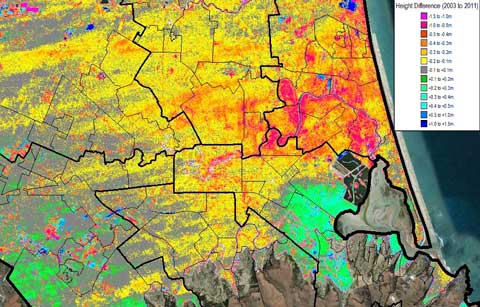
The first major study to look at the impact of sea level rise on Christchurch and Banks Peninsula following the 2010/11 earthquake sequence projects a watery future for many parts of the city and its surrounding shorelines. The image above ((Fig 3-4, p15 in the report.)) shows changes in ground elevation between 2003 and 2011 in the Christchurch region. Areas in green/blue have moved upwards by half a metre – particularly noticeable to the west of the estuary – and areas in red and yellow down, in many places along the Avon and subsidiary streams by a metre or more.

The report, Effects of Sea Level Rise on Christchurch City (pdf), by consultants Tonkin & Taylor was released last week and suggests that as a minimum planners should take into account a 1m rise in sea level over the next 100 years. Combined with the elevations changes caused by the earthquakes, this would mean significant shoreline retreats, increased flooding in many areas and the loss of hundreds of hectares of land to the sea. It’s well worth digging into the report to get the full picture, and it will make uncomfortable reading for many in the city.

Tonkin & Taylor prepared their study before the IPCC’s AR5 Working Group One report was released, and so based their SLR numbers on a literature search and the Royal Society of NZ’s 2010 paper. They suggest a “plausible upper range” of 2m over the next 100 years, with the behaviour of the West Antarctic and Greenland ice sheets in a warming world “probably the largest uncertainty in sea level rise projections”.

And now the bad news…

Continue reading “Sea level rise, earthquakes, and flying PIGs”

TDB today: 2014 – Won’t get fooled again

In my first post of the year at The Daily Blog, I abuse the lyrics to a great old rock song, and express general disbelief that new post-election boss will be any different to the old one.

We are living beyond our environmental and resource means. All our current prosperity and the ecosystem services that make it possible are being stolen from future generations. Delaying action is just making the final bill bigger, and the ultimate damage worse.
We face an existential crisis. If we screw this up, we screw up our entire civilisation, yet we have politicians of all stripes and ideologies who simply don’t take the climate problem seriously.

[The Who, of course]

Why NZ’s Emissions Trading Scheme is failing and how we could fix it

This guest post by Professor Euan Mason of the University of Canterbury’s School of Forestry first appeared at his Photosynthesis blog. His analysis of the NZ and global position, and assessment of the potential forestry response is so interesting that I asked his permission to repost it here.

New Zealand’s initial attempt to mitigate the problem of climate change is moribund, so why is this? The Kyoto Protocol, which we ratified in 1997, bound us to keep our net emissions at 1990 gross emission levels between 2008 and 2012, but also tied us to particular patterns of thinking about greenhouse gases. Not all of these patterns are rational, nor are they all helpful. Nonetheless, with a rather unique emissions profile for a “first world” nation, we could offer the world valuable solutions for developing nations if only we would accept the opportunity. Forestry could easily make us fully greenhouse gas neutral while solving erosion problems and improving profitability of our hill country farms, but for this we need a rational approach to emissions trading and commitment from our populace.

In this article I shall outline some of the key modes of thinking introduced by the Kyoto Protocol; highlight where we are going wrong with emissions trading; and show how forestry could be at the heart of solutions to this global problem.

Continue reading “Why NZ’s Emissions Trading Scheme is failing and how we could fix it”

NZ government climate policy: look, a squirrel!

Two major new government reports on New Zealand’s emissions projections and the expected impacts of four degrees of warming on NZ agriculture were released without fanfare last Friday — the timing clearly designed to minimise media fallout from reports that highlight the paucity and ineffectiveness of current climate policy settings.

Climate change minister Tim Groser dutifully issued a press release welcoming the release of New Zealand’s Sixth National Communication under the United Nations Framework Convention on Climate Change and Kyoto Protocol, the first such report since 2009. Groser praised government policies, but failed to draw attention to the fact that his own report shows NZ emissions failing to meet the government’s targeted cuts, or that current policy settings will do little to reduce them — let alone achieve reductions by comparison with 1990 levels. This graph ((From p126 of the report)) of actual and projected net emissions out to 2030 tells the story of the Key government’s abject policy failure:

Continue reading “NZ government climate policy: look, a squirrel!”