How to talk to a denier

[youtube]Qp-nJKBwQR4[/youtube]

This interesting new video by George Marshall from Talking Climate discusses how to talk to someone who doesn’t accept the reality of climate change or the need to act, and how best to start persuading them that they might be in error. From the Talking Climate blog post:

George emphasises that argument, conflict, and dis­respectful language will make it more difficult to achieve the goals you are aiming for – that is, to encourage some­body who is sceptical about climate change to engage with the problem and possible solutions to it. Finding ‘common ground’ and being able to under­stand why people are sceptical about cli­mate change in the first place is critical. It isn’t all that much to do with a lack of under­standing of ‘the science’, but has a lot to do with the ‘personal journey’ that people go through when forming their beliefs about cli­mate change and whether to engage in sustain­able behaviour.

George last featured at Hot Topic a year ago, when I discussed his talk on the ingenious ways we avoid believing in climate change. In some respects this new talk builds on that, taking into account the social psychology of belief in climate change. For a more detailed discussion of what’s going on, Marshall’s colleague at Talking Climate, Adam Corner, popped up at the Guardian last week to discuss an experiment on how attitudes condition belief:

What this experiment illustrates, though, is that “belief” in climate change is very much what matters. Without belief in climate change, scientific evidence simply bounces off. And it is social views and cultural beliefs that predict climate change denial, not people’s level of knowledge about climate science.

There’s lots of interesting stuff in Marshall’s video, in Corner’s article and at the Talking Climate web site. I would like to think that I follow Marshall’s suggested approach in one-on-one conversations — I usually find it pretty easy to find common ground with my more sceptical neighbours, for instance — but even the best of intentions can break down in the face of an intractable relative, whether Uncle Bob or the sister-in-law from over the sea…

See also: The Debunking Handbook, by John Cook and Stephan Lewandowsky.
[Nick Lowe]

Cartophilia (something to pore over)

Windmap

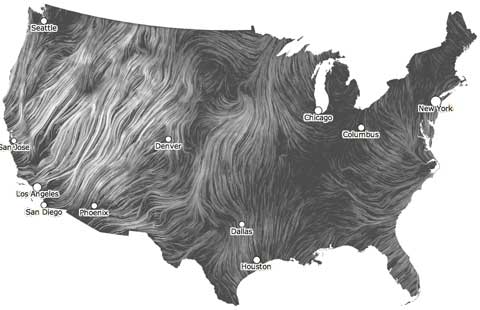
Click on the image. Wait. Watch and be mesmerised by this visualisation by Hint.fm of current wind flow over the USA. It’s a tremendous way to get a feel for the shape of the weather. Something similarly hypnotic and revealing of weather patterns is the animation of global total precipitable water (that is, atmospheric moisture content) from the Cooperative Institute for Meteorological Satellite Studies at the University of Wisonsin-Madison. I haven’t embedded it because it’s a big animation, but it’s well worth a few bits of bandwidth.

Carbonmap

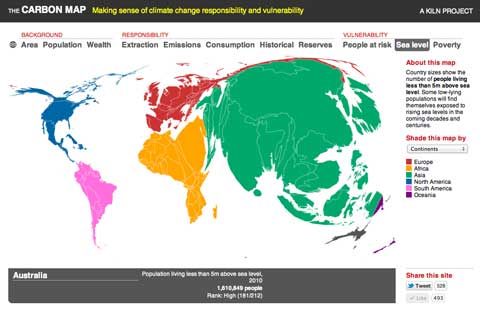
The Carbon Map is another tour de force of data visualisation — changing the shapes and sizes of countries on a global map to show how they measure on a number of indices: area, population, wealth, historic emissions, current emissions, carbon reserves and so on. The image I’ve grabbed shows the exposure of countries to sea level rise. More about the map and its creation at the Guardian.

Updated to add this amazing NASA animation of global ocean currents over 2005/7. Just look at those whorls spinning off the bottom of Africa…

[youtube]CCmTY0PKGDs[/youtube]

Prat watch #5: Ignorance is bliss

What happens when you deny things? Well, if you deny the reality of global warming, and if you are to be in any way self-consistent, then you have to deny every bit of evidence that it might be happening. Here’s a classic example, drawn from New Zealand’s very own little corner of the climate crank echo chamber, Richard Treadgold’s “Climate Conversation Group” blog. Treadgold concludes a recent post thus:

Once more: let’s stop accepting this palpable nonsense that climate change is responsible for anything.

Climate change means global warming. Global warming has not happened for about 15 years, unless you take a micrometer to the thermometer. And if you have to do that just to detect warming, then it’s hardly dangerous, is it?

Oh – if it didn’t happen, then it didn’t cause anything! No droughts, no wildfires, no floods, no storms. No ice melt.

Look at the bit I’ve emphasised. No warming for 15 years? Tell that to the planet, Richard. Here’s what the World Meteorological Organisation says about the first decade of the 21st century:

…climate change accelerated in 2001-2010, which was the warmest decade ever recorded in all continents of the globe.

No warming for 15 years? After we’ve had the warmest decade ever recorded in all continents of the globe?

Continue reading “Prat watch #5: Ignorance is bliss”

Hypocrisy rules: Monckton ducks debate

[Youtube]DCoi94n0aJg[/youtube]

Peter Hadfield, aka video blogger potholer54, notes with some interest that while the noble Lord, Christopher, the discount Viscount Monckton of Brenchley has plenty of time on his current US trip to indulge in fantasies about the President’s birth, long Skype chats with classrooms of students, and addresses to California politicians, he has been unable to find the time to respond to the very public debate with Hadfield that he had committed to on Anthony Watts µWatts blog. The uncharitable might suggest this was because he was getting a drubbing. There’s a big difference between winning a debate through oratory, one of the potty peer’s genuine accomplishments, and living by the undeniable facts. Full text of Hadfield’s open letter here, together with a list of his debunking videos. Good value.

See also: Climate Crocks, Barry Bickmore, and Eli’s burrow.

[Lemon Jelly]

Underneath the shade: Homebrew Crew on climate change

[youtube]o3JLOkPOmpA[/youtube]

A little something for the weekend: NZ rappers Homebrew Crew with a musical commentary on attitudes to climate change. Slightly not safe for work, but I like it. Y’know, getting down with my homeboys, as I believe the young folks say. Fab gear!