Freezing

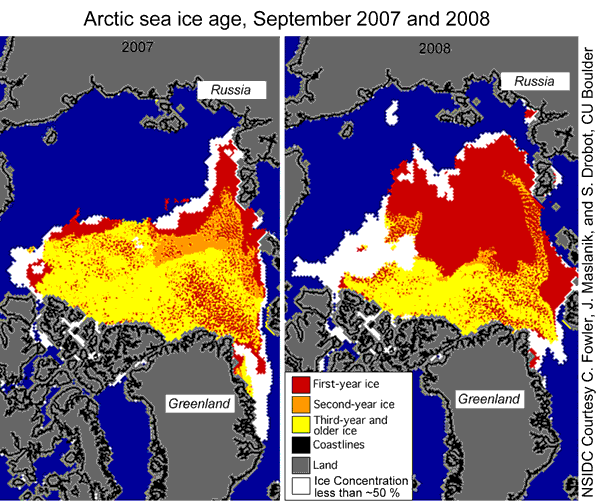
NSIDCmultiyear081004.gif With this summer’s Arctic sea ice minimum done and dusted, the first analyses of the season are beginning to appear. The NSIDC’s latest press release suggests that ice volume decline continued:

NSIDC Research Scientist Walt Meier said, “Warm ocean waters helped contribute to ice losses this year, pushing the already thin ice pack over the edge. In fact, preliminary data indicates that 2008 probably represents the lowest volume of Arctic sea ice on record, partly because less multiyear ice is surviving now, and the remaining ice is so thin.”

Click on the thumbnail above to see the big picture on multi-year ice reduction. The large area of red first year ice will obviously become second year ice next year, but the continuing reduction in thicker, older ice sets the stage for further big losses the next time the Arctic has a warm summer. The European Space Agency confirms this, quoting US National Ice Centre Chief Scientist Dr Pablo Clemente-Colón:

Although last year’s summer sea ice minimum extent record was not broken, a record amount of the thickest multiyear sea ice was actually lost this season impacting the thickness of the sea ice presently found around the North Pole region and setting the stage for more minimum or near-minimum records in upcoming years.

The ESA also provide some nice images…
Continue reading “Freezing”

Catch a (micro)wave

carbonscape.jpgThere are some amazing people in NZ. Just when I’m tearing (what’s left of) my hair out at the idiocy of some politicians, along comes a news story to gladden the heart of anyone living in the real world. Yesterday, Blenheim-based start-up Carbonscape reported that it has just begun batch production of charcoal in a microwave oven the size of a double garage. Wood waste goes in at one end, the oven heats it up and it turns into charcoal – giving off syngas, a mixture of hydrogen and carbon monoxide. The charcoal can be added to soil (as biochar, aka terra preta), fixing the carbon away from the atmosphere and improving soil fertility, while the syngas can be burned to create energy to drive the process – known as pyrolysis.

Carbonscape call their oven the Black Phantom, Stuff reports:

Continue reading “Catch a (micro)wave”

The Dreaming

garnaut.jpg The final version of the Garnaut Climate Change Review on Australia’s response to climate change was released today. I haven’t had time to read it (it’s big, and detailed), but I will be taking it into account when I finish my long-promised post on targets. Money quote (from the synopsis):

There are times in the history of humanity when fateful decisions are made. The decision this year and next on whether to enter a comprehensive global agreement for strong action is one of them. Australia’s actions will make a difference to the outcome, in several ways.

The chances of success at Copenhagen would be greater if heads of government favouring a strong outcome set up an experts group to come up with a practical approach to global mitigation that adds up to various environmental objectives. On a balance of probabilities, the failure of our generation on climate change mitigation would lead to consequences that would haunt humanity until the end of time.

Quite. Barry Brook’s blog (Brave New Climate) will be a good place to go for informed analysis and comment over the next few weeks. And there will be considerable interest in Wellington and from our politicians.

[Title reference: Kate Bush at her daftest (with Rolf Harris on didgeridoo)]

Raw Hide

rodenymorph.gifAs the general election nears and policies are beginning to emerge, ACT is sticking to its “dump the ETS” line and its leader, Rodney Hide, has confirmed himself as a climate crank. In a speech to a public meeting at the Franklin Centre, Pukekohe on Monday, Hide ran through his now familiar “I know better than the world’s climate scientists” schtick:

There is no evidence that CO2 drives climate or that industrialisation is warming the world. In fact, the evidence is the reverse.

No it isn’t.

Hide is telling lies to try to get elected, and our media should call him on it. But if they won’t, I will. I’m willing to debate climate science and policy with Hide, in public, in the run up to the election at a venue in Canterbury of his choosing, or here on Hot Topic. Will he accept my challenge, or rely on a complacent media to get away with spouting this nonsense? I’m not holding my breath…

The speech also suggests a schism on climate policy in the ranks of the National party:

National MPs have sidled up to us to agree with us – and to complain that Nick Smith as hijacked National’s policy. They agreed with John Key when he said climate change was a hoax. Now he too is backing the ETS.

Hide playing politics, or is the climate sceptic rump in the National caucus stronger than Smith and Key would like us to believe?

I think we should be told…

[Title reference]

Every loser wins

The Arctic sea ice has started its autumn freeze up. Both the NSIDC and Cryosphere Today metrics show significant increases over their minima for the year, and so I’ve settled my debts to Malcolm and William “Stoat” Connolley. To settle Malcolm’s bet, I have donated $40 to Women’s Refuge (they’re sending a receipt, which I will happily post when it arrives if Malcolm so wishes), but with William I have elected to go “double or quits” on next year’s minimum. He does get a signed copy of Hot Topic though, and it should be with him by the weekend or early next week. To ensure carbon neutrality for the airmail shipping, I will plant an extra tree in the truffière… 😉

So what are the prospects for next year? Will the ice consolidate a little more, hover around the 2007 and 2008 level, or beat 2007? My gut-feel (and, in the absence of further info on how the ice finished this summer, that’s all it is) is that the odds remain roughly 50/50 on a new record. A warmer winter than last, or a sunnier summer is all that it might take to cause greater loss. So I’m happy with my double or quits – at least for the time being.

NSIDC September 24th update here (note continuing reduction in multi-year ice). NASA reports that ice loss in August was fastest ever seen – and produced an excellent animation of ice coverage over the year (in right column, third image down). Meanwhile, ice loss from Greenland is also increasing (there should be much more concrete info later this year when the 2008 summer season reports start appearing), and a team at Ohio State University are beginning the Arctic System Reanalysis project, which will “merge a decade of detailed atmospheric, sea, ice and land surface measurements into a single computer model-based synthesis. The coupling of these immense data sets will produce complex and instructive descriptions of the changes occurring across the normally frigid, remote region.” The project will generate about 350 TB of data. Won’t run on my Macbook Pro, then… Plus there’s some learning about ice going on at the blog of a real ice man – Bob Grumbine’s More Grumbine Science here.