Roll up, sign up, save money

carbonnews.gifThanks to a brief encounter at last weekend’s Amberley A&P Show (I was in truffle mode, manning a table in the PGG Wrightson tent), Hot Topic is pleased to be able to offer registered readers an exclusive $200 saving on a one year subscription to Carbon News – the premium New Zealand-based carbon and climate news and analysis site. Carbon News is especially valuable for anyone working with the ETS and carbon trading, with comprehensive national and international news and trading information. A one year sub is normally $500 + GST, but thanks to the Carbon News team I am now able offer Hot Topic readers a special price of $300 + GST for the first year. I think that’s terrific value for an excellent service.

This special offer goes hand-in-hand with the introduction of registration at Hot Topic. Until now, commenters have been able to leave comments without logging on to the site, but that seems to encourage spammers. Not many spam comments make it onto the site because I use the excellent spam filtering service Akismet, but I have to wade through piles of rubbish every morning in case a real comment has been misidentified. From now on, to leave a comment you’ll have to log in to the blog. Registration is simple and painless, and your confirmation email will include the special code you’ll need to take advantage of the Carbon News offer. Let me know if you have any problems…
In the heat of the (Arctic) night

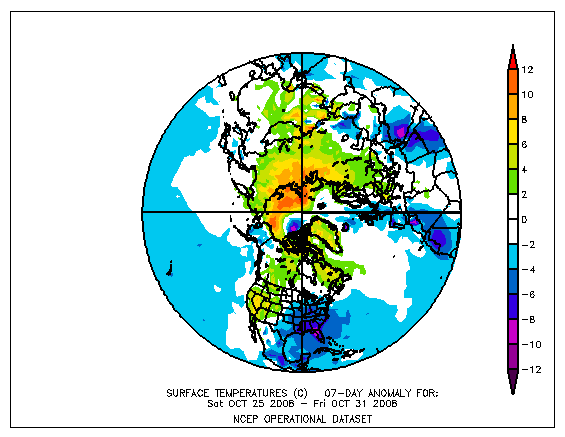
LWOct2008.gif Time for an Arctic update and a bit of “original” research. There’s been quite a bit of polar news around, and a rapid freeze-up is underway in the Arctic – so rapid that some are declaring that the sea ice is “back to normal” for the time of year, based on this graph from the Arctic Regional Ocean Observing System in Norway, which shows sea ice area climbing up towards to the average for 1979-2007, within one standard deviation (the grey area). On the other hand, if you look at the equivalent graph at Cryosphere Today, you’ll see that ice area is 1.25m km2 below the average – which in CT’s case is 1979-2000. So the ice is approaching normal, only if you define “normal” as including the significant ice reductions over the last seven years. How encouraging. But this autumn’s freeze-up has been pretty rapid. Does that mean that it’s been unusually cold up there? I thought I’d take a look…

Continue reading “In the heat of the (Arctic) night”

Canary in a coalmine

[youtube]G9HsU9X1CYM[/youtube]

From Greenpeace, timed to coincide with the launch of the new James Bond movie, we have Coalfinger (wot, no Shirley Bassey?). Full of smutty innuendo (geddit?). That’s Brian Blessed voicing the baddie – a wonderful over the top performance.

Meanwhile, big coal’s biggest critic James Hansen expresses disappointment with the targets set by Australia’s Garnaut Report:

That plan appears to have been written by the coal industry, and, if adopted globally, practically guarantees destruction of most life on the planet. I would be more critical[1. If that’s possible!], except that much of the problem is probably due to our failure to make the climate story clear enough.

Ouch.

[Title reference]

Something in the air (methane mystery)

arcticmethane.jpgAtmospheric methane levels “shot up” in 2007, according to a paper in this week’s Geophysical Research Letters (MIT news release — Rigby, M., R. Prinn, et al (2008), Renewed growth of atmospheric methane, Geophys. Res. Lett., doi:10.1029/2008GL036037, in press. PDF here for AGU members.). This confirms NOAA’s announcement in April that methane levels were on the increase after a decade of stability, but adds a new twist to the data.

One surprising feature of this recent growth is that it occurred almost simultaneously at all measurement locations across the globe. However, the majority of methane emissions are in the Northern Hemisphere, and it takes more than one year for gases to be mixed from the Northern Hemisphere to the Southern Hemisphere. Hence, theoretical analysis of the measurements shows that if an increase in emissions is solely responsible, these emissions must have risen by a similar amount in both hemispheres at the same time.

A rise in Northern Hemispheric emissions may be due to the very warm conditions that were observed over Siberia throughout 2007, potentially leading to increased bacterial emissions from wetland areas. However, a potential cause for an increase in Southern Hemispheric emissions is less clear.

A possible explanation might be a global reduction in the amount of hydroxyl free radical (OH) in the atmosphere. OH “mops up” methane (and other stuff), and is sometimes called the atmosphere’s cleaner or “detergent”. Unfortunately, measuring atmospheric OH is difficult.

“The key thing is to better determine the relative roles of increased methane emission versus any decrease in the rate of removal,” Prinn said. “Apparently we have a mix of the two, but we want to know how much of each” is responsible for the overall increase.It is too early to tell whether this increase represents a return to sustained methane growth, or the beginning of a relatively short-lived anomaly, according to Rigby and Prinn.

Any increase in atmospheric methane is not good news. A possible reduction in OH is also disturbing, because it might indicate that pollution (from all sources, methane, industry, coal burning etc) is beginning to overwhelm the atmosphere’s ability to cleanse itself. Both together would be very bad news indeed.

[Update: Comments from a CSIRO scientist and co-author here.]

[Title reference]

Touch of Gray

gray.jpgOur tame cranks, the NZ Climate “Science” Coalition are trumpeting Royal Society resignee Vincent Gray’s recent update of his seminal paper The Global Warming Scam [PDF], first published on the NZ CSC’s web site in April this year. History does not record if it was first rejected by Nature. In terms of the “science” it contains it’s nothing new. Gray makes muddled (and lengthy) assertions about the impossibility of determining the average temperature of the planet, gets worked up about measurements of CO2 (setting great store by the work of Beck), and is unpersuaded by climate modelling and the IPCC’s use of scenarios. On the positive side, it’s 37 pages long.

In one respect, however, Gray’s magnum opus is most revealing. He devotes a short introduction[2. p3, section 1.1] to the birth of the “scam”:

The global warming scam is the result of the widespread belief in a new religion, based on the deification of a nebulous entity, “The Environment”. “The Environment” is an extension of the concept of “Nature” which was held sacred by the Romantics, but it is a much more demanding deity, requiring constant and increasing sacrifices from humans.

That’s pretty standard stuff on the crank fringe, but Gray opens whole new avenues of thought with his next paragraph…

Continue reading “Touch of Gray”