Don’t let a thief steal into your heart

Quite a fuss about stolen emails over the weekend. Let’s review the story so far. Person or persons unknown hack into servers at the Climatic Research Unit of the University of East Anglia and steal lots of emails and other documents [BBC 1, 2, Times, Bob Ward at The Guardian]. This is a criminal offence in the UK, the USA, New Zealand and many other jurisdictions. The criminals then release edited highlights of these documents and emails by putting them up on a Russian web server, and let the news out via what Nature calls “a relatively obscure climate-sceptic blog” (The Air Vent which may have been Andrew Bolt’s blog in Australia). Within a matter of hours, the usual suspects are out in force, screaming data manipulation, conspiracy to exclude climate sceptics from publishing, and fraudulent behaviour. Criminals are portrayed as whistleblowers, quotes are pulled out of private emails and taken out of context, and the end of climate science is proclaimed.

I’ve been reluctant to weigh in on this issue, because commenting on stolen and possibly edited documents strikes me as unethical. In a courtroom, improperly obtained evidence is not allowed to influence proceedings, and I would prefer to apply the same standard here. That hasn’t stopped the likes of Wishart (peer review is broken, climate science is dead), propagandist in chief Marc Morano (continuously updated “Climategate” coverage at his Climate Depot), or even now well out of the closet denialist, the NZ blogger sometimes known as Poneke (warming stopped in 1998 (yet again)). However…

Continue reading “Don’t let a thief steal into your heart”

Ain’t no mountain high enough

Tutoko.jpg

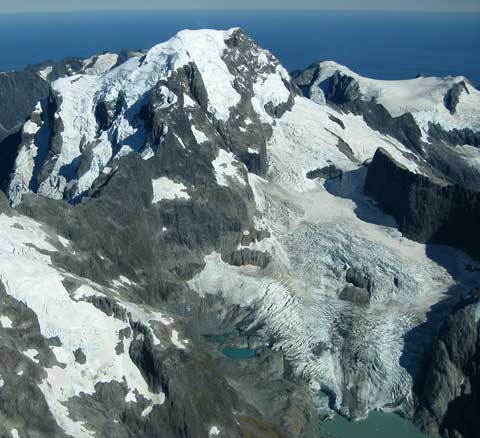
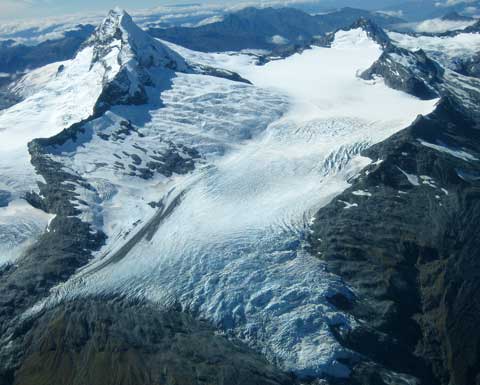
New Zealand’s glaciers are continuing to lose mass according to this year’s aerial survey of the Southern Alps by NIWA scientists. The figures released today show that over 2008-9 the glaciers lost much more mass through melt and calving than they gained from snowfall. From the press release:

NIWA Snow and Ice Scientist Dr Jordy Hendrikx says weather patterns over the course of the year from April 2008 to March 2009 meant that overall the glaciers had lost much more ice than they had gained. This was mainly due to the combination of above normal temperatures and near normal or below normal rainfall for the Southern Alps during winter, and La Niña-like patterns producing more northerly flows creating normal-to-above normal temperatures, above normal sunshine, and well below normal precipitation for the Southern Alps particularly during late summer.

NIWA have also released some of the wonderful pictures taken by Dr Hendrikx during the flights. The photo above shows Mt Tutoko (the highest mountain in Fiordland), with the Donne glacier tumbling down its flanks towards the Hollyford valley and calving into a lake. Below is Mt Aspiring with the Bonar glacier on the left. Must be one of life’s finer jobs — being paid to fly around the magnificent scenery of the nation’s spine. See also: TV One’s report on this year’s flights, and HT’s coverage of last year’s figures.

BonarAspiring.jpg

Oram on ETS debacle: Business Council for Sustainable Development ordered to shut up by big emitters; Nick Smith guilty of “breathtaking hypocrisy”

Fonterra and other big emitters have used their clout to silence the Business Council for Sustainable Development from commenting on National’s proposed changes to the emissions trading scheme, Rod Oram reveals in his Sunday Star Times column today.

…on November 5 Barry Harris, Fonterra’s head of milk supply and sustainability, delivered a withering speech to the council’s meeting. There were 31 other representatives of corporate members in attendance. Harris sharply criticised the council for what he considered its failure to represent the interests of members like Fonterra that “had a lot of skin in the game”.

The council’s insight into how opposed much of the public and some of business is to the ETS changes has clearly rattled some of its less sustainable members. According to some attendees, council chairman Bob Field, chairman of Toyota New Zealand, ordered council staff to stop making public statements on the ETS.

Perhaps Fonterra and Toyota believe that business can only be sustainable if it is protected from the costs of its polluting ways. The huge subsidies, of course, are their’s by right. Meanwhile, it remains to be seen if some of the less hypocritical members of the BCSD will make their voices heard.

In a coruscating column, Oram calls Nick Smith’s headlong rush in to bad legislation “breathtaking hypocrisy”, and quotes extensively from Smith’s comments a year ago when Labour’s ETS was being debated in Parliament.

Oram’s take on the current situation is right on the money:

National is making a dreadful mistake if it believes it can railroad through incompetent, damaging legislation hugely favouring heavy emitters.

At the next election, it will be easy for Labour and Greens to win support from the substantial number of voters who want an ETS that might actually cut emissions. Such an ETS would save the next government some $2 billion a year in subsidies to the heavy emitters, money voters would like spent instead on them and investment in new, clean technologies.

The whole column is worth a read. It’s Oram at his well-informed, combative best.

Stop me and buy one

An item of minor import to the world, but some significance to the writer: the PDF edition of Hot Topic is now available for a mere NZ$10 (all the words and pictures, none of the paper, half the original price) from the “Buy” tab in the menu at the top every page. Traditional paper copies are also available, signed, direct from the author for NZ$25 (NZ residents) or NZ$40 (including airmail shipping) for overseas readers. Copies seldom take longer than a week to reach the furthest corners of the world…

[Grand Union Morris]

Imagining 2020 — the world will be what we make it

Hot Topic is pleased to join with Scoop and Celsias in launching a new series of articles with the theme of Imagining 2020. We want New Zealanders, as Scoop co-founder Alastair Thompson explains in this introductory post, to imagine what a low carbon future might be like:

The idea is to provide a platform for a collective long-term forecasting effort which considers the impacts of economic transformation on each sector in the NZ economy. If we start by dreaming and imagining our futures, then perhaps we can effectively gain some control over them.

Imagining 2020 will be what Al describes as “a creative commons online discussion festival in which individuals and businesses are invited write about how a low-carbon future affects their individual circumstances”. As the project progresses, we hope to get contributions from a wide spectrum of opinion in NZ, with (I hope) a focus on the positive aspects of the transformation we will inevitably have to make. This is your invitation to take part — email (address below) for details. Over to Al:

In recent months the climate change debate has all too often been framed as a matter of what level of sacrifice we as consumers and businesses are prepared to bare to save the planet. Domestically and internationally various economists have produced econometric models which show the likely negative impacts on GDP growth – extrapolated to household income – of climate change mitigation measures.

On the other side the public is berated by doomsayers who tell us the question is not what the cost of change is, but what the cost of not changing will be in the future. However as many commentators have since pointed out, the reality of climate induced economic transformation is infinitely more complicated than either these perspectives indicates.

A sacrifice approach to the issue of climate change induced economic transformation is a wrong headed – as our international trading competitors such as Japan and China have already clearly recognised. There is huge opportunity for economic growth in transformation.

Meanwhile the “fear the future” approach is a giant turn off. It is defeatist for one thing. If we are doomed anyway – say the cynics – then why not enjoy the view while the ship goes down. And while the argument may be true – until we actually start to smell the fear personally, it is hard to comprehend what threats global warming really poses to us.

Therefore a group of New Zealand websites has decided to get together and encourage discussion of the positive side to climate change mitigation. After all — how many of us really believe that the way the world is currently run is optimal – both for our personal lives as well as for the environment.

So let us think about what opportunities and benefits are present in the coming transformation to a low-carbon future for NZ and global economy. How can our lives be improved by a reorganisation of the economy? How can we use this opportunity for change to fix many of the obvious wrongs in the current consumption driven trading and economic system?

Continue reading “Imagining 2020 — the world will be what we make it”