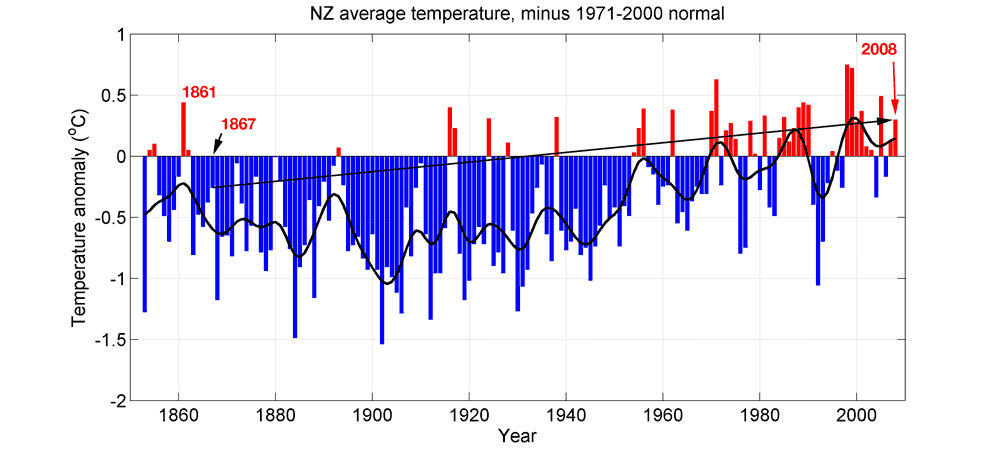

La-la Land again: Jim Hopkins gets it wrong

It must be sceptic idiot week at the Herald. Not content with allowing Garth George to make stuff up, today they unleash that mighty wit (or should that be twit?) Jim Hopkins, who has been reading the Daily Mail‘s daft coverage of a BBC interview with Phil Jones, the man at the centre of the beat-up over stolen emails:

Professor Jones discussed many things with the BBC, including the trouble he has “keeping track” of information, but the professorial concession the Daily Mail pounced upon – and our media ignored – was this: He said that for the past 15 years there has been “no statistically significant” warming. “No statistically significant warming”. None. It’s not happening. Since 1995, we ain’t got hotter. And that’s not the sceptics speaking. That’s from a man who garnered $22 million to prove we were getting warmer. Much warmer, worryingly warmer, “Lucy Lawless was right” warmer. But now he says we’re not. And haven’t been for 15 years.

I suppose we can’t expect a newspaper columnist and professional funny man to understand statistical concepts. Jones did not say that there had been no warming for 15 years. He said that the warming trend over the last 15 years just fails to meet one test for statistical significance. Here’s Jones in full:

Do you agree that from 1995 to the present there has been no statistically-significant global warming?

Yes, but only just. I also calculated the trend for the period 1995 to 2009. This trend (0.12C per decade) is positive, but not significant at the 95% significance level. The positive trend is quite close to the significance level. Achieving statistical significance in scientific terms is much more likely for longer periods, and much less likely for shorter periods. [My emphasis].

The Daily Mail misunderstood and/or misrepresented what Jones told the BBC — and that’s been extensively covered on the web. Hopkins is happy to repeat that misinformation without checking his facts. Perhaps he doesn’t understand how to use Google? More coverage of Mailgate at Deltoid, In It For The Gold, Real Climate, and for a full explanation of what statistical significance means in this context, Tamino has an excellent article here. Meanwhile, Jim should stick to his knitting instead of repeating tabloid lies from Britain.

A visitor from La-la Land: Garth George gets it wrong (again)

I suppose it was inevitable that the feeding frenzy about various “gates” in the British press would attract the attention of the wise old man of Rotorua, Garth George. In today’s Herald he emerges from his sulphurous lair to add his muted sqeak to the hubbub. It’s not much different to his last few columns on the subject, though the borrowing of material is perhaps a little less obvious. He cites his source (a horrendously bad piece by Jonathan Leake in the Sunday Times) and does a proper re-write rather than just quote the whole thing verbatim. But he adds some flourishes of his own:

Their concern – as it is with the data provided by our own National Institute of Water and Atmospheric Research (Niwa) – is about the thousands of weather stations around the world which have been used to collect temperature data over the past 150 years.

These stations, they believe, have been seriously compromised by factors such as urbanisation, changes in land use and, in many cases, being moved from site to site. This, of course, is the charge that has long been levelled at Niwa by a significant section of New Zealand’s scientific community.

Rubbish, Garth. What “significant section” would that be? The NZ CSC and Richard Treadgold’s anonymous team of “scientists”? Perhaps you counted that noted environmental scientist Rodney Hide. De Freitas and De Lange? Fringe figures of no great academic standing. You just made it up, didn’t you? Interviewed your typewriter and polled your patio pot plants, to lend false weight to a ridiculous smear campaign.

The rest of Garth’s piece repeats the main points of Leake’s article (handily debunked at Deltoid: keep an eye out for Tim’s Leakegate posts), but as he opened with some failed predictions from 1957, he closes with a prediction of his own:

So, just as Dr Kaplan’s predictions came to nought, so I believe will the scaremongering global warming predictions of today’s climate doomsayers. Perhaps 53 years from now someone will find an ancient copy of the Herald and laugh at the climate change paranoia which afflicted the world in 2010.

Of two things we can be sure: he will not be around to hear the laughter, and it will be Garth George they will be laughing at — if they’re not shedding tears of rage.

Tipping and other points

During the Copenhagen kerfuffle a lot of interesting stuff hit the web: here’s something that deserves a bit more air – a Proceedings of the National Academy of Science (PNAS) special issue on tipping elements in the earth system, edited by John Schellnhuber, the director of the Potsdam Institute for Climate Impact Research in Germany.

Tipping elements (or points, as Malcolm Gladwell would have them) are changes that once started take on a life of their own, and can’t easily be returned to their original state. In the climate system that might be the rapid loss of an ice sheet in a few decades or hundreds of years, while regrowing it might take many thousands. The PNAS special issue deals with nine: dust production in the Bodélé Depression in Chad, ENSO, Arctic sea ice and ice sheets, the Atlantic Meridional Overturning Circulation, deep ocean hydrates (not shallow sea bed, Siberian methane) — David Archer dubs them a “slow tipping point”, the Amazon rainforest (no “Amazongate” here, just a confirmation that concern is justified), monsoons, oceans, and policy responses to the climate challenge. And the best thing is that all the articles are available online, free (click on the link above). Schellnhuber contributes an introduction, and the Potsdam press release also provides a good overview. For some introductory thoughts, check out Tim Lenton’s discussion here.

Another recent example of a real tipping point is the Pine Island Glacier in West Antarctica. Recent modelling suggests that the glacier’s grounding line retreated beyond a ridge in 1996, and is now free to retreat by several hundred kilometres inland. This could happen in a hundred years and result in the loss of half of the ice in the glacier — enough to raise sea level by 24cm. New Scientist reports:

Observations already show that the model severely underestimates the rate at which PIG’s grounding line is retreating, says Katz. “Ours is a simple model of an ice sheet that neglects some important physics,” says Katz. “The take-home message is that we should be concerned about tipping points in West Antarctica and we should do a lot more work to investigate,” he says.

Amen to that.

IPCC’s future: babies, bathwater, or a new bath?

An opinion piece in this week’s Nature features the views of five diverse climate scientists on how the IPCC might be reformed or restructured in the light of the recent fuss about “errors” in AR4. The headine asks if we should “cherish it, tweak it or scrap it?” It makes interesting reading (it’s behind a paywall, unfortunately), but here’s a summary.

Continue reading “IPCC’s future: babies, bathwater, or a new bath?”

Egg/face interface for Hide and the climate cranks

What was it Richard Treadgold and Rodney Hide were saying? Here’s Hide, speaking yesterday in Parliament:

So, before Christmas, I asked NIWA to disclose the adjustments and their reasons. They said they would. But they have just told the Climate Science Coalition they don’t have the record of the adjustments.

And here’s Treadgold and the NZ Climate Crank Coalition:

This follows an admission by NIWA that it no longer holds the records that would support its in-house manipulation of official temperature readings.

Just to to provide a little balance, here’s NIWA, yesterday:

NIWA has added two new documents to its National Climate Centre web pages to outline how and why it made adjustments to its 7-station temperature readings in order to provide accurate and meaningful data to use in a time series of temperature information.

One document [PDF] lists all the adjustments made to the station records used in NIWA’s long term New Zealand temperature series, while the second [PDF] looks at one station, Hokitika, and explains in detail the rationale for that station’s adjustments.

I look forward to the prompt release of apologies from Rodney Hide, Richard Treadgold, Terry Dunleavy and the NZ Climate “Science” Coalition to NIWA, Jim Salinger and all the scientists involved in preparing and maintaining NZ’s climate records, but I won’t be holding my breath.