
Double dipping: It’s grim up north #3

AMSRESIE100919.gif

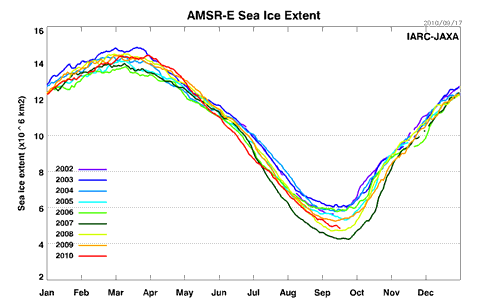
Earlier this week, the National Snow and Ice Data Center (NSIDC) announced that the Arctic sea ice had reached its summer minimum extent, based on a four day run of extent increases. And then, like the fat lady in an overwrought opera refusing to die, trilling her agony and ecstasy to an appreciative audience, ice extent started dropping again. It was, as I suggested it might be at Neven’s Arctic Sea Ice blog, a double dip minimum — and as of this morning the extent (IJIS-JAXA graph above, but the NSIDC’s shows the same thing) is still dropping down towards 2008 — which holds second place in the record behind 2007. I still think it’s unlikely that the 2010 melt will do enough to pass 2008, but there’s a lot of thin ice and warm water up there, as I noted last Monday, and it will be interesting to see how the PIOMAS numbers for ice volume turn out — a new record low is definitely on the cards.

Attention will now turn to the autumn freeze-up, and the potential for the heat released by ice formation to impact northern hemisphere weather patterns. I’ve been reading a few papers on that subject, and will post a discussion as autumn up North progresses.

On a different tack, the future of the Arctic is becoming a popular subject for books. Robin McKie reviewed a selection for the Observer earlier this year (and from that selection I plan to read Charles Emmerson’s Future History of the Arctic, mainly because it seems to have arrived in southern hemisphere bookshops recently), but the book getting the most attention at the moment is Laurence C Smith’s The World in 2050: Four Forces Shaping Civilization’s Northern Future, due out this week (Science Daily). Smith summarises his vision in an article for the Wall Street Journal:

I imagine the high Arctic, in particular, will be rather like Nevada—a landscape nearly empty but with fast-growing towns. Its prime socioeconomic role in the 21st century will not be homestead haven but economic engine, shoveling gas, oil, minerals and fish into the gaping global maw.

That assumes, of course, that the “gaping maw” still exists…
People get ready

Britain needs to step up its efforts to prepare for unavoidable climate change, according to How well prepared is the UK for climate change? the first report of the Adaptation Sub-Committee of the Committee on Climate Change— the body established by the UK’s 2008 Climate Change Act to advise government on all aspects of climate-related policy. Committee chairman Lord John Krebs summarises the thrust of the report like this:
In brief, our headline finding is that whilst the UK has started to build capacity for adaptation through advice and information to a range of public and private sector organisations, there is little evidence that this is translating into tangible action on the ground in a systematic way.

The report identifies five key areas in which early action is required.


From the executive summary:

  1. Taking a strategic approach to land use planning – for example to (i) ensure that new buildings and infrastructure are sited in areas that minimise exposure to flood risk, do not increase flood risk to others, and do not create a legacy of flood defence or water supply costs; (ii) manage competing pressures on land – urban, natural and agricultural – in response to a changing climate; and (iii) enhance green space where effective in the design of towns and cities to help manage surface water drainage and cope with rising temperatures and heatwaves.
  2. Providing national infrastructure (energy, water, transport, waste and communications) – for example to ensure it can cope with rising temperatures; it is resilient to potential increases in certain extreme weather events, such as storms, floods and droughts; and it takes account of changing patterns of consumer demand in areas such as energy and water use, travel and consumption.
  3. Designing and renovating buildings – for example to ensure they can cope with rising temperatures and floods and minimise water use through appropriate use of construction materials and through better design.
  4. Managing natural resources sustainably – for example by using water more efficiently; improving and extending ecological networks so that species can adapt and move as the climate changes; and making space for water along rivers and the coast.
  5. Effective emergency planning – for example by making better use of probabilistic weather forecasts to anticipate extreme weather events more effectively; creating plans that reduce impact on and ensure continuation of care for the most vulnerable groups in society during heatwaves and floods; and developing business continuity plans based on high-quality climate risk information so that businesses can cope better with disruptions to their supply chains during floods and damage to assets from severe weather.

The report’s emphasis on flooding as a major climate change impact is understandable, given the UK’s recent history. Coping with increased flooding is a key challenge for the country given the amount of development that has taken place on vulnerable floodplains. If you are at all interested in how we might plan to adapt to climate change — both the unavoidable change, the climate commitment — and the further changes we hope to avoid by mitigating carbon emissions, then this report is well worth reading. Many of the points it makes are relevant in the New Zealand context. One thing that’s worth picking out (from section 2.4, p25):

Adaptation is context specific. Unlike mitigation, where every unit of carbon has the same cost regardless of where it is emitted, the “optimal” adaptation response is context specific, depending on who is adapting, where in the country, and how they weigh up other factors in their decisions. This makes it difficult to determine in advance what successful adaptation will look like.

And there’s the rub. There’s plenty of politics in deciding how to cut carbon emissions — there’s a whole lot more in coping with unavoidable climate change. At least Britain has a body charged with looking at the big picture and advising government — something that’s sadly lacking in New Zealand. [See also BBC, Guardian]

[Al Green]

Monday miscellany

I‘m going to be away from my desk for a few days this week, so here’s a few interesting things to read and reflect on. First up: Wellington’s hosting this year’s New Zealand Soil Carbon Conference at Te Papa from Wednesday to Friday. Keynote speakers are Tim Flannery and Christine Jones, and topics to be covered include:

  • The science behind climate change and soil carbon
  • The on-farm benefits of biological farming
  • How research can support innovative farmers
  • An overview of the new biological economy and market opportunities
  • Practical tips to build soil carbon, humus and soil biology
  • Future directions for NZ agriculture and extension services

Full programme here — Friday’s a field trip day. Sounds very worthwhile. If any HT readers are attending (or if the conference organisers are reading this), I’d be very happy to carry a report on events.

Adding to the long list of material debunking standard sceptic & crank claims about climate change, Deutsche Bank’s Climate Change Advisors (DBCCA) have produced a nicely referenced document (PDF), prepared for them by the Earth Centre at Columbia University. Here’s a sample from the executive summary:

Claim: Human society and natural systems have adapted to past climate change.

Response: Past climate changes have often been accompanied by migration, war, and disease. The growing human population will inevitably make environmental change more disruptive in the future, even in the face of increased technological prowess.

A couple of items from Nature News: in Collapse of the ice titans, NN interviews Richard Bates, recently returned from a summer sail along Greenland’s NW coast on the Gambo (more on that voyage at Jason Box’s Meltfactor.org blog) about the melt season at the Petermann and Humboldt glaciers. Ocean conveyor-belt model stirred up looks at a new paper in Nature Geoscience that finds greater than expected variability in the great ocean current network known as the Thermohaline Circulation (THC). Understanding the short term changes in THC flows will be important in attempts to model short term and regional climate change.

The Arctic sea ice looks to be fast approaching its summer minimum, heading for somewhere between 2008 and 2009 — making it the third lowest in the record. Best place to keep up with events is (as it has been all NH summer) Neven’s Arctic Sea Ice blog. The two boats (Northern Passage, Peter 1) attempting to circumnavigate the Arctic Ocean in a single season are both now heading for the southern route of the NW Passage. In the southern Beaufort Sea the Norwegian team are reporting high sea temperatures:

We are still surprised and worried about the high water temperature. At the moment we are registering around 7 to 8 degrees Celsius, which according to the experts is far higher than normal.

Also of interest for sea ice aficionados: a new paper in Quaternary Science Reviews looks at what we know of the history of Arctic sea ice. Coverage at Climate Central and Science Daily but here’s Climate Central talking to the NSIDC’s Mark Serreze:

“They’re telling us that there was maybe no ice during the Arctic summers 7,000 years ago, and also ice-free summers during the last interglacial 125,000 years ago.” Those were due to natural factors, most notably the changes in Earth’s orientation to the Sun that brought more sunlight to the Arctic in summer. This time, says the paper, there is no known natural explanation, and climate skeptics who claim the ice is rebounding after the 2007 low, he says, “are grasping at straws.”

And finally: the British government starts planning to adapt to inevitable warming (but offers no new money). Plus ça change…

Take a peek at Pukaki’s climate history

Irishmantreambasin.jpg

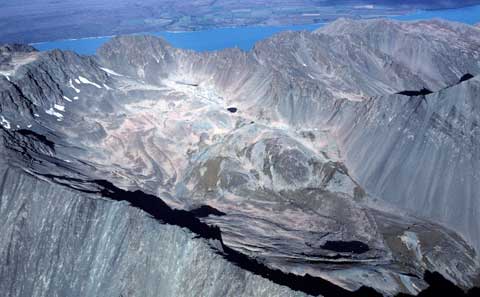
High in the Ben Ohau range to the west of Lake Pukaki in the South Island’s Mackenzie basin, the glacial moraines in the Irishman Stream Basin (Google Map) are providing important confirmation that the southern hemisphere warmed during a rapid northern hemisphere cooling event at the end of the last ice age. In a new paper in Nature, Glacier retreat in New Zealand during the Younger Dryas stadial Michael Kaplan and a team including three NZ scientists reconstruct the retreat of the glacier that used to fill the basin.

The team dated the sequence of moraines (piles of rock left by the retreating glacier) by measuring the “cosmogenic” beryllium isotope (10Be) in quartz crystals in the rocks — formed by bombardment by cosmic rays — giving a measure of how long the rocks have been exposed to the sky. By modelling the amount of ice in the valley at various moraine positions, they were able to reconstruct the glacier’s decline as the local climate warmed.

Why is this important? Because it’s another important bit of evidence in piecing together the sequence of events as the world warmed up from the last ice age — and in particular because the precise dating confirms that the Younger Dryas cold spell was not global in effect. From the abstract:

Our late-glacial glacier chronology matches climatic trends in Antarctica, Southern Ocean behaviour and variations in atmospheric CO2. The evidence points to a distinct warming of the southern mid-latitude atmosphere during the Younger Dryas and a close coupling between New Zealand’s cryosphere and southern high-latitude climate. These findings support the hypothesis that extensive winter sea ice and curtailed meridional ocean overturning in the North Atlantic led to a strong interhemispheric thermal gradient during late-glacial times, in turn leading to increased upwelling and CO2 release from the Southern Ocean, thereby triggering Southern Hemisphere warming during the northern Younger Dryas.

See also Science Daily. Ref: Kaplan et al. Glacier retreat in New Zealand during the Younger Dryas stadial. Nature (2010) vol. 467 (7312) pp. 194-197

[Edited to correct my original abysmal geography fail – wrong lake in the title]

The “inconsistencies” of Chris de Freitas

Auckland University associate professor Chris de Freitas (yes, that one) is a favourite of the NZ Herald opinion editor, regularly popping up in the paper to argue a sceptic line on climate change or, as has happened a couple of times recently, to talk about responses to earthquake disasters. Quite why the paper would go to CdF for the latter when there are many other better-qualified academics who could address the issue remains to be seen, but his article in response to the Canterbury quake in yesterday’s Herald was interesting. Compare and contrast CdF, 6/9/2010:

The focus on earthquake-disaster planning and crisis management is on risk reduction, readiness, response and recovery. In this context, government and local authorities have the responsibility to minimise social vulnerability and have a duty to promote community resilience through enlightened planning.

… with CdF, 1/5/09:

No one knows for sure what the future holds, but there are some good clues as to what’s going on. It hinges on growing evidence that natural influences on climate are in fact stronger than any man-made greenhouse effect. It may be premature to discard our anxiety over the threat of possible human-caused global warming, but this anxiety should not be based on ignorance of what science can tell us.

So for earthquake hazards, de Freitas is happy to argue for risk minimisation despite imperfect knowledge of the size of the risk (his piece looks into failed attempts to predict quakes), but when it comes to climate issues his argument is we shouldn’t do much because we don’t know enough!

Another example of the remarkable intellectual flexibility we have come to expect from the scientific advisor to NZ’s Climate “Science” Coalition. Or perhaps it’s simple hypocrisy. You decide…