This perceptive little cartoon comes from Argentinian Andrés Diplotti’s Flea Snobbery blog (La Pulga Snob, in the original Spanish), but perhaps most amusing is the way I found it… I noticed hits coming in from the comments under the Spanish version of the cartoon, and on investigation they turned out to be from a link (by Andrés) to my Don Easterbrook graph-fiddling exposé. I wonder if by chance there’s any resemblance between the elderly scientists? ![]()
Author: Gareth
Wake the world
This is a guest post by Anthony Giddens and Martin Rees. Giddens is a former director of the London School of Economics, a fellow of King’s College, Cambridge and the author of The Politics of Climate Change. Rees is president of the Royal Society.
This year has seen outbreaks of extreme weather in many regions of the world. No one can say with certainty that events such as the flooding in Pakistan, the unprecedented weather episodes in some parts of the US, the heatwave and drought in Russia, or the floods and landslides in northern China were influenced by climate change. Yet they constitute a stark warning. Extreme weather events will grow in frequency and intensity as the world warms.
No binding agreements were reached at the meetings in Copenhagen last December. Leaked emails between scientists at the University of East Anglia, claimed by critics to show manipulation of data, received a great deal of attention – as did errors found in the volumes produced by the UN’s Intergovernmental Panel on Climate Change. Many newspapers, especially on the political right, have carried headlines that global warming has either stopped or is no longer a problem.
All around the world
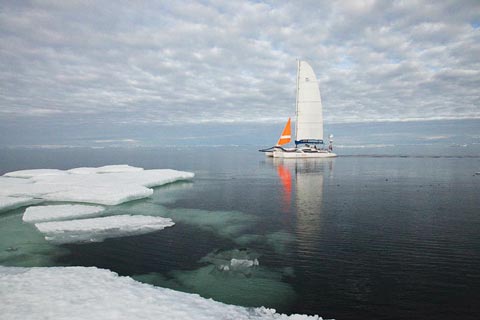
The Arctic Ocean has been circumnavigated by sailing vessels in a single season for the first time. The Norwegian trimaran Northern Passage reports that it has passed 74ºN, traditionally regarded as the eastern end of the NW Passage, and is now sailing into Baffin Bay heading for Pond Inlet. The Russian boat Peter 1is reported to be about one hour’s sailing ahead of them. In their blog post marking the milestone, Thorleif Thorleifsson and Børge Ousland provide this telling comment:
It is, unfortunately, the dramatic changes in Arctic sea ice conditions in recent years that have made this trip possible. On the time of Roald Amundsen it took five to six years to complete the same distance, due to the extremely difficult and demanding ice conditions. Now we have proven that it is possible to make the voyage in a 31-foot fibreglass sailing boat, equipped with a 10 horsepower outboard motor for emergencies. This shows how dramatic and how fast these changes are happening. The changes that we are witnessing will influence climate on a global scale, in addition to the whole range of animal life in the Arctic – especially seals and polar bears, whose lives are dependent on the sea ice.
It is our hope that our voyage will be seen as a strong, visible symbol of the scale and the speed of these changes.
Congratulations to both teams for their remarkable achievement. Given that the first circumnavigation by a sailing vessel was made by the French yacht Vagabond over two seasons as recently as 2002-2003, it’s clear that the pace of change in the Arctic is not slackening. Reflecting that, the Arctic Forum — a meeting of countries with claims to Arctic territory — is currently underway in Moscow. The Independent reports that the mood of the meeting is “conciliatory”, but the pressure to establish territory is growing as the rush to exploit oil, gas and mineral resources intensifies (see BBC for more).
[Updated] And to remind us that what’s at stake in the Arctic is a great deal more than a few billion barrels of oil, Yahoo News carries an IPS story on Arctic warming and the methane problem. If the average global warming is held to 2ºC (which doesn’t seem likely under present policy settings), the Arctic will warm much faster. NSIDC director Mark Serreze is characteristically blunt:
“I hate to say it but I think we are committed to a four- to six-degree warmer Arctic,” Serreze said.
If the Arctic becomes six degrees warmer, then half of the world’s permafrost will likely thaw, probably to a depth of a few metres, releasing most of the carbon and methane accumulated there over thousands of years, said Vladimir Romanovsky of the University of Alaska in Fairbanks and a world expert on permafrost. […]
That would be catastrophic for human civilisation, experts agree.
In other words, we have very good reasons to believe that settling for a 2ºC target would be to acquiesce in a global disaster. We can only hope for two things: that the climate commitment (the inevitable warming “in the pipeline”) does not push the Arctic into a huge release of methane, and that the world’s leaders wake up to the real scale and urgency of the problem. For all our sakes
[Oasis]

Monckton: the final slapdown
Britain’s most bumptious climate crank, Christopher, Viscount Monckton of Brenchley, deputy leader of the UK Independence Party (a party so fringe it probably has a surrey underneath) and inventor of a cure for AIDS, multiple sclerosis, influenza, and herpes simplex VI, gave evidence to a US Congressional committee last May at the invitation of the Republican party. As Monckton watchers might recall, his testimony was riddled with errors, and now a team of top scientists (including the one he threatened to sue, John Abraham) have submitted a detailed rebuttal [Response to Monckton (PDF)] to Congress. Skeptical Science has all the details, and Leo Hickman at the Guardian covers the story here, but for connoisseurs of the potty peer, his email to Hickman responding to the rebuttal is a minor classic:

The scientists were unaware of my letter to Congress because they did not have the good sense or courtesy to contact me – or even to contact the vast majority of the scientists whose conclusions I had cited – before circulating to friendly news media their prolix, turgid, repetitive, erroneous and inadequate response to my testimony. From their calculatedly furtive approach, it is legitimate to infer that their exercise was motivated more by politics than by science. One of the lead authors is currently under criminal investigation for alleged fabrication of results: another has been caught out in repeated lies: a third admits to suffering a mental disability: and many of the scientists whom these lead authors invited to contribute are among the long-discredited clique of Climategate emailers. Accordingly, it is unlikely that Congress will pay much attention to their political rant, which displays a lamentable absence of quantitative detail and a pathetic reliance on fashionable but questionable forecasting techniques that have long been compellingly contradicted by hard data.
I’ve highlighted the best bits. Perhaps he was upset that the scientists point out that his testimony that ocean acidification could not be caused by CO2 provides “a compelling example of his lack of understanding of ocean chemistry”. I await his 400 page response with interest… In the meantime, let’s just revel in the breathtaking hypocrisy that has become the good Lord’s hallmark.
House by the sea (not a good idea)
The Royal Society of New Zealand has just published an interesting paper on sea level rise [pdf], the latest in a series on “emerging issues” of public concern. It’s a very good overview of the current state of our understanding of the risk of future sea level rises, reviewing the evidence that’s accumulated since the IPCC’s Fourth Report (AR4), and puts that information into the NZ context.
The paper suggests that as we’re learning more about the behaviour of the great ice sheets of Greenland and West Antarctica it’s becoming clear that there’s a risk of sea level rise this century much greater than the upper limits given in AR4 (which ignored increasing ice sheet melt). On the other hand, the extreme rates of sea level rise seen during the last deglaciation (4-5 metres per century at times) look less likely, with data from the last interglacial (LIG, aka the Eemian) suggesting 1.5 metres/century is more plausible.
The RS paper also includes a useful summary of various SLR planning guidelines issued around the world. New Zealand’s guidelines (Bryan’s take here), based on AR4, look to be on the low side, but speaking at the press conference to launch the paper, Prof Martin Manning, director of Climate Change Research Institute at Victoria University , suggested that in his recent experience Environment Court judges were taking care to stay abreast of current scientific knowledge. That’s important, because as NIWA’s Doug Ramsay pointed out at the conference, 12 of the 15 largest towns and cities in NZ are on low-lying coastal and estuarine margins, there’s been enormous pressure to develop on prime beachfront locations and large chunks of our road and rail infrastructure are within 5 metres of current sea level.