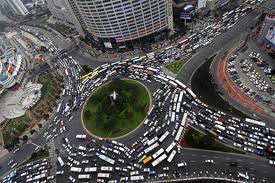
 Environmentalist Lester Brown is a competitive long-distance runner even into his late seventies. There’s something of the dogged persistence of that sport in the way he keeps delivering the message that humanity must change course, and backing up what he has to say with masses of data. The latest email I received a few days ago from his Earth Policy Institute underlined that message yet again, along with stark figures. It’s a short article headed Learning From China. I was taken with its directness and simplicity and thought it worth sharing here. He reflects that for as long as he can remember his own country, the US, with 5 percent of the world’s population has consumed a third or more of the earth’s resources. But today China consumes more basic resources than the US does. China uses a quarter more grain than the United States. Its meat consumption is double that of the United States. It uses three times as much coal and four times as much steel.
That’s national consumption. What if per capita consumption in China were to catch up with the US? That will happen by 2035 on the conservative assumption that China’s economy slows from the 11 percent annual growth of recent years to 8 percent.
If the Chinese spend their income more or less as Americans do today, then things get pretty well impossible. Continue reading “The Lesson from China”
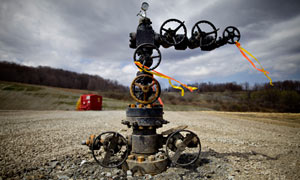 My heart sinks when I read enthusiastic acclamations of natural gas as a substitute for coal. It releases less CO2 on combustion, we’re told. It is a good bridge to the time when renewable energy is sufficiently developed to take over. And latterly, with the development of fracking, that’s going to be a very long bridge. There are claims that if we can extract all the shale natural gas there’s enough to
  Professor Tim Naish, Director of the Antarctic Research Centre, Victoria University of Wellington, and Principal Scientist, GNS Science, is giving a lecture tomorrow, Thursday 15 September, from 12.30-1.30 at VUW’s Pipitea Campus, Railway West Wing 501. It’s part of the NZ Climate Change Research Institute’s Seminar Series. Recommended to Wellingtonians, and worth attention from the rest of us for its sobering content indicated below.