Life’s a gas

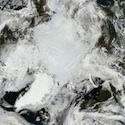
While Britain celebrates (Monarchists should not click on that link, be warned) its Queen’s Diamond Jubilee, and New Zealand hibernates on her birthday (which, of course, it isn’t), the planet has hit a notable milestone on its rapid transition to a new climate state. From way up in the Arctic, where the early summer melt is in full swing (click on the thumbnail to see more), NOAA reports that:

The concentration of carbon dioxide in the atmosphere of Barrow, Alaska, reached 400 parts per million (ppm) this spring, according to NOAA measurements, the first time a monthly average measurement for the greenhouse gas attained the 400 ppm mark in a remote location.

And it won’t be long before the rest of us get there:

“The northern sites in our monitoring network tell us what is coming soon to the globe as a whole,” said Pieter Tans, an atmospheric scientist with NOAA’s Earth System Research Laboratory (ESRL) in Boulder, Colo. “We will likely see global average CO2 concentrations reach 400 ppm about 2016.”
Continue reading “Life’s a gas”

Another Antarctic ice shelf at risk of melt

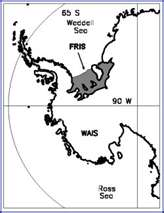
In the last episode of the Climate Show Gareth drew attention (at 13:40)  to two recent papers suggesting that the Weddell Sea area of the West Antarctic Ice Sheet may be more vulnerable to warming than previously realised. One paper, published in Nature Geoscience, recorded that radar mapping has uncovered a deep sub-glacial basin close to the edge of the ice sheet at the head of the Filchner-Ronne ice shelf. The basin measures 100 by 200 km and is well below sea level, nearly 2km deep in places. The ice sheet, currently grounded above the deep basin, may be more unstable than previously thought and could quickly undergo ice loss.

In a related paper, published in Nature, models reveal that the Weddell Sea region may experience warmer ocean conditions at the end of the 21st century, which could provide the trigger for ice sheet change. Professor Martin Siegert of the University of Edinburgh, who led the project, said:

“This is a significant discovery in a region of Antarctica that at present we know little about. The area is on the brink of change, but it is impossible to predict what the impact of this change might be without further work enabling better understanding of how the West Antarctic Ice Sheet behaves.”

I’ve been reading an interesting collection of expert opinion on the second paper, made available by the New Zealand Science Media Centre (SMC) ; it was gathered by the Canadian SMC.  The seven experts who commented all thought the paper worthy of respect, and together provided a sense of the breadth and liveliness of scientific interest in the behaviour of the ice shelves.  I thought Hot Topic readers might be interested to get the flavour of the comments.

Continue reading “Another Antarctic ice shelf at risk of melt”

20 years on, NZ’s Rio response inadequate: WWF

PandalogoThe WWF report this week on how New Zealand has handled its responsibilities since the first Earth Summit 20 years ago is damning on the matter of greenhouse gas emissions. We have failed to measure up to our undertakings given back in 1992 and again in 2002. New Zealand signed up to the United Nations Framework Convention on Climate Change on the first day of the that Rio meeting, and subsequently ratified it. We committed in Article 4 to:

“Adopt national policies and take corresponding measures on the mitigation of climate change, by limiting its anthropogenic emissions of greenhouse gases and protecting and enhancing its greenhouse gas sinks and reservoirs. These policies and measures will demonstrate that developed countries are taking the lead.”

The WWF report points out that nothing happened here for the next fourteen years and the country’s greenhouse gas emissions continued to increase. They flattened off after 2007, but that was mainly due to a major drought affecting agriculture and then the subsequent recession. The report considers the Emissions Trading Scheme enacted in 2008 and weakened in 2009 has had limited impact on emissions.

We have clearly failed to set emissions on a downward trajectory.

Continue reading “20 years on, NZ’s Rio response inadequate: WWF”

IEA: emissions up, 2ºC target looking unlikely

Fatih Birol, chief economist at the International Energy Agency (IEA) said at Reuters’ Global  Energy & Environment Summit this month that the door for a 2 degree Celsius target is about to be closed and closed forever. That’s a serious statement, but one which has been backed up in recent days by a news release from the IEA announcing that their preliminary estimates show that in 2011 global carbon-dioxide emissions from fossil-fuel combustion reached a record high of 31.6 gigatonnes (Gt).

This represents an increase of 1.0 Gt on 2010, or 3.2%. Coal accounted for 45% of total energy-related CO2 emissions in 2011, followed by oil (35%) and natural gas (20%).

The 450 Scenario of the IEA’s World Energy Outlook 2011, which sets out an energy pathway consistent with a 50% chance of limiting the increase in the average global temperature to 2°C, requires CO2 emissions to peak at 32.6 Gt no later than 2017, i.e. just 1.0 Gt above 2011 levels. The 450 Scenario sees a decoupling of CO2 emissions from global GDP, but much still needs to be done to reach that goal as the rate of growth in CO2 emissions in 2011 exceeded that of global GDP.

Not surprisingly Birol repeats his warning: “The new data provide further evidence that the door to a 2°C trajectory is about to close.”

Continue reading “IEA: emissions up, 2ºC target looking unlikely”

The Climate Show #27: Aussie hockeysticks, cherry pies and electric planes

[youtube]prR5zce-kdA[/youtube]

It’s a first! Glenn, Gareth and John manage to record a show that clocks in at under an hour — but it’s still packed with interesting stuff. We’ve got news about a new Australasian hockey stick — a paleoclimate reconstruction that demonstrates that the last three decades are the warmest in the last 1,000 years, a look under an Antarctic ice shelf, more methane research, and good news from Greenland. John Cook from Skeptical Science looks at the misuse of temperature records from the Sargasso Sea, and we look at electric planes and boats and the latest version of the solar “leaf”. And… Glenn announces his imminent move to the UK, but never fear, the show will go on — just as soon as he sets up his computer in London (which might be a couple of months).

Watch The Climate Show on our Youtube channel, subscribe to the podcast via iTunes, listen to us via Stitcher on your smartphone or listen direct/download from the link below the fold.

Follow The Climate Show at The Climate Show web site, and on Facebook and Twitter.

Continue reading “The Climate Show #27: Aussie hockeysticks, cherry pies and electric planes”