Rationality wins US greenhouse gas case

Tom Bennion, a Wellington environment lawyer who has not flown since 2009, takes a look at the recent Environmental Protection Agency versus the “Coalition for Responsible Regulation” case in the USA.

Opponents of regulation of greenhouse gases in the US, including a number of states, have just received a spanking in the DC Court of Appeals, a level just below the Supreme Court. The court has thrown out a variety of challenges to EPA rules regulating greenhouse gases. I will briefly explain the ruling (pdf here) and then comment on prospects from here.

The background is that in 2007 the Bush era EPA argued that it could not regulate greenhouse gases as pollutants under the Clean Air Act. In Massachusetts v. EPA the Supreme Court determined that it could.

Subsequently, the Obama era EPA has made an “Endangerment Finding” that greenhouse gases may “reasonably be anticipated to endanger public health or welfare.” Then it issued a “Tailpipe Rule” setting emissions standards for cars and light trucks which would save around 960 million metric tons of CO2e emissions. It also issued “Timing and Tailoring Rules” requiring only the largest stationary sources such as new power stations to meet emissions standards, on the basis that regulating every small polluter would be overly onerous.

Various states (drought afflicted Texas and thawing Alaska among them) and industry groups attacked both the Endangerment Finding and the rules on the basis that the Endangerment Finding and Tailpipe rules were “arbitrary and capricious” exercises of discretion by the EPA resulting from factual and procedural errors, and a misreading of the Clean Air Act.

The three member appeal court threw out all of the challenges.

Continue reading “Rationality wins US greenhouse gas case”

This is our planet

[vimeo]44801709[/vimeo]

A wonderful video to start the weekend — time-lapse photography from the space station compiled by Tomislav Safundžić. If anyone ever tries to tell you that man’s influence is too puny to affect our great planet, point them at this. The world is littered with our lights, and much else besides. Watch the full HD version at Vimeo for the best effect.

Introducing the Kyoto Escalator: did anyone sign the protocol in good faith?

Simon Johnson introduces the Kyoto Escalator chart (inspired by the Skeptical Science Escalator chart) and argues that New Zealand was just as complicit as the major European countries in negotiating the Kyoto Protocol so that it could be complied with while gross and net emissions continued to increase.

New Zealand's Gross net and Kyoto greenhouse gas emissions 1990 to 2012
The Kyoto Escalator: New Zealand’s Gross greenhouse gas emissions (blue) increase by 19%; Net emissions (brown) increase by 23% and ‘Kyoto’ emissions (red) are less than average 1990 gross emissions.

Professor Dave Frame is the new director of the Climate Change Research Institute at Victoria University of Wellington. He is a University of Canterbury-trained scientist who has worked for some years in Britain. He has just joined the climate change fray with a very interesting opinion editorial “International focus needed over climate” in the Dominion Post. Welcome to climate change issues back in New Zealand, David.

Frame notes that New Zealand does not want to be thought of as the country that reneges on international treaties.

“Reputationally, accepting commitments and then failing to deliver on them is not a look New Zealand likes. “Doesn’t honour the treaties it’s signed” is not one of the few sentences we want people to remember about us.”

So, yes, I agree, New Zealand should honour the treaties it signs. I hate to nitpick, but isn’t New Zealand a country that is remembered for a treaty that we didn’t honour? Is our record on international climate change treaties any better?

Frame goes on to describe some of the different motivations underlying the negotiations that lead to the Kyoto Protocol.

Continue reading “Introducing the Kyoto Escalator: did anyone sign the protocol in good faith?”

Greenland melt record likely

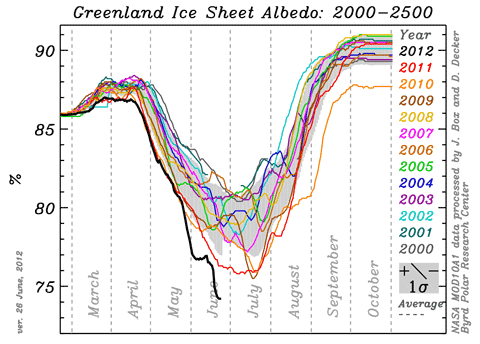
Jason Box reports that the Greenland ice sheet darkening recorded in satellite albedo ((High albedo = very white, lots of reflection; low albedo = darker, more heat absorbed)) measurements is setting new records this summer, especially at high altitudes. Box recently blogged that ice sheet reflectivity this summer “has been the lowest since accurate records began in March, 2000”.

Here’s the latest “noodle plot” ((Looks like a spaghetti graph to me. What is it with climate people and pasta?)) (regularly updated here) for the ice sheet between elevations of 2,000 and 2,500 metres. 2012 (the black line) is well down into new record territory:

2000 2500 Greenland Ice Sheet Reflectivity Byrd Polar Research Center

Box comments:

What I expect we will see if these low albedo conditions persist is 100% surface melting over the ice sheet. This would be a first in observations. It may not happen this year, but the trajectory the ice sheet is on, along with amplified Arctic warming, will have the ice sheet responding by melting more and more.

To see this darkening in action, have a look at the MODIS image of the west Greenland ice sheet here. You can see the surface melt spreading inland and upwards, grey ice dotted with blue lakes. Add another interesting, if depressing, graph to the panoply of information on the Arctic summer. The sea ice doesn’t look too good either…

In other Greenland-related news, a new study published in Proceedings of the National Academy of Science by Liu et al ((Zhengyu Liu, Anders E. Carlson, Feng He, Esther C. Brady, Bette L. Otto-Bliesner, Bruce P. Briegleb, Mark Wehrenberg, Peter U. Clark, Shu Wu, Jun Cheng, Jiaxu Zhang, David Noone, and Jiang Zhu. Younger Dryas cooling and the Greenland climate response to CO2. Proceedings of the National Academy of Sciences, June 25, 2012 DOI: 10.1073/pnas.1202183109 – PDF here.)), Younger Dryas cooling and the Greenland climate response to CO2 (Science Daily, PNAS abstract), looks at the ice sheet temperature record inferred from the oxygen isotope measurements taken from ice cores, and concludes that they may overestimate the extent of the Younger Dryas cooling. This is interesting stuff for those who have been following the Easterbrook story, because Don places great store by the ice core temperature record. He was wrong before this paper hit the presses, but he’s even wronger now!

No dallying with denial

Will Hutton’s Observer column this week was forthright on the folly and danger of climate change scepticism. “Climate change is already hurting and, unchecked, will turn into a catastrophe.”  Against that statement he points to the intellectual bankruptcy of allowing ideological preference for reducing the role of government in society to somehow justify climate change scepticism. It’s not even as if capitalism is under threat of disappearance.  “Capitalism is not going away: the task is to reform it deploying a more agile, intelligent state.” But taxation and regulation will be part of that reform and the climate sceptics on the right need to come to their senses on that necessity.

Hutton’s was the sort of direct statement we should expect from informed journalists. He notes in passing that the media is often less interested in the evidence that it should be. “It likes a spat: the idiosyncratic brave climate change dissenter is pitched as the David against the Goliath of established opinion.”

The day after I’d read Hutton’s column the NZ Herald’s monthly magazine Element accompanied Monday’s edition of the paper and cheered up my morning. There was no dallying with denial here. Editor James Russell gave voice to the slight embarrassment many of us who worry about climate change probably feel in some company.

Continue reading “No dallying with denial”