
 Jim Salinger’s sacking by NIWA has gone to mediation. Stuff has an iffy picture but good background to today’s first meeting: six NIWA execs attended, facing up to Salinger and his lawyer. The meeting finished at 3pm this afternoon, and Jim tells me that “the matter has not reached resolution, but talks continue”. He won’t be saying more until the process has concluded. Meanwhile Ken Perrott has an excellent summary of the reaction to Salinger’s sacking from the NZ scientific community at Open Parachute. Should be more coverage in the days to come, and I’ll update this post with links as they come in.
What’s a few tears to the ocean?
 New Zealand could be amongst the first places in the world to feel the effects of ocean acidification, according to a new “emerging issues” paper released today by the Royal Society of New Zealand. Surrounded by cold oceans which absorb CO2 faster than warm waters, and with a $300 million shellfish industry based on mussels, oysters, scallops and paua, NZ is vulnerable to disruptions in the carbonate chemistry used by these animals to build their shells, but the risks cannot be quantified at present.
At a briefing to launch the paper, Professor Keith Hunter of the University of Otago pointed to recent work which suggests that for creatures that build their skeletons from a form of calcium carbonate called aragonite, the Southern Ocean could be reaching a critical point as early as the 2030s, as this slide shows:
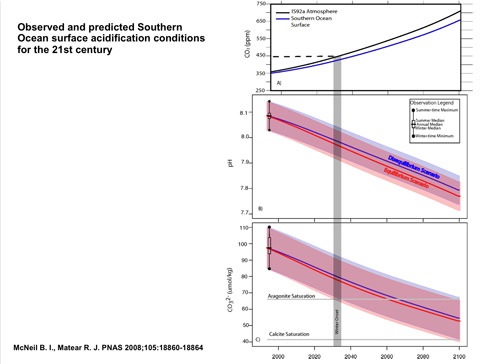
The magic number is 450 ppm: at that point low pH waters in winter could begin to make it difficult for creatures to build aragonite skeletons or shells. How this might cascade through marine ecosystems is unknown, because the impact on different species can vary through their lifecycle and by season. Some species are also known to be able to adapt. Sydney rock oysters, for example, have been bred to withstand more acid conditions, but it’s not known whether this sort of work would be possible with mussels and other shellfish.
Work on ocean acidification is beginning to provide a valuable and independent line of evidence supporting the need to shoot for stabilisation of atmospheric CO2 at low levels. It may also point to problems with emissions trajectories that are allowed to “overshoot” the desired target: if oceanic CO2 uptake does produce a biologically critical response, exceeding that point might be very bad news for oceanic ecosystems.
The new Royal Society paper gives a very useful overview of what we currently know about ocean acidification and its potential to impact New Zealand ecosystems and marine farming operations. The RS is also organising a workshop in September to discuss the issue.
[Dimmer]
Blog bits #438(b)
Observant readers might have noticed a few changes at Hot Topic over the weekend. Two new navigation options have popped up over the header: Book Reviews and Debate Map. The first one’s fairly straightforward, it’s a link to the book reviews category — a short cut to all the book reviews we’ve published at Hot Topic since Bryan started diligently working his way through new and notable climate-related books. Thanks to his efforts we now host the most comprehensive review coverage of climate books on the web (that’s my claim, and I’m sticking to it).
The Debate Map link goes to a new page created to provide a permanent home for the Debategraph interactive map of the climate debate I first posted about back in March. It’s a wiki-style site given a nice graphical structure. I find the whole thing fascinating, so I urge all Hot Topic‘s readers (even sceptics) to go and have a play and don’t be afraid to contribute items and arguments. Debategraph head honcho David Price provides the accompanying text, and is very happy to discuss any aspects of the map with interested readers.
One other tweak regular readers may like: I’ve updated the site’s theme to allow for “threaded comments”. This means you can now reply to individual comments by clicking on the “reply” link at the bottom of each comment. Your response will then appear immediately underneath, slightly indented. You should be able to reply to replies up to five indents deep, but I haven’t tested that…
Heaven is a place on earth
The Australian twin to Wishart’s Air Con is Professor Ian Plimer’s Heaven and Earth: Global Warming, the Missing Science, published last month. According to Bob Carter (in all his oleaginous glory here) on Leighton Smith’s Newstalk ZB programme recently it’s “an excellent book”. Carter assures Smith that “the authoritative science is in Ian Plimer’s book”. Fortunately, to save Hot Topic the chore of wading through Plimer’s prose, The Australian (noted for a tendency to push crank arguments) has published a most interesting review of Plimer’s opus by Michael Ashley, a professor of astrophysics at the University of New South Wales. What does he make of Plimer’s “authoritative science”?
Perhaps we will find a stitch-by-stitch demolition of climate science in his book, as promised? No such luck. The arguments that Plimer advances in the 503 pages and 2311 footnotes in Heaven and Earth are nonsense. The book is largely a collection of contrarian ideas and conspiracy theories that are rife in the blogosphere. The writing is rambling and repetitive; the arguments flawed and illogical.
Just like Wishart then.
Plimer has done an enormous disservice to science, and the dedicated scientists who are trying to understand climate and the influence of humans, by publishing this book. It is not “merely” atmospheric scientists that would have to be wrong for Plimer to be right. It would require a rewriting of biology, geology, physics, oceanography, astronomy and statistics. Plimer’s book deserves to languish on the shelves along with similar pseudo-science such as the writings of Immanuel Velikovsky and Erich von Daniken.
[Hat tip: Deltoid]
See also; Prof Barry Brooke’s review of Plimer’s book.
[Belinda Carlisle]
Blackleg miner
 Solid Energy, NZ’s state-owned coal mining company, is promoting an alternative to an economy wide emissions trading scheme. According to Carbon News, the approach is being “heavily peddled to policy makers and others in Wellington”, and it is seen to have “great simplistic appeal”. Carbon News has made the document, A Durable Climate Change Strategy for New Zealand, available here.
The essence of the scheme, once you plough through Solid Energy’s reasons for disliking the ETS as currently proposed, is that the government should plant lots of trees, funded by a $1/tonne carbon levy applied across the economy. Lots and lots of trees — a million hectares of new exotic and native forest planted over the next 20-30 years. Solid Energy claims that “Kiwiforest” would provide enough cheap carbon sequestration to allow the economy to grow without the need to impose steep carbon prices. An ETS would only be introduced when there was a truly global interlinked network of carbon markets.
Sounds attractive, on the face of it. Who could object to planting lots of trees? Certainly not me. Unfortunately, as a national emissions strategy it looks too simplistic to be realistic, and on Solid Energy’s numbers delivers emissions reductions that aren’t credible.