The Clean Industrial Revolution

The Clean Industrial Revolution: Growing Australian Prosperity in a Greenhouse Age

The problem with cutting greenhouse gas emissions is that it will harm economic growth. Right? No, quite the opposite, says Ben McNeil in his book The Clean Industrial Revolution. It’s an age-old myth that doing good for the environment is bad for the economy. He’s addressing Australians, but what he has to say will arrest readers from many countries. It has certainly grabbed the attention of some prominent New Zealand businessmen who have presented every MP with a copy of the book and used it to back a call to the Prime Minister for a joint business/government task-force to focus attention on emerging clean technologies.

McNeil is a senior research fellow at the Climate Change Research Centre at the University of New South Wales. Besides a PhD in climate science he also holds a Master of Economics degree.  The two worlds are bridged in this energetic book.  Australia is very vulnerable to climate change through sea-level rise, rainfall changes, storms, and a decrease in food production. It is also highly carbon-intensive in its economy and its export industries will suffer as a consequence when the world starts to move heavily to reduce carbon emissions and impose carbon tariffs.

Such consequences can be pre-empted by a clean-energy revolution, one for which Australia is well-endowed. That hot arid interior is the potential source of vast quantities of high capacity solar power. The use of mirrors to concentrate sunlight so perfectly that the ultra-high temperatures convert water to steam is one way. Another, already under construction in north-west Victoria, uses mirrors to concentrate the sunlight on to high-performance photovoltaic panels. Solar power could replace the need for coal-fired power stations. A massive underground “hot rock” heat source can be tapped to create steam for power generation, a technique already being worked on by a number of companies at several sites throughout Australia. Wind power in the south could supply 20 percent of the country’s needs. Advanced biofuels that do not impact on food can be produced.  Biomass-fuelled electricity is already generated in some parts of rural Australia. Carbon capture and storage may hold some hope for the continuing use of coal, though not while coal companies put a miserly 0.3 percent of their production value into research, apparently believing that governments will do the work for them.

McNeil argues that Australia must take up a forefront position in the low-carbon economic future if it wants to remain prosperous. At the time of writing in 2009 he expected the emissions trading scheme to kick in, putting a price on carbon and pointing the economy towards investment in clean energy. This has been delayed, but even without it there is ample reason for the change of focus away from the carbon-intensive economy (carbon obesity he calls it).  The world will soon be crying out for clean energy technology.  Australia will continue to prosper in the future if it has used research and development to drive down the cost of renewable energy technologies, and investment to commercialise them and prepare them for export.

McNeil illustrates this with a striking imaginary scenario. A series of climate catastrophes hit the world in the 2020s. Global greenhouse gas sanctions quickly followed. Those nations with expanses of desert which had been working on the development of solar power became the energy superpowers of the 21st century. Australia led in the building of the Asia Pacific Electricity Grid following a breakthrough in transport efficiency for transmission cables discovered by Australian researchers. The grid connected Australian energy supply to its Asian neighbours.  The scenario is much more elaborated than this, but it all certainly sounded feasible.

Back to present reality. McNeil is adamant that there are solid employment opportunities in an economy focused on clean energy. More than offered by the present carbon intensive economy, and jobs which can’t be outsourced. Creating energy-efficient homes and buildings, for example, is a proven source of increased jobs. The European Commission suggests that energy efficiency creates three to four times the level of employment as an equivalent investment in a new coal-fired power station. Renewable energy requires two or three times more people for operation than an equivalent coal-based energy project. A comparison between Denmark’s wind industry and New South Wales coal industry clinches that. A renewables manufacturing industry is feasible kept based in Australia by a strong domestic market.

McNeil provides a wealth of illustrative material from many countries and forward-looking firms. He instances General Electric’s ‘Ecoimagination’ programme launched in 2005, aimed at developing low-carbon solutions. The company reports that it has never had an initiative that generated better financial returns so quickly. Cloudy Germany is the world’s largest market for solar energy and German solar manufacturing companies produce over half the world’s solar panels. German companies are positioning themselves for the burgeoning global clean-tech market. Tiny Denmark manufactures over half the world’s wind turbines, obtains 20 percent of its electricity from wind and plans to increase that to 40 percent. McNeil notes dryly that contrary to some prophesies Danes are far richer than Australians by GDP per capita, while cutting their carbon intensity by over one-third in less than ten years.

Innovation needs science, and McNeil titles one of his chapters “How Science Must Save Us”. If Finland can produce Nokia, Australia also can help shape the world, not by raw military or economic might but by “the seeding of ideas in an interconnected world.” Education and research funding are crucial for the development of science and he discusses how they can be expanded. Scientists and engineers will not only develop new generation clean energy but also seek to understand and monitor the effects of climate change on the natural ecosystems of Australia with its immense variety of specially evolved plants and animals. They will also continue to seek the development of techniques for reducing methane emissions from livestock, which produce 10 percent of Australian greenhouse emissions.

McNeil knows first hand how serious the implications of climate change are.  The disease has been diagnosed but his attention in this book is on the cure. He matches the environmental imperative of emissions reduction with the economic benefit of entering wholeheartedly into a new, clean, low-carbon industrial revolution. Climate change poses a great risk to the Australian economy, and so does their over-reliance on fossil fuels. They need to embrace the change to clean energy. The costs of not doing so will far outweigh the cost of making the change.

One doesn’t need to be an Australian to be cheered by much that the book has to say and the detail with which it is illustrated.  But the final sentence has to be conditional:

“If Australia sets strong greenhouse gas emission targets and invests in unleashing clean-technology innovation,…”

Unfortunately it’s still a big if, not only for Australia.  But here’s the rest of the sentence:

“…not only will Australia help the world as it makes the transition towards a low-carbon development pathway to solve climate change, it will bring new prosperity and employment growth to a country desperately needing economic reform in its energy policy.”

Note: There’s a short relevant interview with Ben McNeil here on YouTube.

[Check out this book at: Fishpond, Amazon.com, Book Depository]

The thing we need to fix is ourselves

If you have 18 minutes to spare, spend them watching coral reef ecologist Jeremy Jackson’s recent TED talk about the ways in which humanity is wrecking the world’s oceans. Climate change is only one of the factors driving the massive changes being seen in the global ocean, and if we’re to have any hope of dealing with them we have to work out how, as Jackson puts it, we’re going to put Humpty together again. And we won’t manage that unless we fix ourselves first. Compelling, unsettling viewing.

Hat tip: Resilience Science.

Fools rush in…

At the Heartland climate crank conference in Chicago a speaker predicts global cooling, and immediately becomes headline news for Morano and the denial echo machine. At the very same time, NOAA releases its global climate report for April, and notes that not only is April the warmest in the long term record, but that January to April is also the warmest start to any year. If you were gambling on 2010 becoming the undisputed warmest year ever, the odds just shortened considerably. As Joe Romm noted yesterday, the last 12 months is already warmer than any other 12 month period…

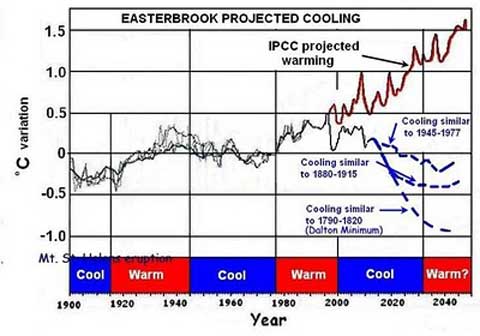
On the other hand, this is what Don Easterbrook thinks will happen:

Easterbrookcooling.jpg

Interesting graph. It might need some work, given that he seems to start all his blue lines almost 0.5ºC below where 2010 is likely to end up. I’ll bet it got warm applause from the crank crowd…

Meanwhile, Jeff Masters notes the continuing high sea surface temperatures in the Atlantic: “an eye-opening 1.46°C above average during April.” Not good news for the hurricane season…

Hat tip to Andy Revkin, first to note the delicious irony.

[Ricky Nelson]

Bum notes from the Brill building (and a question for the minister)

The new chairman of the NZ Climate “Science” Coalition, Barry Brill OBE, is certainly not shy about parading his point of view to the world at large. Brill, a lawyer and former junior minister in the 1975-81 “Think Big” Muldoon government, has attempted to argue with John Key’s science advisor, Sir Peter Gluckman, and last weekend followed in the oversize footsteps of Bob Carter by popping up at denier-friendly Aussie “journal of ideas” Quadrant Online with a lengthy rant on the “Crisis in New Zealand climatology”. Crisis? What crisis? It appears he means the ACT Party beat-up of the shonky analysis by Richard Treadgold and un-named “researchers” at the Climate “Science” Coalition. Brill seems blissfully unaware of the real controversy surrounding this affair, but his article — and its appearance at places such as Watts Up With That— gives me another chance to demonstrate that this whole affair is nothing more than a politically-inspired attempt to undermine action on climate change.


Underpinning this manufactured controversy is one big lie: that the New Zealand temperature record has been important in determining government policy on climate change, and has somehow been influential on a global scale. Here’s Brill:

For nearly 15 years, the 20th-century warming trend of 0.92°C derived from the NSS [NIWA’s “seven station series”] has been at the centre of NIWA official advice to all tiers of New Zealand Government – Central, Regional and Local. It informs the NIWA climate model. It is used in sworn expert testimony in Environment Court hearings. Its dramatic graph graces the front page of NIWA’s printed brochures and its website.

Internationally, the NSS 0.92°C trend is a foundation stone for the Australia-New Zealand Chapter in the IPCC’s Third and Fourth Assessment Reports. In 1994, it was submitted to HadleyCRUT, so as to influence the vast expanses of the South Pacific in the calculation of globally-averaged temperatures.

At the centre of advice to government? A foundation stone for the IPCC? Brill is channelling Treadgold, but doing us the favour of being explicit. He wants us to think that the NZ temperature record is really, really important. The bad news for Brill? It isn’t, and never has been. The New Zealand record is interesting, certainly, but has only ever been a tiny part of the global evidence that has persuaded governments around the world to enact policies designed to address climate change. The truth is that even if the NZ record showed cooling (which it doesn’t), the case for taking action wouldn’t change one iota. However, Brill wants us to believe that warming in New Zealand isn’t real:

First, we know what New Zealand’s average temperature was in 1867. The predecessor of the Royal Society of New Zealand (The New Zealand Institute) made a formal minute in 1868 of:

“Tables, which form the most reliable data for judging of the Climate of New Zealand, are extracted from the Reports of the Inspector of Meteorological Stations, for 1867”.

The mean annual temperature was 55.6F – the equivalent of 13.1C. Now consider this extract from NIWA’s “Climate Summary for 2005”: The national average temperature of 13.1°C made 2005 the fourth warmest year nationally since reliable records commenced in the 1860s.

No change whatever in 138 years! In fact, if 2005 was warmer than most 21st century years, New Zealand has obviously experienced some cooling during the past century or so.

Oh really? Brill is here lifting “work” from none other than Bryan Leyland, which I dealt with in this post in January last year. But for the purposes of further showing Brill to be wrong, take a look at the cover of this book:

Hasst.jpg

This is the cover of a 2005 book from Canterbury University Press. The top sketch was painted by Julius von Haast in 1864, and shows the Cameron Glacier in the Arrowsmith Range in Canterbury. The photograph underneath shows the same scene in 2004. The glacier has retreated more than two kilometres. A lot of ice has vanished. I wonder how that happened? Fairies, perhaps? Or oofle dust? Here’s a photograph of the Cameron taken a few months ago. Still retreating, it would seem. As Jim Salinger noted in his PhD thesis, when commenting on a paper by Jim Hessell which purported to show little warming in NZ since 1930:

However, almost universal occurrence and synchroneity of the warming at 66 out of 70 sites associated with years of profound glacial retreat cannot be explained simply by instrumental or observer error.

We can be confident that New Zealand has warmed not just because the temperature record shows that to be the case, but because the country has lost a huge amount of ice over the same period. The ice melt is confirmation that the process Jim followed when adjusting station records for moves and changes was yielding results that pointed in the right direction.

Brill moves on to thank his supporters:

Piecing together the provenance of the New Zealand historical temperature record has been no easy task. Much of the detail is set out in the Climate Conversation blog. It has involved a myriad of investigative methods but the most productive has been the placement of nearly 50 Parliamentary Questions for Written Answer, for which credit must go to John Boscawen MP. The New Zealand mainstream media, all highly partisan on climate change matters, have evinced little interest in the scandal to date.

Fifty questions to Parliament, about a shonky analysis being given a politically-inspired beat-up? That sounds like an outrageous waste of tax payer funds to me. I wonder which MP will have the nous to ask Wayne Mapp, the minister responsible for NIWA, how much time and money the National Institute of Water and Atmospheric Research has had to expend on answering those 50 questions. Because that’s the legacy of Treadgold, Brill and the ineducable Boscawen — a spectacular waste of time and money.

There’s the real scandal. NIWA and its scientists have been subjected to baseless attacks and smears, and the organisation’s limited resources have been diverted to feed nothing more than the monstrous egos of New Zealand’s climate cranks, who are happily slinging mud as part of an extreme right wing political campaign to persuade the government to drop the ETS. Brill’s fact-challenged rant only demonstrates that he’s the latest in a long line of people prepared to spout nonsense in pursuit of inaction.

[The Animals, doing an appropriate Brill Building song (Mann/Weil)]

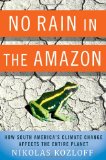
No Rain in the Amazon

U.S. writer Nikolas Kozloff aims to give a voice to the peoples of the Global South in his new book No Rain in the Amazon. At the same time, as indicated by the sub-title How South America’s Climate Change Affects the Entire Planet, he warns that what happens in the Amazon affects us all, wherever we live.

In this book the South is mainly Peru and Brazil. For the purposes of the book Kozloff traveled throughout the two countries, speaking with government officials, experts, environmentalists, and indigenous peoples. A specialist in Latin American affairs, Kozloff is not a scientist but is well acquainted with current climate science.

He has a lot to tell as he develops his major themes. Among them: climate change is already being experienced in the region and taking effect on poorer people’s lives; it poses further threats for them in the future; the Amazon forests are threatened by climate change, particularly drought; they are also severely threatened by the deforestation caused by humans; loss of Amazon forest is global in its impact because of the vital part it plays in the global environment; the Global North is complicit in deforestation and must help stop it.

In Peru the melting of glaciers carries serious implications on many levels, from  irrigation for farming and water for pack animals through to the long term threat to the water supply to Lima, a city of 7 million built on a desert.  Unpredictable and testing weather patterns are emerging in some regions. The Andean cloud forests, which carry out a vital hydrological function as well as maintaining extraordinary biodiversity, are under threat from climatic change as clouds condense at higher altitudes. Kozloff considers the drastic effects of El Nino events on Peru, including outbreaks of cholera and dengue, and points to the IPCC expectation that El Nino-like conditions are expected to become more frequent with continued global warming.

Kozloff doesn’t constantly enter scientific caveats when assigning the effects of climate change on the lives of poorer people. It’s reasonable that he doesn’t: the cumulative picture is strong, and he’s not arguing the scientific case but giving a voice to people whose plight is being ignored. He comments on the extreme inequalities whereby, in general, the people who are most at risk from global warming live in the nations that have contributed the least to the atmospheric accumulation of carbon dioxide and other greenhouse gases. They also, like Peru, tend to be among the poorest and hence ill-equipped to deal with the changes they are facing.

Turning to the Amazon Kozloff points out that it contains about one-tenth of the total carbon stored in land eco-systems and recycles a large fraction of its rainfall. Drawing on the expertise of much-cited Brazilian scientist Philip Fearnside he explains how El Nino-driven drought is threatening the forest. The warming of sea surface temperatures in the tropical North Atlantic may also be linked to Amazonian droughts. Climate change is responsible for these enhanced threats. And of course the effects are not just local. Tropical rainforest literally drives world weather systems. The billions of dollars needing to be provided by the rich nations to tropical countries to sustain forests are an important and necessary insurance policy.

But the Amazon is threatened by more than climate change.  Deforestation as a result of human activity is the focus of a major section of the book.  Kozloff sets the scene for his survey by pointing out that the relentless slashing and burning of tropical forests is now second only to the energy sector globally as a source of greenhouse gases.  Powerful political and economic forces within Brazil are pushing deforestation, but the Global North is complicit  in the destruction. The affluent nations, acting through large financial institutions, fund destructive tropical industries and buy up the tropical commodities that are hastening the day of our climate reckoning.

The cattle industry accounts for 60 to 70 percent of deforestation in the Amazon. Kozloff recounts some of the brutal realities of ranching and its “insidious alliance” with politicians. Land ownership is often unclear and plagued by corruption. Poor workers can labour in conditions amounting to virtual slavery.  An activist like Sister Dorothy Strang who worked on behalf of landless farmers and advocated for sustainable development projects was eventually simply assassinated. She was an “agitator” who had only herself to blame for her death, said a local cattle ranchers’ leader.  The Brazilian state seems hopelessly compromised by powerful agricultural interests and finds it hard to police the Amazon and control deforestation. But financial institutions in the Global North, like the World Bank, provide key investment backing to the ranching explosion. Northern companies purchase leather, beef and other products and consumers buy them. Blame is shared.

The depressing news doesn’t end with cattle. Kozloff moves on to soy and its reach into the Amazon and the Brazilian cerrado, which covers one-fifth of the country and is the world’s most biologically rich savannah.  Soy monoculture liberates carbon from the soil of the cerrado and its advance also displaces cattle farming into new forest development.

Kozloff acknowledges that there are problems with the Reducing Emissions From Deforestation and Forest Degradation progamme (REDD), not helped by the blocking by the US, Canada, Australia and New Zealand of moves to incorporate protections for indigenous peoples into the programme. But he sees it as “the only game in town right now that makes preserving forests more economically valuable than cutting them down”. Which is the nub of the matter.

Kozloff is not impressed by the “clean energy” initiatives being pursued in Brazil, hydro-electric dams for electricity and biofuels from sugar cane for transport. Apart from the population displacement and road building associated with dam-building, the dams in forest areas lead to vast emissions of methane from the decaying vegetation.  Ethanol from sugar cane has been one of Brazil’s apparent success stories, but it involves destruction of the coastal Atlantic rainforest, one of the world’s top five biological hotspots. The nasty hell of debt-slavery operates in many sugar cane plantations. American agribusiness giants are now rushing to set up shop in Brazil to help greatly expand the industry. Much of the growth may be outside the rainforest, as officials claim, but it is planned to be within the cerrado.

If the Global North wants to avert yet further climate change, Kozloff says, it needs to get serious about the transfer of truly green technologies, particularly wind, solar, and waves. He points to the need for a “Manhattan Project” scale development of alternative clean energies, and the sharing of the new technologies with tropical nations such as Brazil. There’s little sign of such transfer taking place.  Indeed before Copenhagen the US House of Representatives voted unanimously to ensure that the negotiations would not “weaken” US intellectual property rights on wind, solar, and other green technologies.

Full of interesting accounts though it is, the book is hardly a cheering read. Not because nothing can be done for Peru and Brazil by way of mitigation and adaptation but because it is by no means clear that the Global North is ready and willing to provide the necessary assistance. Nevertheless Kozloff presses the case for action convincingly.

Note: There’s a Democracy Now interview with Nikolas Kozloff relating to his book here on YouTube. (It’s in two parts.)

[Buy through: Fishpond, Amazon.com, Book Depository.]