Doug digs denial

Waikato farmers who deny human-caused climate change will be cheered by the support lent by a real live scientist in an interview prominently reported in the latest issue of the Waikato Farmer, a monthly feature supplement of the Waikato Times.  Admittedly not a climate scientist – a soil scientist actually – but one who has done much reading on the subject, including Nigel Lawson’s A Cool Look At Global Warming.  Thus fortified he is able to substantiate the opinions of the 99 percent of the farmers consulting him who he says think global warming is a hoax and the Emissions Trading Scheme unnecessary.

Doug Edmeades is his name.  He’s not listed as a member of the NZ Climate Science Coalition, but his “coming out” as a sceptic was posted on their website. To be fair, in his statement on his joining the ranks of the sceptics he acknowledges that he does not read the scientific literature on climate change and cannot be considered as an authority on the subject. Indeed he says he’s a layperson who must rely on the views of others who specialise. However those whose views he then goes on to cite don’t include any climate scientists. Willem de Lange and Bob Carter are the two scientists he mentions, and they are buttressed by Bjorn Lomborg, Ross McKitrick and, yes, Christopher Monckton who demonstrated there is no scientific consensus.

Back to the Waikato Farmer interview. It’s the usual farrago. Climategate was a scandal which confirmed most farmers’ suspicions that global warming is a politically driven theory. Phil Jones has admitted there was no global warming in the past 15 years, calling into question the reliability of climate models and temperature records. Water vapour is the biggest greenhouse gas; why aren’t we taxing it? Doubled carbon dioxide will increase food production by about 30 percent. Carbon dioxide doesn’t determine global temperatures.  Humans and the natural world are good at adapting to survive.  Even if the alarmists are right and the average temperature increases by 2-4 degrees the likelihood is that we could be better off. And so on.

Edmeades’ expressed views are mostly wrong or reckless or silly. There’s nothing in what he says to deserve time spent countering it here. But it’s depressing that views of this nature should be regarded as worth highlighting in a farming publication and are evidently nourishing the opinion of many farmers that global warming is a matter of no great moment or still under dispute.  The edition of the Waikato Farmer in which the interview appears is much concerned with the cost of the Emissions Trading Scheme to farmers.  One can understand that this should be a matter of concern and debate.  But to couple it with denial of the seriousness of climate change is a different matter.  One of the farmers reported didn’t go as far as that, but said, “The science is not robust enough. Some of the research has been a bit shaky.”  This is perception, not knowledge. It’s high time the NZ farming community discovered that the essentials of the science are established and did its thinking about the ETS or other mitigation schemes without dallying with the idea that perhaps there’s nothing in climate change to be worried about. Then people like Edmeades can be valued for their soil science and ignored for their rejection of climate science.

What becomes of the broken Hartwell?

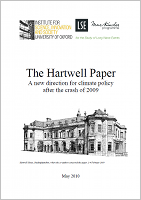
Calls for a radical re-framing of policies to deal with climate change are intuitively attractive — after all, current national and international policies don’t seem to be doing much to curb rising emissions. The latest effort comes from a group of developed world academics brought together by London School of Economics professor Gwyn Prins, and takes the form of The Hartwell Paper [PDF] — a document based on discussions held in February at the English country houseof the same name. It suggests ditching Kyoto and all its structures, and instead tackling climate change with policies that approach the problem more obliquely. The authors claim:

…it is not possible to have a ‘climate policy’ that has emissions reductions as the all encompassing goal. However, there are many other reasons why the decarbonisation of the global economy is highly desirable. Therefore, the Paper advocates a radical reframing – an inverting – of approach: accepting that decarbonisation will only be achieved successfully as a benefit contingent upon other goals which are politically attractive and relentlessly pragmatic.

Sounds reasonable enough at first reading, but my suspicions were roused when I read beyond the executive summary.


Prins et al derive the need for their new approach from what they describe as two watersheds that were crossed in late 2009: the failure of COP15 in Copenhagen to deliver on its promise of a global deal to follow Kyoto, and what they call “an accelerated erosion of public trust [in climate science] following the posting […] of more than a 1,000 emails from the University of East Anglia Climatic Research Unit” last November. Copenhagen clearly did not live up to expectations, and the UN-mediated policy process may well have lost impetus, but the authors go on to assert that the CRU email theft, and the subsequent press furore and investigations means that “the legitimacy of the institutions of climate policy and science are no longer assured”. That, it seems to me, is a very long bow to draw. To see the Hartwell take on the emails applauded by Steve McIntyre and that they approvingly reference Andrew (Bishop Hill) Montford’s book The Hockey Stick Illusion suggests to me that the authors are coming at the issue with their own set of preconceptions — a framing they want to impose on the issue. A look at the author list (Roger Pielke Jr, Nordhaus and Shellenburger from the US think tank The Breakthrough Institute, amongst others) hardly dispels that notion…

When they consider the underlying science, they are at pains to misrepresent what’s going on:

Climate change was brought to the attention of policy-makers by scientists. From the outset, these scientists also brought their preferred solutions to the table in US Congressional hearings and other policy forums, all bundled. The proposition that ‘science’ somehow dictated particular policy responses, encouraged – indeed instructed – those who found those particular strategies unattractive to argue about the science. So, a distinctive characteristic of the climate change debate has been of scientists claiming with the authority of their position that their results dictated particular policies; of policy makers claiming that their preferred choices were dictated by science, and both acting as if ‘science’ and ‘policy’ were simply and rigidly linked as if it were a matter of escaping from the path of an oncoming tornado.

If “the science” has been unhelpful, then this misrepresentation of the message is even more so. The basic message from “the science” is clear enough. There’s too much carbon in the atmosphere, and adding more is going to make life very uncomfortable — all life, not just human beings — in the not too far distant future. Did scientists really bundle this message with “particular policy responses”? Only if reducing carbon emissions can be considered a policy response — but that’s the very response Prins et al seems to want to dance around. Decarbonisation they can countenance, but not now, not quantified. They want to ignore the quantification of the size of the problem we face because it might be inconvenient:

We share the common view that it would be prudent to accelerate the historical trend of reducing the carbon intensity of our economies, which has been a by-product of innovation since the late eighteenth century. However, we do not recommend doing so by processes that injure economic growth, which we think – and the history of climate policy demonstrates – is politically impossible with informed democratic consent.

What if political impossibility is confronting the harsh impact of physical reality? The Hartwell Paper assumes that we have the luxury of time, that we can step away from the progress made over the last 20 years , and somehow recast international policy according to a wishlist of interventions that might (if we’re lucky) set us on the right path. They imply that we need not face reality now, that we should take the Capability Brown approach to a country house, up a winding path that yields carefully framed glimpses of our goal, rather than march straight towards a target defined by our understanding of physical reality.

There is some good analysis of The Hartwell Paper at the Economist (with nice Eno reference), and by Richard Black at the BBC. Both writers suggest that whatever the merit of the Paper’s recommendations, the authors cannot ignore where we are now. We may not want to start from where we are, but we have no choice. In a wider perspective, the Paper is arguing for a bottom up approach to carbon reductions, looking for the low hanging fruit — efficiencies, black carbon reduction — while the Kyoto approach is top-down, starting (with luck) from an informed appreciation of what we would do well to avoid. It seems obvious to me that we need both approaches, at a national as well as international level. Setting a 40% target for emissions reduction by 2020 is just as valid as mandating the use of low energy lightbulbs, or encouraging the adoption of electric vehicles.

Prins, Pielke Jr et al prefer to ignore what we really know about the climate system and the one-way nature of the changes we’re imposing on it (who can put a species back after it’s gone, or reconstruct a coal seam?), adopting instead a high-minded but ultimately wishy-washy stew of policies that look a lot more like sticking plasters than a remedy. And, being a cynic, I can’t resist asking the cui bono question… who might benefit most from the policy mix they propose? I leave the answer as an exercise for the reader.

[Jimmy Ruffin]

Offshore wind beats oil

As the US counts the cost of offshore oil drilling Janet Larsen of the Earth Policy Institute has sensibly respondedwith a reminder of the advantages of offshore wind energy. Offshore drilling has tempered the rapid decline in US oil production which peaked in the early 1970s. But only somewhat and with increasing difficulty and apparently at a level of risk greater than credited until now.

We should leave oil before it leaves us” was the advice of Fatih Birol, chief economist at the International Energy Agency.  Larsen points out that it’s not as if there aren’t other options. One is expanded public transport and better space for bicycles and pedestrians. That’s not an insignificant contribution to lowered use, though it’s not one that has any appeal for our Minister of Transport who is intent on starving public transport in favour of roadbuilding over the next few years. A second is the electrification of vehicles and powering them through renewable energy sources. Larsen points to the US Pacific Northwest National Laboratory estimates that the current electrical infrastructure could power over 80 percent of the US car fleet, relying largely on off-peak electricity as cars are charged at night. She notes that upgrading to a stronger, smarter, and interconnected national grid that taps into the country’s enormous wind, solar, and geothermal resources completes the transition. Here in New Zealand the positive possibilities of powering our entire car fleet from renewable energy sources have been canvassed with similar optimism.

Wind-sourced electricity has the potential to work particularly effectively in powering vehicles. The Edison pilot project in Denmark will aim at showing how:

“The basic idea is to charge the vehicles at night when the wind continues to blow, but when there is low demand for electricity. During the day, each vehicle will become a mobile electricity storage unit that can be plugged back in after the morning commute, potentially supplying energy back to the grid during times of peak demand, thus smoothing out energy distribution woes.

“Electricity charging stations powered by wind turbines will be installed in private homes as well as in corporate and public parking lots. Both fast-charging stations as well as battery swapping alternatives will be explored by the project.”

Back to Larsen’s article. A recent study published in the Proceedings of the National Academy of Sciences finds that the world’s top carbon emitters have enough wind energy potential to meet their current electricity needs many times over. When land-based sites are included, the total US potential from wind is estimated at 22 times current electricity use. For China the wind resource potential is 15 times greater than the country’s current electricity consumption, and for Russia, it is a staggering 170 times higher.

Offshore wind alone, Larsen points out, has the potential in the US to provide four times the nation’s current electricity use.  Looking at only the offshore potential she provides a graph of the ten top CO2 emitting countries.

To date most of the offshore production has been in Europe, but China and Japan have begun developing offshore farms and it seems possible that the US will soon join them. The recent approval of the Cape Wind project off the coast of Massachusetts and other proposals under consideration point in that direction.

Wind energy is still much disputed, including here in New Zealand.  This statement from the Wind Energy Association was issued in March in reply to what it saw as the failure of the Institute of Professional Engineers to understand the potential wind power offers. But for all the naysayers the industry is growing rapidly in many countries, including the US and China.

I liked Janet Larsen’s final paragraph:

“Unlike oil, wind is widely-distributed and clean; it does not spill or disrupt climate. It is also becoming increasingly cheap. With wind, we have a well that will not run dry.”

Tell that to Gerry Brownlee as we offer extended tax breaks for offshore oil exploration in New Zealand.

Eaarth

Eaarth: Making a Life on a Tough New Planet

“The momentum of the heating, and the momentum of the economy that powers it, can’t be turned off quickly enough to prevent hideous damage. But we will keep fighting, in the hope that we can limit that damage.”

Bill McKibben’s words occur on the final page of his newly published book Eaarth: Making a Life on a Tough New Planet. The misspelling indicates a planet still recognisable but fundamentally changed. A planet that he first warned about over twenty years ago in his earlier book, The End of Nature.

McKibben is an activist as well as a writer. He led the 350.org campaign last year. 350 parts per million is the level James Hansen and other scientists consider the upper limit of a safe level of carbon dioxide in the atmosphere. McKibben’s team adopted that figure to spearhead their internet-based campaign which saw public actions in many parts of the world in the lead-up to the Copenhagen conference. Nothing happened at that conference to suggest that the world is about to take the necessary steps to avoid dangerous climate change. Eaarth recognises that we are heading to a world different from that in which civilisation has developed.

It won’t be a better world. We can expect a planet “with melting poles and dying forests and a heaving, corrosive sea, raked by winds, strafed by storms, scorched by heat.” McKibben considers the process well under way. He says we may, if we’re very lucky and very committed, eventually get atmospheric carbon dioxide back down to 350 parts per million, but great damage will have been done along the way, on land and in the sea. There’s no longer any escaping that. He’s unrelenting as he lists why. Disparate data points such as the higher susceptibility of Chinook salmon to parasites, or the advancing ocean at a beach in North Carolina, or the more flourishing growth of ragweed, are part of the picture. So are the numerous stories of poor people who are grappling with new uncertainties in the seasons and rains that can no longer be counted on. But the rapid changes in huge physical features are the most telling. They are completely unprecedented in the ten thousand years of human civilisation. Here he includes the melting Arctic ice cap, the loss of Greenland ice, the acidifying and rising oceans, the more powerful hurricanes, the melting inland glaciers of the Andes and the Himalayas, the drying rainforest of the Amazon, the dying boreal forests of North America. They are big trends; once they get rolling we can’t stop them.

The growth paradigm won’t help, sympathetic though McKibben is to green growth advocates like Friedman and Gore. He realises this is “a dark thing to say, and un-American” but proceeds to make his case. Infrastructure, already neglected, is imposing steadily rising costs. Recovery from flooding is enormously expensive. Insurance costs are climbing. Endless expansion spells all kinds of trouble, including wars over climate change-affected resources. He looks back to the book Limits to Growth commissioned in 1972 by the small group of European industrialists and scientists known as the Club of Rome. The book was translated into 30 languages and sold 30 million copies. But it was before its time. He quotes from a 2002 ad from Exxon Mobil: “In 1972, the Club of Rome published ‘Limits to Growth,’ questioning the sustainability of economic and population growth….The Club of Rome was wrong.” Not wrong, McKibben rejoins, just ahead of the curve. “You can ignore environmental problems for a long time, but when they catch up to you, they catch up fast.” Basically, he says, the book was right. “You grow too large, and then you run out of oil and the Arctic melts.”

Scientists have not exaggerated our environmental woes; they’re more likely to have understated them. We are in deep trouble. The question is how to survive what is coming at us. McKibben proposes words to help us think usefully about the future. Durable, sturdy, stable, hardy, robust. “Squat, solid, stout words.” The racehorse, fleet and showy, has to become the workhorse, dependable and long-lasting. In place of expansion and growth we need maintenance and repair. The transition from a system that demands growth to one that can live without it. In this context he speaks of dispersing resources, of tilting back from heavy centralisation towards lower levels of government and smaller societies. On a tougher planet community needs to come back into its own. “We are going to need to split up, at least a little, if we’re going to avoid being subdued by the forces we’ve unleashed.”

He pursues this theme into the essentials of our future: food, energy, and the internet. Industrially farmed monocultures may produce impressive results to begin with, but their success is outweighed by the productivity of small farms. He disagrees with those who claim that only industrial farming can provide the food the growing population will need. Even World Bank economists now accept that redistribution of land to small farmers would lead to greater overall productivity. The US Department of Agriculture reports that according to its latest census smaller farms produce more food per acre, whether measured in tons, calories or dollars. New information, new science and new technologies are further assisting this productivity. He instances a large organic farm in upstate New York: “…we substitute observation, management, planning, and education for purchased inputs.” Resilience is the word McKibben uses to describe smaller scale farming, such as the resilience “which comes with three dozen different crops in one field, not a vast ocean of corn or soybeans”. He is, of course, an advocate of the consumption of locally produced food wherever possible.

He’s also an advocate of the local and dispersed when it comes to energy production. Energy conservation is the first. step. After that, he considers that the potential of locally produced energy via wind turbines and solar panels and biomass is underestimated. He quotes one study which showed that half of all American states could meet their energy needs entirely within their borders, and most could meet a significant percentage.

The internet looks the odd man out in this localising process. In some respects it is. It ensures that we are never stifled by the local or out of touch with the major information sources we need. But it is decentralised, and also it can be used for local purposes, for which use he offers several examples. It was crucial in the 350.org campaign which mobilised the localised demonstrations last year.

McKibben writes with great verve. His book is packed with real life stories and illustrations. There is nothing stolid about his presentation. Indeed the vigour and aptness of his prose can sometimes have the reader temporarily forgetting the utter seriousness of the situation he confronts. But he means it when he says: “The Holocene is staggered, the only world that humans have known is suddenly reeling.” The hunkering down process he urges is presented not as a preference but as a necessity if we are to avoid the threat of total collapse in the hard times ahead.

There is urgency in McKibben’s writing, but he doesn’t clobber the reader. His book is reasonable and engaging, an invitation to discussion and consideration. It merits both, as a serious contribution to the most fundamental issue of our time.