
Sunday Times apologises for “Amazongate” misinformation

Three months after Simon Lewis laid a complaint with the UK’s Press Complaints Commission, which I reported here, the Sunday Timeshas retracted Jonathan Leake’s disgraceful Amazongate article and apologised to Dr Lewis. The article has been removed from their website. Here’s the apology:

The article “UN climate panel shamed by bogus rainforest claim” (News, Jan 31) stated that the 2007 Intergovernmental Panel on Climate Change (IPCC) report had included an “unsubstantiated claim” that up to 40% of the Amazon rainforest could be sensitive to future changes in rainfall. The IPCC had referenced the claim to a report prepared for WWF by Andrew Rowell and Peter Moore, whom the article described as “green campaigners” with “little scientific expertise.” The article also stated that the authors’ research had been based on a scientific paper that dealt with the impact of human activity rather than climate change.


In fact, the IPCC’s Amazon statement is supported by peer-reviewed scientific evidence. In the case of the WWF report, the figure had, in error, not been referenced, but was based on research by the respected Amazon Environmental Research Institute (IPAM) which did relate to the impact of climate change. We also understand and accept that Mr Rowell is an experienced environmental journalist and that Dr Moore is an expert in forest management, and apologise for any suggestion to the contrary.

The article also quoted criticism of the IPCC’s use of the WWF report by Dr Simon Lewis, a Royal Society research fellow at the University of Leeds and leading specialist in tropical forest ecology. We accept that, in his quoted remarks, Dr Lewis was making the general point that both the IPCC and WWF should have cited the appropriate peer-reviewed scientific research literature. As he made clear to us at the time, including by sending us some of the research literature, Dr Lewis does not dispute the scientific basis for both the IPCC and the WWF reports’ statements on the potential vulnerability of the Amazon rainforest to droughts caused by climate change.

In addition, the article stated that Dr Lewis’ concern at the IPCC’s use of reports by environmental campaign groups related to the prospect of those reports being biased in their conclusions. We accept that Dr Lewis holds no such view – rather, he was concerned that the use of non-peer-reviewed sources risks creating the perception of bias and unnecessary controversy, which is unhelpful in advancing the public’s understanding of the science of climate change. A version of our article that had been checked with Dr Lewis underwent significant late editing and so did not give a fair or accurate account of his views on these points. We apologise for this.

Leake’s article was not only celebrated ad nauseam in the denialist community but also taken up by mainstream media in many countries.  Here in New Zealand the Dominion Post used it in an editorial claiming that the ethics and integrity of climate scientists is being called into question. I wrote about that here. The editorial accepted that human activity is contributing to global warming, but drew this appalling conclusion about the IPCC:

“Why trust a panel that confuses opinion and fact, wrongly attributes that opinion, tries to shout down critics and displays a determination to make the facts fit the theory rather than the other way around.

“The IPCC should leave the spin to the politicians and get on with its real job – establishing the facts. By glossing over inconvenient truths and misrepresenting opinion as scientific fact, it has undermined its credibility.

“It now has a great deal of work to do if it is to persuade peoples and governments that its findings should be taken seriously.”

Jonathan Leake and the Sunday Times have a lot to answer for, but so do journalists in many places who allow themselves to be so easily misinformed. The credulity with which they have received accusations of malpractice by the East Anglia scientists, and alleged IPCC errors (beyond the acknowledged and regretted error relating to the Himalayan glaciers) is astonishing. Where on earth did the Dominion Post find the confidence to make such a declaration about the IPCC?  Not by reading the science, that’s for sure.  And that’s the nub of the matter: the media generally gives the impression that it has not ensured that enough of its journalists are informed about climate science. That’s why the mischief wrought by disinformers, especially when they’re backed by seemingly reputable papers, can reach global media proportions overnight.

Perhaps any of our readers who see the Dominion Post might consider writing to the editor and inviting them to retract their editorial, or at least to write another acknowledging that they have reason to reconsider their verdict on the IPCC.

The Sunday Times correction has been published on their website here, but be warned that you have to go through a full registration procedure to view it.
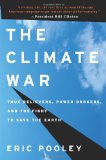
The Climate War

The climate change rhetoric when Obama came to power was exciting. It sounded as if he would lead from the front and the US would soon have a federal cap-and-trade system. “Delay is not longer an option. Denial is no longer an acceptable response.”  Certainly we have seen an end to denial from the White House. But we are still waiting for an end to delay, and increasingly it looks as if we’ll be waiting for a long time. Why?

Eric Pooley’s book The Climate War: True Believers, Power Brokers, and the Fight to Save the Earth sheds a good deal of light on why it is that America, in spite of all the scientific evidence that demonstrates the threatening reality of climate change, is still unable, and often unwilling, to mobilise itself to address the danger.
The author is an accomplished journalist who has spent hundreds of hours over the past three years interviewing some of the players in America’s painfully slow progress towards climate change legislation.  The result is an illuminating story of battles in an ongoing war which is far from conclusion. It’s told painstakingly but with a narrative verve that carries the reader along irresistibly through its mass of detailed accounts. It’s compelling reading, from which I’ll mention just a few examples.

The Environmental Defense Fund (EDF) is the climate change group to which Pooley devotes most of his attention. A large organisation which has been at work for over 40 years, the EDF has long argued for a cap and trade system to tackle CO2 emissions. Its president, Fred Krupp, is focused on partnership with business to bring about political action on climate change and was influential in the formation of the US Climate Action Partnership (USCAP) in 2007, initially a group of ten companies and four environmental groups. Among them was Jim Rogers, CEO of Duke Energy. In typically detailed fashion Pooley recreates the drama of meetings at which were hammered out the conditions on which Rogers felt he could join the Call for Action USCAP planned to issue. It hinged on whether allowance was made for initial free distribution of allowances to utilities like Duke, a sticking point for Rogers.

USCAP may have been looked at askance by many Green groups, but Roger’s involvement didn’t go down well with his colleagues at the Edison Electric Institute either. He was chairman at the time and several CEOs called for him to step down. At the Heartland Institute denier’s convention in 2008 Steven Milloy bitterly expressed his dismay that CEOs would endorse a mandatory cap. “What do you do when the people who represent business and free enterprise have switched sides on you?”

As the Waxman-Hartley bill was developing, the question of emission allowances being free or auctioned remained vexed. Krupp was willing to give way to the companies, maintaining that it didn’t matter. The only thing that mattered was how many allowances were distributed in a given year and how quickly the number was ratcheted down. The declining cap would see to it that coal use declined.

After his close coverage of the tortuous development of the bill, Pooley concludes:

“Of course Waxman-Markey was full of flaws, compromises, and reluctant nods to political reality.  But the bill got right a lot more than it got wrong.  By giving carbon allowances to electric distribution companies and requiring them to pass the value on to customers, it used the cap and trade mechanism to address to genuine cost imbalances between regions of the US – making the system fairer and helping the very heartland people who most wanted to see the whole thing wither and die.”

Pooley recognises that the intransigence of the Republicans meant that the bill reflected negotiations only between the left and right wings of the Democratic party, not between the left and right wings of America. “Like a wounded animal, the GOP’s only reflex was to lash out. Anything Obama was for, they would be against.”  It’s a sad commentary on a party which has too often allowed itself to be informed on global warming by the organised denial movement which Pooley also takes into his purview.

Al Gore features frequently in the book. His Alliance for Climate Protection organization aimed to spend $100 million a year for three years on advertising campaigns. In July 2008 his Repower America speech challenged the nation to commit to clean energy within ten years. After the elections he sought to orchestrate a large, loud chorus of voices calling on the president-elect and the new Congress to go big and go quickly on the energy front. Some wanted an energy bill first and to leave cap-and-trade for later. Gore disagreed. “If we’re going to have a fight on climate, let’s have a big fight.”

James Hansen enters the picture from time to time.  He met with Rogers over a meal. Pooley records each man’s feeling as they left the restaurant. Rogers felt positive: I’m not a confrontational guy, and neither is he. Hansen felt disappointed: This man has a reputation for being green, but he doesn’t really know what it means. His priority is making money.

Pooley records at best mixed messages from the White House. On a good day Larry Summers told USCAP leaders that the stimulus bill needed to be complemented with a cap-and-trade mechanism. “It’s like two blades of a scissors…We need both of them.”  But when it came to the Waxman-Markey bill, chief of staff Rahm Emanuel and senior adviser David Axelrod wanted to stick to the clean energy message and leave climate policy to Waxman. Pooley tells of the committed greens in the White House being defeated time and again by those in the political and economic teams who consider voters don’t care about climate action enough for the president to fight for it. The president who we expected to lead on the issue remains strangely constrained.

Obama went to Copenhagen having failed to move a climate bill. Pooley credits him with an honest, even heroic, attempt there to break the deadlock by bringing the major developing nations to the climate table. His speech offered welcome straight talk on the science, though little on the necessary action to address it. But the possibility of a triumph at Copenhagen had already been ruled out by his decision at home not to mount an education campaign on climate science and clean energy jobs to counter the sceptics, and the failure to put a top-level aide in charge of the international climate issue.

Pooley ends with questions:

“Alexis de Tocqueville long ago said that in the US, events ‘can move from the impossible to the inevitable without ever stopping at the probable.’  Was that still true?  How bad did things need to get before the moment came?  Would the prospect of a clean energy economy, and the jobs it would bring, mobilize enough people to make a difference?  Or would some sort of monstrous, galvanic weather event – epic heat and drought, Katrina on steroids – be needed to shake America fully awake?”

They seem to me open questions.  After following through the labyrinthine processes the author describes by which anything happens, if it happens, in the American political system and recognising the blinkered self-interest and sometimes sheer malevolence that seems to motivate many of the players, I found it hard to credit that America is on the verge of significant progress.  But I took what comfort I could from Pooley’s final brief paragraph where he imagines that the campaigners refused to be paralysed by the questions posed, “splashed some cold water on their faces, ran their fingers through their hair, threw back their shoulders and marched toward the sound of the guns”.

[Buy at Fishpond (NZ), Amazon.com, Book Depository (UK)]

Still talkin’ (open thread #2)

Here’s another open thread, for discussion of anything not covered in recent posts. In response to a few requests, I have ditched the Intense Debate comment service, and reverted to the WordPress built-in system. I’ve installed a couple of plug-ins to allow comment editing and rating (which caused some weirdness with the blog theme and a late night for me until I worked out a temporary fix). I’ve also switched off comment nesting/threading, so your comments will appear in the order they’re posted. If you’re replying to a particular comment, please use the comment number or link to it (the link is under the number). As before, you’ll need to register and log-in to make a comment. If anyone has any problems with their log-ins contact me (gareth@ the site domain) and I’ll see what can be done.

A note on the comment rating scheme: four positive votes or three negative votes, or more than eight votes in total will give comments distinctive styles. Please try it out — I want to see what they look like! I could change this to make unpopular comments invisible, but only with tweaking. Let me know if it’s something you really want. Feedback on other aspects of the blog would also be welcome.

The King will come

Sir David King, former chief scientific adviser to the UK government, has not retired into quiet obscurity since leaving that position. He co-authored the book The Hot Topic (reviewed here) in 2008 and works as director of the Smith School of Enterprise and the Environment at Oxford, which addresses the major environmental threats and opportunities facing the world. He’s written two articles in recent days which seemed to me worthy of mention. Yesterday in New Scientisthe urged readers not to despair despite the apparent lack of progress at the recent Bonn talks.

He acknowledges that there’s reason for gloom at the failure of December’s Copenhagen summit to come up with a successor to Kyoto — failure which he puts down to a combination of serious organisational issues and glaring, often naïve, political errors. He describes the end result as “the victory of unambitious realpolitik over correct, but wishful, thinking.” But some positives resulted.

First,  climate change now has the full attention of the world. “The anger of poorer nations is a powerful and lucid expression of their full appreciation of the scale of the problem.” Second, we realise that a single collective leap won’t bring a successor to Kyoto. Third, we now have global agreement to avoid a dangerous 2 degree temperature rise and deforestation is now part of agreements.

However, the main reason for his optimism is that he sees alternative ways to regulate carbon through national and regional commitments to emissions trading.

He points to the European Union whose Emission Trading System is the largest of its kind in the world. If the US introduces its own version, Mexico’s president is keen to join and wants to see Canada sign up too, forming a North American trading group. Another emissions trading market may emerge among the Association of Southeast Asian Nations.

Harmonising such parallel markets would be a challenge, especially for international trade policy, but co-ordinating across a small number of commodity markets is likely to be easier than across a large number of sovereign states. There is the issue of regional schemes initially leading to industries in different parts of the world paying different prices for emitting carbon and thus giving an advantage to manufacturers in regions where the price of polluting is low. King’s reply is that high-price countries would impose tariffs on imports from low-price regions to level things up. He has said elsewhere that if this causes trouble with the WTO it also presents an opportunity for the WTO to step in and “persuade nations to get their act together”.

He is sceptical about attempts to create multibillion-dollar funds to help poorer nations adapt to climate change, since he’s not sure that the pledges of the developed world are credible. A better approach in his view would be to extend existing trading schemes to these nations.

“This would encourage them to develop lower-carbon economies and generate income through taxes on high-carbon imports. It would also unify emissions trading, overtaking troubled efforts to devise a global trading scheme with a single carbon dioxide price. Regardless of the details of the mechanism, it is plain that one of the central challenges for climate policy is to find a credible way to meet the concerns of the poorest countries while offering the right development incentives.”

Add to these factors the increasing confidence of the growing economies of Brazil, Russia, India and China, and King sees hope ahead by the time of the meeting in Rio de Janeiro, Brazil, in 2012, the 20th anniversary of the Earth Summit in the same city that started the Kyoto process.

“We are all custodians of a global commons, and we have moral responsibility to future generations to curb our greenhouse emissions. I am optimistic that Rio can deliver.”

On Sunday, King wrote in the Observer about the different but closely related question of oil supply and demand, under the heading We must abandon oil before it’s too late. In the context of the Gulf of Mexico oil disaster he presses the point that demand for oil may outstrip supply sooner than people realise. Analysis undertaken at Oxford suggests that the IEA is overestimating the reserves in fields yet to be developed by some 30%. He expects oil prices to rise very considerably soon to be more than $100 a barrel, peaking at $130 a barrel by 2015.

The effect of this on importing countries will be harsh, especially on developing countries.  King is scientific adviser to the Rwandan president, Paul Kagame, and has recommended that the country do all it can to decouple its currently rapidly growing economy from oil.

Kicking the oil habit is increasingly necessary for economic reasons, but when added to the imperative to reduce carbon emissions and prevent dangerous climate change he considers the case for change is overwhelming.

He briefly sketches the kind of measures that will need to be taken. The efficiency of transport will need to be increased by reducing air friction, improving engines and running smaller, lighter vehicles. Alternative fuels will be important, moving from petrol to new generations of biofuels, hydrogen fuel cells and electric vehicles. We will also need to go beyond the designs of the vehicles and fuels and look at changing urban design, at building and improving mass transportation systems, and changing the ways that people drive.

His organisation is holding a World Forum on Enterprise and the Environment between 27-29 June in Oxford on the theme of low carbon mobility. There’s an interesting short video clip launching the forum here.

[Wishbone Ash]

Terry keeps his clips on

As predicted, New Zealand’s tame band of climate cranks have waxed all pompous and upset about Sir Peter Gluckman’s perceptive comments on climate change denial. But I was wrong about one thing. Instead of Barry Brill stepping up to the plate, it’s the grand dame of NZ denial, Terry Dunleavy, “honorary secretary and webmaster”and co-founder of the NZ Climate “Science” Coalition who does the honours.

Terry’s piece is nothing new. Certainly nothing newsworthy. But I can’t resist quoting Richard Treadgold on the subject, because it made my day. Under the heading PM’s Chief Science Adviser must change — or go, Treadgold reproduces Dunleavy’s thoughts verbatim. But he can’t resist adding a final thought of his own:

I would suggest that our highly respected Sir Pete ought to acquaint himself with some real climate science if he wants to be taken seriously by the scientists in the NZCSC.

Gave me the best laugh of the day… “Sir Pete” is, I imagine, rather uninterested in what scientists of the calibre of — who, Vince Gray? — think of him. And the scientists in the C”S”C would do well to try to be taken seriously by — well, anyone, really…

[Former greatest living Englishman Viv Stanshall]