
Which is the greater crime?

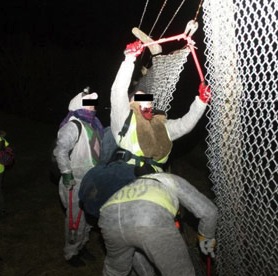
Alice Bows’ testimony evidently wasn’t enough to persuade the Aberdeen jury to acquit the nine Plane Stupid protestors accused of breaching the peace by their brief occupation of Aberdeen airport last year. A majority verdict yesterday declared them guilty, and the Guardian reports that they are likely to face heavy fines or jail terms.

Those undertaking acts of civil disobedience do not normally expect to escape legal consequences. One of the defendants, Don Glass, 25, of Glasgow, said afterwards he was not surprised to be found guilty. However he pointed out that the trial had served a useful purpose:

“ We were in the self-titled oil capital of Europe and to get climate change in front of a jury is an achievement in itself. To get one of the top sheriffs in Aberdeen to say let’s not dispute that climate change is man-made is an achievement.

“Two weeks talking about the important civil disobedience and protest and freedom of expression in the face of runaway climate change is an achievement. We now know the importance of non-violent direct action in the fact of inaction from the courts.”

What he meant by inaction from the courts is probably indicated by the comments of another protestor, Tilly Gifford, 24, from Glasgow:

“We set out to show in court that policies such as the aviation white paper contradict what the science demands. Now that the court has heard expert witnesses testify to the imperative need to cut emissions, they are mandated to prosecute the real criminals, the corporations who are profiting from polluting.”

There appears to be no legal structure to enable charges against corporations and feet-dragging governments with crimes against future generations and probably against existing populations in some parts of the world.  But the claim that acts of non-violent civil disobedience have legal excuse  because they aim to prevent a higher crime against humanity through carbon emissions is an entirely reasonable defence to offer. If Don Glass’s declaration post-trial that climate protesters now have to step up their campaigns of civil disobedience proves to have substance, we will see more such trials and hear more such defences. Even when they fail they will surely keep the question alive in the public mind. I salute those who are prepared to do that. And lament that it should be necessary. In a rational world it would by now be the chief focus of government and business to work furiously to decarbonise our economies.

Arctic sea ice projections: 6 billion dead within a year (it really is grim up North)

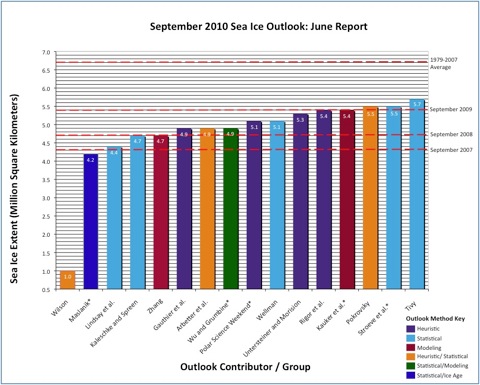
The first set of ARCUS/SEARCH projections for the September Arctic sea ice minimum have been released, and amid all the mundane statistical, heuristical, and modelistical musing there’s a remarkable effort — and I really do mean remarkable — by one Charles Wilson. Here’s the graphic showing all of the submitted forecasts. See if you can spot Mr Wilson’s offering:

ARCUS1006.jpg

Yes, that’s him on the left. He appears to have no affiliation to any academic institution, but he is not afraid to make a very definite projection. Download the full set of forecasts [pdf], and take a look. He expects a massive melt, leaving the Arctic Ocean more or less ice-free by September. That’s pretty scary, but here’s what he thinks this may bring for the northern hemisphere. Ocean current disruptions will bring 300mph winds to the northern hemisphere:

= Destruction of nearly ALL aboveground structures North of 10 Degrees Latitude = 99% Deaths in USA, Europe, etc. within 2 years. … In the Worst Case:
Immediate Action can create Clouds with: Airplane contrails, seawater mists, or high- altitude sulfur (e.g. heightening Smokestacks at Norilsk).
But it needs to be done in the next few Weeks – – – months before we can be sure an Early Melt WILL happen.

In a comment at µWatts he expands his point a little:

If the Great Melt Off happens = Warm Currents turn around = 300 mph Winds come February or so..
Currently I give it 15%
… times 6 Billion dead.

Now that’s what I call alarmist.

Continue reading “Arctic sea ice projections: 6 billion dead within a year (it really is grim up North)”

Defending the future: scientists take the stand

Perhaps serving as defence witnesses will prove a new opportunity for climate scientists to make the clear public statement that the confused processes of the media often muddy.  In 2008 James Hansen famously defended the UK protestors, the Kingsnorth Six, who were charged with criminal damage when they climbed to the top of the smokestack at Kingsnorth coal-fired power station in Kent. His role was to provide expert opinion about the dangers of climate change and the part played by coal as the fossil fuel most responsible for increasing CO2 levels. He was an hour and a half on the stand, much of the time given to explaining the consequences of continuing to increase the CO2in the atmosphere. The concluding paragraph of his written statement related his material to the trial:
Recognition of these basic facts by the defendants, realization that the facts were also known by the government, utility, and fossil fuel industry, and realization that the actions needed to protect life and property of the present and future generations were not being taken undoubtedly played a role in the decision of the defendants to act as they did.

The six were acquitted.

Now another climate scientist has given evidence for the defence in the trial of nine members of the Plane Stupid protest group facing breach of the peace charges for occupying Aberdeen airport and disrupting flights in March last year. They plead not guilty, on the grounds that their actions were justified as they assembled peacefully to prevent a greater crime to future generations through climate change. The vandalism charges they also faced have been dropped.

Alice Bows (pictured) from the Tyndall centre for climate change research is the climate scientist who has testified as an expert witness. Yesterday she said in court that the Scottish government’s climate change programme, which seeks to cut emissions by up to 40% by 2020 and 80% by 2050, was “welcome” but not enough. (Reports from Climate9 and the Guardian.)

“The UK Government’s Committee on Climate Change policy of 80% reduction in emissions by 2050 only gives us a 50:50 chance of avoiding dangerous climate change. You wouldn’t go to sleep in a house that had a 50:50 chance of burning down in the night, so we need even tougher targets. In fact we need a complete de-carbonisation of the economy in the next few decades. Because we need to tackle emissions right now, the actions of both governments and individuals are important.”

Bows added that the aviation industry was of particular concern.

“Condensation trails, or the white trails, are also causing climate warming. On a UK basis, air travel contributes 6% of carbon dioxide emissions. If you compare that to other sectors, it’s quite a significant contribution.”

There’s nothing new in what Bows, and Hansen before her, have to say.  But the theatre in which it is said means that it gains sustained public attention. The fact that scientists are willing to emerge from their world of research and speak in the defence of activists is also in itself a sign to the public of how important they hold their message to be.

In August 2008 Alice Bows and Kevin Andersen published a paper, Reframing the climate change challenge in light of post-2000 emission trends, in the Philosophical Transactions of the Royal Society.  The abstract opened with these sentences:

The 2007 Bali conference heard repeated calls for reductions in global greenhouse gas emissions of 50 per cent by 2050 to avoid exceeding the 2°C threshold. While such endpoint targets dominate the policy agenda, they do not, in isolation, have a scientific basis and are likely to lead to dangerously misguided policies.

It’s a fair bet that Bows’ court appearance has achieved more public notice than the carefully argued paper in the Royal Society publication. Not that the paper didn’t therefore matter, but it’s also crucially important that such messages are heard loudly and clearly by the lay public. The action of the Dundee Nine has enabled that as a bonus.

Incidentally, the judge is noted in the Climate9 report as having referred to a BBC radio report of the study discussed in the recent Hot Topic post demonstrating that 98% of climate scientists agree that climate change is anthropogenic.

Sceptics face yawning credibility gap

We know that the vast majority of climate scientists support the explanation of anthropogenic climate change set out by the Intergovernmental Panel of Climate Change. That majority is now quantified in the first study of its kind published yesterday in the Proceedings of the National Academy of Sciences, Expert credibility in climate change.
“Here, we use an extensive dataset of 1,372 climate researchers and their publication and citation data to show that (i) 97–98% of the climate researchers most actively publishing in the field support the tenets of anthropogenic climate change (ACC) outlined by the Intergovernmental Panel on Climate Change, and (ii) the relative climate expertise and scientific prominence of the researchers unconvinced of anthropogenic climate change are substantially below that of the convinced researchers.”

The study explains the criteria by which these conclusions were reached, paying particular attention to the question of expertise, where weight was given to the number of climate publications of researchers and to their citation levels.

“We show that the expertise and prominence, two integral components of overall expert credibility, of climate researchers convinced by the evidence of ACC vastly overshadows that of the climate change skeptics and contrarians. This divide is even starker when considering the top researchers in each group.”

The team of four has obviously put a good deal of time into the study which was contributed for publication by Stephen Schneider (pictured). Why bother, one might ask.  Surely it’s all too apparent. It may be to readers of Hot Topic but the study notes that considerable and even growing public doubt remains about the anthropogenic cause and the level of scientific agreement about the role of anthropogenic greenhouse gases in climate change. The vocal minority of researchers and other critics who contest the conclusions of the mainstream scientific assessment has received large amounts of media attention and wields significant influence in the societal debate about climate change impacts and policy.

An analysis such as the study offers has not been conducted before, and the writers observe that it can help inform future ACC discussions. Translated into common parlance I guess that means they hope this will put paid to the idea still abroad, in at least the American media, that denial of anthropogenic climate change retains a respectable level of scientific credibility.

That may be optimistic. Journalism in general still has difficulty getting its head around the reality of mainstream climate science. The idea that there is a realistic alternative shows remarkable persistence. When I was writing occasional columns for my local paper, the Waikato Times, I discovered that my attempts to explain aspects of the current science eventually came up against an anxiety that the paper was not presenting a balanced picture. There was finally talk of pairing my column with another which would meet the paper’s obligation to offer its readers more than one opinion. I protested that I was representing mainstream science and asked why the paper should feel that needed to be balanced. I made that my last contribution and escaped the indignity of a balancing viewpoint. It seemed fairly clear that the East Anglia emails and the baseless attacks on the IPCC report by the likes of Jonathan Leake were enough to unsettle the journalists with whom I was dealing and bring back to life concerns which I thought had long been laid to rest.

One nevertheless hopes that  surveys and appraisals such as this one in a highly regarded journal will make a difference to media perception and help establish in the public mind the seriousness of the scientific understanding and predictions. It seems inconceivable that we should continue much longer refusing to face the reality.  But I’ve been thinking that for four years now.

When the rain comes…

The extreme weather flavour of the moment is without doubt heavy rain and flooding. As I write, severe flooding has caused 132 deaths in southern China and 19 in Burma. The Var region in southern France is recovering from spectacular flash flooding that killed 25 people (watch the BBC video), Tennessee’s recovering from a 1000 year flood in May, and NZ hasn’t escaped. The Metservice blog reports that the flooding in Whakatane a few weeks ago was caused by rainfall of 89.8mm in one hour (with more heavy rain either side of that hour). As the blog notes, that’s tropical rain happening well outside the tropics. But what struck me at the time was a comment from a Whakatane resident included in the TV3 News coverage of that flooding. I can’t remember his precise words, but it was something along the lines of “should be a wake-up call for anyone who doesn’t think global warming’s an issue, because this is what global warming delivers…” Perceptive, I thought, because one of the more robust predictions of climate science is sometimes described as an intensification of the hydrological cycle.

Continue reading “When the rain comes…”