Climate Refugees

Climate Refugees

Eleven French journalists – writers and photographers of Collectif Argos – visited some of the people who live on the front line of climate change. Their report was first published in France in 2007, and the Massachusetts Institute of Technology has now published an English version: Climate Refugees. It invites reading. The written narratives are engaging and immediately informative. The related photographic sections are strikingly alive and stir the imagination. But it’s not lightly done -– the journalists spent time staying with the people whose lives they describe and there’s satisfying depth to the stories and the pictures.

Nine places were visited: Alaska and New Orleans in the US, the low-lying halligen on the North Sea coast of Germany, Lake Chad in Africa, the village of Longbaoshan near Beijing in China, Himalayan Nepal, the small town of Mushiganj in the south west corner of Bangladesh, the Maldives in the Indian Ocean and Tuvalu in the Pacific.

Shishmaref is a village of 600 people on the small island of Sarichef off the coast of Alaska in the Arctic Ocean. As their village slowly crumbles into the sea and the whole island moves towards becoming inhabitable by 2050 the issue is not whether they will have to relocate. It’s where they will go. On offer is a move to towns 200 miles away to take advantage of the urban infrastructure. But the Shishmaref Inupiaq are convinced that relocating to a city would be tantamount to “burying their culture, soul, uniqueness and future”. What many would prefer is to recreate the village on a mainland site only 12 miles away. But it would be double the cost – $200 million as against $100 million – and the fear is that the state will not pay the extra.

The village of Longbaoshan, just 38 kilometres north-west of the Beijing suburbs, is not falling into the sea but being slowly buried by advancing sand. Only 700 people now remain. In recent years 200 have already left for the capital.

“My fields are nothing but stones and sand, sand and stones. Where’s the soil? Where’s the rain? The sky is my only hope, the only way we are able to eat. After the big storm in the spring of 2000, my son had to leave. He became a cook at a restaurant in a Beijing suburb. We don’t see him any more.”

The journalists went to the city to track down a couple who made the move, leaving their young son with his grandfather. They found them working very long hours and living in a nine-square-metre single room.

Around the town of Mushiganj in Bangladesh it’s too much water which is driving people away from their homes. Bangladeshis are accustomed to flooding and have learned to use it to their benefit. But global warming has added a scope and duration to floods which are destroying that balance. In the area the journalists visited the salinity of the soil has increased and crops have been replaced by shrimp farms, which bring far fewer jobs than rice paddies. Drinking water has to be fetched in exhausting trips. The nearby mangrove forests of the Sundarbans offer some fishing and other resources but are infested with pirates and are the refuge of the dangerous Bengal tiger. So for many it’s Dhaka for employment and income, albeit in demanding and exhausting work such as rickshaw driving.

The climate change pressures on Bangladesh will only increase and Dhaka will simply be unable to absorb the large-scale rural exodus anticipated. Where will people go? The journalists spoke with a geography professor who rules out neighbouring India and Myanmar as destinations for political and climate change reasons. He looks for cooperation outside southern Asia in preparing for the massive migrations anticipated.

“I think that countries with larger land areas will have to change their immigration policies. If we believe climate change is a global problem. then we must look for global solutions. Trying to solve it at national level is a mistake.”

Another researcher put it this way:

“For a long time now, I’ve been proposing the following solution. Each country must take responsibility for – in other words transport and accommodate – a quota of climate refugees proportional to its past and present greenhouse gas emissions.”

The water problem in Lake Chad is quite a different one. The lake is disappearing and taking life with it. Over the past 40 years it has lost 90% of its area, shrinking from 25,000 to 2500 square kilometres. A UNESCO statement describes the gradual drying up of the lake as the most spectacular example of the effects of climate change in tropical Africa, attributing it to low amounts of rainfall, evapotranspiration from high temperatures and a series of severe droughts. The effects on the surrounding populations are harsh. “God needs to send us a miracle because there’s too much suffering involved in living on the lake.”

When the journalists began their stay in Tuvalu they record that they couldn’t help feeling some irritation at what they saw as the carefree attitude and love of the easy life of the Tuvaluans. However further acquaintance revealed a pragmatic people fully aware of their inevitable fate and wanting to do everything in their power to stay on their land as long as possible, though involved in a global struggle to negotiate their relocation under optimal conditions. The Chief of Staff at the Ministry of Foreign Affairs:

“We asked the governments of Australia and New Zealand to acknowledge the concept of climate refugees.  They refused, saying that, according to international law, refugees can only be people subject to persecution or political, ideological, ethnic or religious pressure – a narrow definition that suits them just fine.”

The journalists, however, wonder whether, based on current scientific knowledge, the existence of climate refugees may give rise to the concept of ‘environmental persecution’ of the most vulnerable populations by the major greenhouse-gas emitters. This could be, they suggest, the beginning of climate justice in which the biggest polluters per inhabitant would not be able to turn away Tuvaluans forced to flee their land.

The Maldives face a similar prospect to the Tuvaluans. The valley residents of Nepal are seriously threatened by growing number of glacial lakes high above them that are becoming engorged with water from receding glaciers and may explode in outburst floods. Many former residents of New Orleans have been relocated in Houston and elsewhere in the US. The sparse population of the halligen in the meantime have a great deal of government money spent on keeping them in their threatened enironment because protecting the halligen means helping protect the mainland.

What is the rest of the world going to do if under the pressures of climate change it becomes apparent that large numbers of people must move from where they now live and work?  The book puts that question squarely in front of us. Some of the migration will be within national borders. That will be demanding enough. But some will have to be beyond those borders. Will the rich nations face up to the responsibility they have incurred?  Will ethical imperatives survive the crunch times ahead?  It would be a hard heart which looked at the photographs in this book and didn’t hope so.

[Buy via Fishpond (NZ), Amazon.com, Book Depository (UK)]

Don’t watch that, watch this!

If you’ve got any interest at all in the state of the Arctic Sea Ice, resist the temptation to watch the World Cup, or the start of the All Black’s winter season, and take a look at David Barber’s talk at the International Polar Year’s Oslo Science Conference. Go to the “Web TV” page, then scroll through the videos on offer until you see Barber’s talk — On Thin Ice: The Arctic and Climate Change (or use the direct link). Barber’s a good lecturer — he gave yesterday’s (Friday) morning plenary talk at the conference — and he delivers a fascinating overview of his work on the Circumpolar Flaw Project, one of the biggest components of the 2007-8 IPY. Most interesting of all is his description of the state of the sea ice last autumn, as the icebreaker Amundsen went in search of multi-year ice in the Beaufort Sea. He gives a graphic description (involving pyjamas) of the ice breaker discovering that what the Canadian Ice Service maps were suggesting was thick multi-year ice was nothing of the sort — the Amundsen was making a comfortable 13 knots through it, not far short of its top speed of 13.7 knots. That section of his talk starts at about 20 minutes in (by the timer on the player), but it’s worth watching the whole thing. The press release for Barber’s talk is here.

Continue reading “Don’t watch that, watch this!”

The bad news, and the good

Naomi Oreskes and Erik Conway have an interesting article in Yale Environment developing ideas from their book Merchants of Doubt. Some of it summarises the findings of the book concerning the organised campaigns of denial of science, but there are some new expressions of anxiety which are deserving of notice.
They draw attention to the fostering of a public image of climate science as a criminal conspiracy by a group called Cooler Heads Coalition, a creation of the Washington-based Competitive Enterprise Institute (CEI). The CEI itself has accused NASA, the largest funder of climate science, of faking important climate data sets. And earlier this year Senator James Inhofe of Oklahoma, whose positions are frequently cited and promoted by CEI, called for a criminal investigation of 17 climate scientists from a variety of institutions for allegedly falsifying or distorting data used in taxpayer-funded research.
Continue reading “The bad news, and the good”

It’s grim up North #2

GreenlandIllulisatcrop.jpg

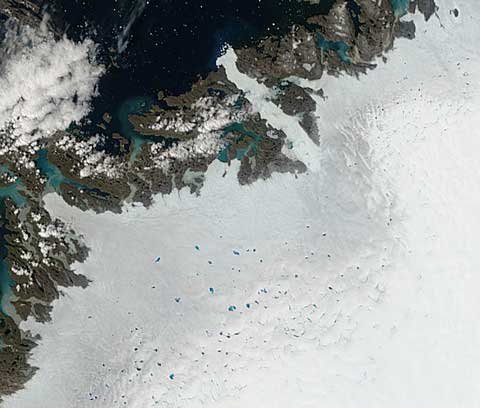
From NASA’s eyes in the sky, this is a view of the west coast of Greenland downloaded earlier today, looking down on the Ilulissat Icefjord — the outlet for the Jakobshavn Isbrae, the biggest outlet glacier in Greenland and the largest in the northern hemisphere. It’s the long tongue of white reaching up from right of centre to the top of the frame, where you can see the white dots of newly calved icebergs drifting out into Disko Bay (click on the picture to see the 250m/pixel original image at the MODIS site). All very interesting, of course, but I’m posting it to show the numerous large lakes of glacial meltwater that have appeared on top of the ice sheet over recent weeks. At the edge of the ice sheet, the winter snow has melted revealing the greyer ice underneath, but as you climb up the ice away from the coast you get back up into unmelted snow (bottom right). And there are lakes like this a very long way up the west coast, all primed to deliver their water down through moulins to the base of the sheet and thence out to sea, or over the surface in glacial rivers.

I hope this illustrates that there’s more to a melting Arctic than the sea ice — the rest of this post is catching up with sea ice news…

Continue reading “It’s grim up North #2”

Gluckman: climate denial undermines all science

NZ PM John Key’s Chief Science Advisor, Professor Sir Peter Gluckman, tackled denialism head on in a lecture at Victoria University of Wellington’s Institute of Policy Studies last night. Titled Integrity in Science: Implications from and for the Climate Change Debate [pdfof full text], it’s an interesting and worthwhile overview of the issue from someone steeped in the science. Gluckman’s thesis is that the tactics of those who deny climate change — for whatever reason (he defines three) — are undermining all science:

…in an electronically connected world the tactics of those who reject the consensus, whatever their motives, can undermine confidence in the entire science system. In a world that is increasingly dependent on science in many domains, I cannot regard it as helpful to actively promote distrust and suspicion of the scientific process for political ends.


Gluckman begins by discussing the nature of science and true scepticism, then moves on to define the climate debate thus:

At the heart of the climate change issue are three questions:

  • What is the rate of change in global temperature and what will be its local effects?
  • What is the level of certainty about these predictions and the assumptions made in reaching these predictions?
  • What is the nature of response that the world community must make?

The bulk of climate science and indeed the IPCC consensus approach has been an effort to deal with the first two questions.

Finding answers to the third question is the hard bit, because that’s where what science tells us feeds into policy decisions, and special interests and ideologies come into play. Gluckman defines three groups opposed to action on climate change:

…a small group of scientists who sustain a contrary view for a variety of reasons, some scientific and some not, those who have a vested interest in promoting denial and those who for a variety of reasons, largely philosophical, will reject the evidence.

One philosophy he considers in some more detail:

In particular, many with a libertarian ideology do not accept that the state should control how they live their lives, particularly when the actions required will not impact for a generation or so. The economic libertarian believes growth is paramount and if there is a problem then technology will eventually solve it. There seems to be some irony in accepting that science may solve a problem but that it cannot correctly identify the problem.

That might ruffle a few feathers. I suspect a pop-gun broadside will be on its way from Barry Brill in the near future. In reality, Gluckman is being rather cautious. I find it a little disappointing (if entirely understandable, given his position) that he doesn’t go on to describe how these groups have become intertwined, to the extent that climate denial is now almost a required position for anyone with strong right wing views. It’s also clear that the melange has been encouraged, planned and funded through a clever campaign by special interests. Gluckman notes the parallel with tobacco denial, but doesn’t draw the obvious conclusion: that the tactics and tools for delaying action were first developed there, and then transferred on to climate and other issues. If he hasn’t already got a copy of Merchants of Doubt or Climate Cover-Up, perhaps we should club together to send him copies…

The media plays an important part in all this, and Gluckman is pretty direct about the responsibility they carry:

The issue here that concerns me is that of how to communicate complex science. The public has a right to understand these issues and in the end they determine how society will respond. However without responsible media it is not clear how this can be achieved. Publishers, editors and journalists all have a role in ensuring quality in the information exchange.

He underlines his point by quoting from a recent essay and book review (pdf) by Philip Kitcher in Science (which is well worth a read in its own right):

“It is an absurd fantasy to believe that citizens who have scant backgrounds in the pertinent field can make responsible decisions about complex technical matters on the basis of a few five minute exchanges amongst more or less articulate speakers…”

He goes on a few sentences later to say:

“Those covering the questions in the media, have the duty to convey the results so that citizens can cast their votes as an enlightened expression of freedom, justifiably aimed at the outcomes for which they hope. Staging a brief disagreement between speakers with supposedly equal credentials, especially when it is not disclosed that one of them is answering to the economic aspirations of a very small segment of society, is a cynical abnegation of that duty“.

Clearly, communicating science in those circumstances is a difficult task, and Gluckman notes how difficult and frustrating that can be for working scientists. Naomi Oreskes (reported in a Revkin tweet) goes further:

Scientists and academic institutions need to expand definition of what their “real work” is: “The work is not done, in my opinion, until it’s communicated in a way that citizens understand.”

It’s just as difficult and frustrating for communicators who aren’t working scientists, forever playing whack-a-mole with arguments and ideas that have been repeatedly debunked, dealing every day with the deluge of denialist propaganda. And I can’t help but have sympathy for the under-resourced and hard-pressed non-specialist journalists who have to deal with the issue in New Zealand’s media. The easy option may sometimes be the only feasible option.

Gluckman’s key point, however, is that the encouragement of confusion and mistrust of climate science has wider implications:

There is a growing concern among those of us who have some role in marrying science and policy that the way the debate is being framed is undermining confidence in the science system.

I would put it more strongly. The tactics being used to delay and undermine action climate change are quite deliberately poisoning the interface between science and policy-making. It has become almost standard corporate practise to deny, delay and defer action. Policy-makers are left in an invidious position — especially when those corporates and their shareholders play a significant role in funding politicians and parties. John Key’s appointment of Gluckman was a step in the direction of a solution. One can only hope that the PM is following his advice.