Kevin Cudby doesn’t rush to easy conclusions in his new book From Smoke to Mirrors: How New Zealand can replace fossil liquid fuels with locally-made renewable energy by 2040. He is clear that fossil fuels must be eliminated but seeks to be realistic about how that can be done. The focus on New Zealand is not exclusive; however, he considers that New Zealand can provide an example which many others will want to learn from and follow. There’s also an economic imperative that we be able to show those who holiday here or buy our products that they are not thereby exacerbating climate change. Cudby envisages a society continuing to have the transport opportunities we currently enjoy and depend on, but fuelled differently. He fully accepts the warnings of climate science, taking James Hansen as a guide in that respect.
The book painstakingly leads the reader through a wide variety of technologies relevant to its search. Battery vehicles receive close and sympathetic attention but are seen as unlikely to be sufficiently developed to be widely used in NZ road transport before 2040, though they may well make sense for some transport businesses. In discussing hydraulic hybrid (rare as yet) and plug-in battery hybrid vehicles he notes that their low fuel consumption will cancel out rising fuel prices. Hydraulic hybrids should have proved by 2020 whether they can deliver what the promoters promise; he certainly sees them becoming common on machines such a ditch diggers. Hydrogen fuel cell vehicles show much promise, and he sees a future for them in New Zealand, though not in significant numbers before 2040. The discussion of these differently powered vehicles is illuminating in its detail, with very useful explanations of how they work and what problems have yet to be overcome in each case.
Liquid fuels will continue to play a major part in NZ transport by 2040, in the author’s view. They will also remain essential in non-road equipment and vehicles, which Cudby frequently reminds the reader are substantial users of fuel. It will not be enough to eliminate fossil fuels from road transport. Air and sea travel must also be fuelled from non-fossil sources. At this point in his book the Biomass Gasification and Fischer-Tropsch (BGFT) process enters the scene. It yields synthetic crude oil that can be converted into diesel, kerosene, fuel oil, and petrol. BGFT fuels directly replace conventional liquid fuels. They work best with dry biomass. They are expected to be commercialised by 2015, and although they will be more expensive than conventional fossil fuels their use should not affect transport costs because improved vehicle efficiency will offset the higher cost. Cudby estimates that to provide sufficient biomass to satisfy its entire liquid fuel requirements with BGFT synthetic fuels New Zealand would need purpose-grown energy forests covering between nine percent (low scenario) and thirteen percent (high scenario) of its total land area. Excluding from consideration native forests and conservation areas, as well as arable or high quality pastoral land, he finds that between 29 percent (low scenario) and 40 percent (high scenario) of steep low quality land would suffice for the energy forests. I was reminded of the report in 2006 of the Energy Panel of the Royal Society of New Zealand 2020: Energy Opportunities which envisaged a rapid transition to carbon-neutral transport fuel and produced an analysis which demonstrated that New Zealand can easily grow the required biomass without impinging on productive soils.
The book also considers the Hydrothermal Liquefaction (HTL) process, a likely useful complement to BGFT because it copes well with wet biomass and is a promising candidate for converting microalgae into liquid fuels as he notes NZ company Solray Energy is demonstrating. Algae biofuel receives attention but Cudby sees it as not yet ready for commercial-scale stand-alone fuel production. Biodiesel, which he differentiates from synthetic diesel such as BGFT or HTL, is not an option for running the NZ transport system but could fulfil a very useful niche role as a lubricity additive to synthetic diesel. Ethanol will have a role, but for the present its high cost and inferior environmental performance compared with synthetic hydrocarbons tells against it.
This general outline does little justice to the detailed coverage Cudby gives to all these and many related topics as he outlines the options for transport and non-road liquid fuel use. The technically inclined reader will be well engaged. As the author proceeds to his assessment of the options he acknowledges that the world’s transport systems will eventually depend on solar fuels, hydrogen, batteries, or perhaps algal biofuels. However for now none of them are competitive with conventional vehicles fuelled by synthetic biofuels. While we wait to see which technologies will ultimately succeed we should get on with the decarbonising of our supply of liquid fuels. He proposes opening renewable energy facilities at 18-month intervals beginning in 2018. The first six factories would make hydrocarbon liquid fuels. Thereafter it would depend on how world technologies are developing. The products of the first factories would certainly be needed during a 20-year investment life of the factories. Energy forests have a twenty-five year rotation and he looks to an acceleration of the process in the first stages by using some existing forests for energy, by planting trees close together and harvesting them sooner, and by using unwanted pine trees, gorse and other scrubby weeds.
There are two distinct stages to the transition. The first is replacing the essential hydrocarbon fuels, that is, non-road petrol and diesel, aviation kerosene, and fuel oil. The second is carbon-neutralising road transport, which may involve the vehicles as well as the fuels and perhaps include a mix of different technologies.
It can be done by 2040 but in Cudby’s view it won’t happen as a result of carbon pricing schemes, whether by emissions trading or a direct tax. Energy companies will continue to pursue the enormous potential for liquid fuels made from natural gas, tar sands, heavy oil, oil shale, coal, and methane clathrates. We must therefore progressively ban imported fossil fuel as we develop our biomass synthetic fuel, and while we are about it ban indigenous fossil fuels as well.
“…the only foolproof way to eliminate fossil fuels is to outlaw them”. This is an eminently sensible thing to say, especially when the writer has set out in considerable and thoughtful detail how they can be replaced. But as I read this section of the book I tried to imagine our Minister of Energy engaging with it and failed. In fact he is doing precisely what Cudby says the energy companies will continue to do, pursuing fossil oil to its last drop, holding out a promising future for coal and expressing hope that methane clathrates can be tapped.
Full marks to Cudby and others like him for a thorough and patient exploration of the means by which we can end our reliance on fossil fuels. His vision of New Zealand showing the way, able to demonstrate renewable fuel in almost every type of vehicle even invented, is not bombast but technically grounded. “What are we waiting for?” are his final words. To which I fear the answer is political leadership intelligent enough to understand the danger of climate change and resolute enough to take a lead in tackling it. And voters ready for such leadership. Technologically, if Cudby is right, we are ready, but politically is another matter.

 A few days ago I used a combination of Arctic sea ice volume data from the University of Washington’s PIOMAS model and NSIDC sea ice extent numbers to project that the Arctic Ocean would be effectively ice-free in late summer within ten years. The key to that exercise was the rate at which the volume of sea ice has been declining — 350 km3 per year over the last 30 years for the full dataset, 410 km3 per year over the last 20, and 740 km3 over the last decade at summer minimum. The rate of volume decline has obviously been increasing. Using those numbers to project ice extent in the future is one thing, but they also tell us something interesting about the overall Arctic heat budget — and we can use that to make a rough guess about when the Arctic will become ice-free year round. The answer is surprising…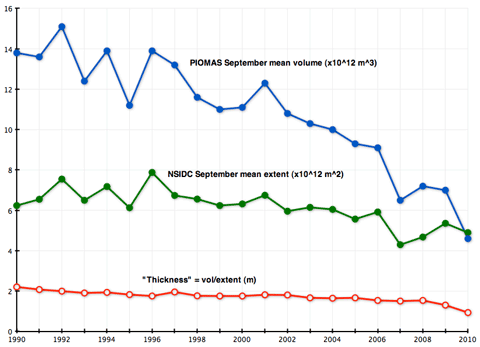
 It appears that the crank pantheon has a new hero: