

Back in Judy’s jungle

Judith Curry is a climate scientist who in recent times has achieved prominence in accusing her colleagues of groupthink, criticising the IPCC process, and suggesting that scientists can gain from more tolerant engagement with the sceptics. She is not a sceptic of the science herself, but unsurprisingly she has been welcomed by many of the deniers and is frequently quoted as evidence of the soundness of their complaints. Michael Lemonick of Climate Central has written a lengthy article about her published today in the Scientific American. He is even-handed to a fault, but I found nothing to alter my perception of what has struck me as her opacity and naivety in the few pieces of her writing I have seen.


Lemonick’s article raises the question of uncertainty in the scientific predictions, something which Curry apparently feels is not sufficiently acknowledged.

“Curry asserts that scientists haven’t adequately dealt with the uncertainty in their calculations and don’t even know with precision what’s arguably the most basic number in the field: the climate forcing from CO2—that is, the amount of warming a doubling of CO2 alone would cause without any amplifying or mitigating effects from melting ice, increased water vapor or any of a dozen other factors.”

I’m not a scientist. I’ve enjoyed reading science books for the general reader over the years and tried to have a broad understanding of major scientific theories. All relatively gentle and interesting. When it came to climate science however there was a dimension of urgency which was not present when reading about evolution or trying to understand relativity. If the climate scientists were even partially right the human future was under an almost unimaginably severe threat, though one which could yet be avoided. It rapidly became apparent that this was a science where one couldn’t just be an interested observer, even though a non-scientist.

In this context I can’t say it bothers me that scientists don’t know with precision the warming resulting from a doubling of CO2. I’ve seen the range that is generally considered possible and that’s quite sufficient to alarm me given that its effect is likely to be amplified by accompanying feedbacks. Apparently Curry feels that the uncertainty of the feedbacks is also not sufficiently acknowledged, but nothing I’ve read from the scientists offers certainty in estimating feedbacks, and what we are actually observing in the melting of Arctic sea ice or the acceleration of Greenland and Antarctic ice sheet loss is quite enough evidence for me that the feedback amplification effect is a serious factor.

Similarly it doesn’t bother me if the IPCC reports are judged to have not always communicated the level of uncertainty as carefully as they might have done. “Sometimes they do it well, sometimes not so well,” said Harold Shapiro, the head of the InterAcademy Council which recently reported on the IPCC procedures. That’s fine by me. I can cope with uneven performance. It doesn’t lead me to think that the overall scientific picture is unreliable. And even Curry acknowledges that uncertainty works both ways and can be overstated as well as understated. Again, observations that some effects of warming are occurring well ahead of expectations illustrates that.

It’s the broad sweep of climate science that rivets my attention as a concerned human being. Curry seems to me to be magnifying comparative trifles. Which is precisely what many of the deniers and delayers depend on. I doubt that she’s right in the matters she alights on, but even if she were it doesn’t alter the overwhelming reality of human-caused climate change. There’s a coherence to the scientific picture which we would be utterly foolish to allow ourselves to be blinded to even by a practising scientist.

Curry may have a gripe with her colleagues, but it is neither here nor there in terms of what the science means for the actions we should be taking. I notice she seems to be keen on cost-benefit analysis. I don’t know how you sit down and do that sort of analysis in the face of the threat of climate change. When disaster looms you do everything in your power to avert it.

[Brian Eno]

Arctic report card 2010: a one-way trip to warming

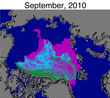
Last week NOAA released the 2010 update of its Arctic Report Card, covering the 2009/10 winter season and 2010 summer sea ice minimum. It makes for sobering reading. Greenland experienced record high temperatures, ice melt and glacier area loss, sea ice extent was the third lowest in the satellite record, and Arctic snow cover duration was at a record minimum. It’s worth digging through the whole report — it’s concise, well illustrated and referenced back to the underlying research — but a couple of things struck me as really important.


The first is the dramatic melting seen in Greenland this summer. From the Greenland report card:

Summer seasonal average (June-August) air temperatures around Greenland were 0.6 to 2.4°C above the 1971-2000 baseline and were highest in the west. A combination of a warm and dry 2009-2010 winter and the very warm summer resulted in the highest melt rate since at least 1958 and an area and duration of ice sheet melting that was above any previous year on record since at least 1978.

And…

Abnormal melt duration was concentrated along the western ice sheet (Figure GL3), consistent with anomalous warm air inflow during the summer (Figure GL1) and abnormally high winter air temperatures which led to warm pre-melt conditions. The melt duration was as much as 50 days greater than average in areas of west Greenland that had an elevation between 1200 and 2400 meters above sea level. In May, areas at low elevation along the west coast of the ice sheet melted up to about 15 days longer than the average. NCEP/NCAR Reanalysis data suggest that May surface temperatures were up to 5°C above the 1971–2000 baseline average. June and August also exhibited large positive melting day anomalies (up to 20 days) along the western and southern ice sheet. During August temperatures were 3°C above the average over most of the ice sheet, with the exception of the northeastern ice sheet. Along the southwestern ice sheet, the number of melting days in August has increased by 24 days over the past 30 years.

Not good news for the ice sheet. The atmosphere report card draws attention to the impact Arctic warming is having further south, dubbing it the warm arctic/cold continents pattern (WACC).

While 2009 showed a slowdown in the rate of annual air temperature increases in the Arctic, the first half of 2010 shows a near record pace with monthly anomalies of over 4°C in northern Canada. There continues to be significant excess heat storage in the Arctic Ocean at the end of summer due to continued near-record sea ice loss. There is evidence that the effect of higher air temperatures in the lower Arctic atmosphere in fall is contributing to changes in the atmospheric circulation in both the Arctic and northern mid-latitudes. Winter 2009-2010 showed a new connectivity between mid-latitude extreme cold and snowy weather events and changes in the wind patterns of the Arctic; the so-called Warm Arctic-Cold Continents pattern.

So now you know where the WACCy winter weather’s coming from…

The Flooded Earth

The Flooded Earth: Our Future in a World without Ice Caps

Paleontologist Peter D Ward is scared and not afraid to admit it. He doesn’t mince matters in his latest book The Flooded Earth: Our Future in a World Without Ice Caps. His own study of Earth’s geological past makes him well aware of what changes to the ice caps can mean for sea level and also of how closely past temperature rises and falls have been tied to levels of atmospheric carbon dioxide. He is alarmed by the prospect for this century and also for the centuries ahead if we keep loading the atmosphere with carbon dioxide from fossil fuels. Over coming centuries we can expect metres of sea level rise at a minimum, and much more if there is rapid disintegration of one or more ice sheets. His example of how rapid change can be is a rise which occurred during the most recent ice melt 14,000 to 16,000 years ago when the sea appears to have risen by nearly 50 feet over 300 years.

Scientific reticence is not for him. He discusses it at one point in the book. In relation to sea level rise he considers the fear of being wrong is inhibiting the sounding of the alarm that new discoveries call for. He refers to James Hansen on the question of caveats and caution. Hansen regards caveats as essential to science, but warns that there is a question of degree and “gradualism” as new evidence comes to light may not be appropriate when an issue is pressing. Ward welcomes the robustness of Hansen who says he expects more than 3 feet sea level rise by century’s end. Ward also notes climatologist Stephen Rahmstorf’s recent estimate, based on a new kind of model, of a minimum of 2 feet and a maximum of almost 5 feet this century. Ward doesn’t himself settle on a particular figure for this century, but has no doubt that the rise will continue so long as carbon dioxide levels are permitted to continue to rise, and that it will be very difficult for human society to cope with.

The book has many warnings to give about what rising sea levels will mean. They are pitched to the understanding of non-specialist readers and they bring into focus the work of a wide range of researchers in a variety of fields. One area of major concern is how even a modest increase in sea level will dramatically affect world agricultural yields. Some land will be drowned, but Ward draws particular attention to salt intrusion from the sea in agricultural areas near to oceans. A detailed examination of the Sacramento Delta region in California illustrates just one highly susceptible area. Ward considers the world overpopulated, and the prospect of feeding 9 billion or more people is certainly not enhanced by encroaching sea water.

It is estimated that even an 8-inch rise in the Bay of Bengal will displace 10 million Bangladeshis in an already heavily populated country.

The flooding of threatened countries and cities as sea level rise gathers pace is the focus of another chapter of serious warning. Bangladesh and Holland are two countries he discusses. It is estimated that even an 8-inch rise in the Bay of Bengal will displace 10 million Bangladeshis in an already heavily populated country. A 3-foot rise in sea level will put Holland on the ropes; a 16-foot rise will knock it out, flooding huge areas and displacing millions. Venice and New Orleans feature in his discussion of cities, but he points to myriad coastal cities which will face neighbourhood triage – deciding which areas to fight for and which to give up. If sea level rises much beyond 5 feet expensive infrastructure will be threatened and some enormous economic blows suffered. Airport runways in San Francisco, Honolulu, and Sydney will be the first to go. In many cases it will be more cost-effective to abandon coastal cities rather than try to protect them.

Ward frequently offers imaginary scenarios at various stages of the future, ranging from twenty years through to several hundred or even thousand years. They are not comforting, but they are all too possible if we refuse to take seriously the effects our fossil fuel habits are having on the global environment. His picture of what effect the Canadian operations to extract oil from tar sands will have had by 2030 if they continue is shocking – the desolate, devastated landscape, the health and environmental hazards visited on the First Peoples, the vast increase in carbon dioxide emissions. Another imaginary picture in 2045, with carbon dioxide levels at 450 ppm, portrays the last visit of tourist divers to Osprey Reef in the Coral Sea. The reef has changed tenants. Its once-numerous corals have been replaced by microbes that thrive in hot, acidic water. No longer a coral reef in the Coral Sea, it has become a bacterial reef in the Bacteria Sea. A more distant scenario is in 2400 on the Bangladesh-India border. Carbon dioxide levels are at 1200 ppm. More than half of Bangladesh is under water. He pictures a mass border breakthrough of a tide of humanity met by tactical nuclear weapons killing fifty thousand Bangladeshis instantly and many more in weeks to come.

One can hear the scoffing of denialists and delayers. But I found nothing alarmist in the scenarios.  What else do we think is going to happen as the seas continue an inexorable rise brought on by the gradual or more than gradual disintegration of the ice sheets? Ward knows what the ice sheets mean for sea level. He also knows what elevated carbon dioxide means for global temperature. Earth has been through this before. The difference this time is that it is our own doing and that it is happening to a planet heavily populated with human beings.

The book includes a chapter titled “Extinction?”. The question mark was a small relief. Here he discusses his concern at the eventual possibility of a slow changeover of the oceans through global warming from their current “mixed” states to a stratified state which in the past has always been a prelude to biotic catastrophe. The chapter recapitulates briefly the argument of his previous book Under a Green Sky, reviewed here, and emphasises the contributory role of sea level rise to the process of slowing oceanic currents and interrupting the mixing of oxygenated top waters with those below. In his view this is a point where we need to see a vital connection between ancient climates and impending climate change. He observes that the media have not allowed scientists to make this case, not because they disbelieved it but because the past scenarios were too horrifying for us to contemplate their happening again, and soon.

There’s an element of understandable desperation in Ward’s final chapter. It considers carbon sequestration possibilities through afforestation, charcoal burial, acceleration of natural weathering processes and other measures. Also, albeit with not much conviction and some trepidation, it canvasses major geo-engineering proposals to which we may be driven in extremity.

I found Ward’s book hard to put down. He draws out the implications of what we already know with clarity and force. That is a most valuable service. The more scientists will overcome their inclination to reticence and share their fears with the general population the better. Any risks in doing so pale beside the consequences of not doing so.  We must be faced with the full reality of what we are doing to the climate while we can still escape the more extreme consequences.

[Buy via Fishpond (NZ), Amazon.com, Book Depository (UK, with free shipping worldwide).]

How Kiwi know-how can save the world

This a guest post by Kevin Cudby, the author of From Smoke To Mirrors, reviewed earlier this week by Bryan.

I started researching my new book, From Smoke to Mirrors, back in 2007. I had been following alternative energy stories, and I was inundated with blogs and press releases from hucksters peddling silly ideas that would do nothing but separate investors from their savings.

So, in late 2007 I set out to document the strengths, weaknesses, and costs of all the options. I kept in mind that hydrocarbon liquid fuels (petrol, diesel, jet fuel, and fuel oil) underpin key elements of human civilisation, such as food production and distribution. Although the relative importance of cars, trucks, aircraft, and tractors might change over time, it will only be possible to eliminate liquid-fuel-related greenhouse emissions if we can find practical alternatives for every vehicle and machine. Forty percent of New Zealand’s liquid fuel is used on non-road applications, so it would be pointless to fix road transport and ignore agriculture, construction, aviation, and all the other non-road liquid fuel users.


My engineering background helped me sort the practical options from the vacuous nonsense. It had been a while since I’d worked with battery technology, and I enjoyed ferreting out detailed technical information about the latest rechargeable batteries, information their promoters would rather keep secret. I learned, for example, that battery-powered farm tractors would be about as practical as concrete helicopters. Then I moved on to hydrogen fuel cell vehicles—which, from the practical perspective, are looking pretty good. But hydrogen tractors are almost as impractical as battery-burners.

We know about practical processes for converting softwood chips into electricity, hydrogen, hydrocarbon fuels, and ethanol

It is clear that energy forestry is New Zealand’s most practical option for hydrogen, and for hydrocarbon fuels. New Zealand scientists knew about this possibility way back in the 1970s, though the technology for making trees into fuel was still being developed. Now, we know about practical processes for converting softwood chips into electricity, hydrogen, hydrocarbon fuels, and ethanol. No matter which technology New Zealand uses for road transport, our energy forests would occupy pretty-much the same amount of land. Researchers have calculated that the “energy profit” (or EROEI) of fuels made from wood chips will be better than that of our existing fossil fuels.

Perhaps the most exciting discovery, for me, was that radiata pine forests offer so many environmental side-benefits. I knew from personal observation that the native undergrowth in a 25-year-old radiata forest is far more luxuriant than the undergrowth in a 25-year-old stand of regenerating kanuka. But I am not a biologist, so I had to listen to the experts. I learned that converting steep low-quality grazing land into energy forests would improve biodiversity by creating habitat for a wide range of native species, from fungi to kiwis and falcons (the bird, that is). And I learned that foresters do not use fertiliser, and that third-generation radiata forests in the Central North Island are doing as well, or better, than the original plantings.

It seems New Zealand foresters have invented a biomass production process that can operate indefinitely. The technique has been thoroughly proven over many decades of real-world practice. We can share this expertise with other countries, which means Kiwi know-how can help knock a very large dent in anthropogenic greenhouse emissions.

There’s an excellent chance New Zealand will have the world’s cheapest renewable petrol and diesel

Even more exciting, there’s an excellent chance New Zealand will have the world’s cheapest renewable petrol and diesel. I’m guessing many New Zealanders will be very excited about that, especially considering what I learned about the future of conventional cars and trucks. Talking to overseas engineers, I learned about simple, practical engine and transmission systems capable of more than halving the fuel consumption of conventional road vehicles, without downsizing them, and without relying on battery hybrid systems.
So, although renewable petrol and diesel will be somewhat more expensive than today’s fuels, the improved efficiency of future vehicles will more than compensate.

We can be almost certain that sometime between now and 2030, the global economy will hit serious problems with the supply of liquid fuels. That is because fuel supplies will increasingly come from synthetic fuel factories. It can take up to six years to design, build, and fully commission a synthetic fuel factory, regardless of whether it makes climate-neutral fuel, or fossil fuel. Multi-national energy companies will be able to maximise their profits by delaying construction of synthetic fuel factories until prices begin to skyrocket. We know this will happen, but we cannot say exactly when it will start to affect global fuel prices. A growing number of analysts think it will happen before 2030, and the real pessimists think it will happen before 2020.

However, by 2040, if New Zealand gets stuck in and builds the necessary infrastructure, we can reasonably expect freight costs, and vehicle running costs, to consume a smaller fraction of the family budget than they do today.

There is no sign of any practical alternative for hydrocarbon liquid fuels for non-road applications. But these applications account for nearly half of New Zealand’s liquid fuel consumption.

So, while car and truck manufacturers are playing around with every technology that can turn a wheel, New Zealand should climate-neutralise its supply of essential, non-road fuels. This will keep us busy well into the 2020s. By then, thanks to advanced fuel injection and exhaust treatment systems, tailpipe emissions from conventional vehicles will be insignificant compared with pollution from tyre wear. All road vehicles have tyres, so environmental concerns will not influence our choice of cars and trucks. We’ll use whichever technology is the most practical.

From Smoke to Mirrors outlines a transition plan that takes account of these and other factors. I did not invent the transition plan. Associate Professor Susan Krumdieck did that, leaving it up to people like me to flesh it out and show why it is practical. Krumdieck proposed a direct attack on the problem’s fundamental origin. Fossil fuels cause greenhouse emissions, and greenhouse emissions cause climate change, so Krumdieck says we should simply ban fossil fuels. If you read From Smoke to Mirrors, you’ll see how simple and practical this would be.

New Zealand can do this. In fact, New Zealand should do this. We are a very small country, and if we cannot work together, how can we expect the rest of the world to do it?We need all our political parties to work out a multi-party agreement. This is about banning fossil fuels and developing the infrastructure to fully replace the billions of litres of fuel we’ll need by 2040. Left-right political questions, such as whether to build roads or railways, would be outside the scope of this agreement.

I’ve met young people who say: “We’re stuffed anyway, so I’m just gonna get as much as I can , while I can, and to hell with having kids.” That’s OK if there is no technical solution, or if the solution involves returning to medieval technology. But I’ve seen enough good technology to know the world will not go there. So, I hope my book will provide hope for those young people who have been led to believe there is no hope. My grandchildren’s generation will be the first to grow up knowing that we can solve this problem, because “From Smoke to Mirrors” makes the solutions readable and easily understood.

New Zealand can be self-sufficient for climate-neutral energy. Other countries can benefit from Kiwi expertise. This is a multi-decade project that could inspire every New Zealander. The question is whether our politicians are up to the challenge.

The man don’t give a….

Rodney Hide’s warm-up act for the launch of Bob Carter’s new book Climate: The Counter-consensus — a Scientist Speaks in Melbourne a couple of weeks ago took the form of a remarkable speech, now available at the ACT web site. I know that it’s customary on these occasions to be nice to the author, but Rodney seems to have gone just a tad over the top:

Professor Bob Carter has written the best book on the science of human-induced global warning I have read.


Par for the course. Hardly likely to say that he preferred Plimer’s book, was he?

It’s a very significant book. It will save countless lives.

It will also save trillions of dollars in resources, natural, human and physical. Precious resources that the human race striving to provide every human being with the means for them to reach their full potential can ill-afford to lose.

In the strange version of reality being explored by Carterist science, everything is upside down.

His book stands in stark contrast to the dry and boring and politicised IPCC tomes. And so in this book Bob Carter rescues both the world and science and what could be a more valuable contribution than that.

Bob rescues the world! And science! Hurrah!

Some truth here, though:

We are easily fooled. That’s why Prof Carter’s work is so important.

Too true, but not perhaps in the way Rodney intended.

Science doesn’t deliver truths down from on high by consensus.

Pardon? If real science doesn’t do consensus, how can Carterist science offer a counter consensus?

I know that if “Climate: The Counter Consensus” had been published two years ago New Zealand would have been spared its wealth-sapping Emissions Trading Scheme.

And much more in the same vein. Risible, if it weren’t coming from an associate minister of education in the New Zealand Government. But it is, and that makes it tragic.

[Super Furry Animals]