
Democracy under strain

I have recently often found myself thinking of a sentence in the late Stephen Schneider’s book Science as a Contact Sport, reviewed on Hot Topic a year ago. Towards the end of the book he reflected on the greed and short-term thinking which has led business interests to advance a campaign of confusion and doubt on the science of climate change, aimed at stalling action. It didn’t surprise him, but what worried him was that so many decent people are still taken in by it. Then came the sentence which reverberates almost daily for me:

What keeps me up at night is a disquieting thought: ‘Can democracy survive complexity?’


It is the run-up to the US mid-term elections which has ensured Schneider’s sentence nags so insistently. Candidate after candidate (mostly Republican) asseverates “I don’t believe in manmade global warming” or “I have not been convinced” or “I am sceptical about the science” or any of numerous similar positions which can be coupled with an assurance that he or she won’t back action to reduce emissions, and may even move aggressively to prevent it. As I read or, if I can bear it, listen, to these confident deniers, many of them articulate and well presented, I wonder where they find their assurance. Generally speaking they seem ignorant of the science. In fact their confidence seems in inverse proportion to their knowledge.

The clear message from the science simply doesn’t flow through society to these would-be decision makers. It is intercepted and at best muddied, at worst completely blocked. What is a coherent picture, supported by the vast majority of scientists with expertise in relevant fields, attested by highly reputable national academies of science and international  science organisations, somehow emerges in the hands of political candidates as variously highly debatable, deeply uncertain, or even the product of a vast conspiracy.

It is tempting to dismiss the candidates as a bunch of contemptible liars who cynically set the goal of gaining power well ahead of any regard for truth or human welfare. Maybe some of them are. But some of them no doubt genuinely think they are speaking truthfully when they voice their scepticism. They inhabit an intellectual world from which the real science has been excluded and they are unaware of the fact. The misinformers have done their work and constructed an alternative reality undisturbed by the need to take action against the threat of rising carbon emissions.

It’s a temporary alternative, and it only appears real.  Sooner or later the bitter truth will assert itself. But in the meantime the country on whom so much depends for effective action against global warming appears likely to spend a few more years in delay to the perceived benefit of vested interests.

To be elected these politicians need voters. They wouldn’t be saying the things they are about climate change if their sentiments weren’t shared by a wide slice of their constituencies.  Whole sectors of society have been taken in by the misinformation industry and its false assurances.

Climate science and the policies to respond to its message are complex, but hardly to the extent that they are incommunicable to the public at large. It is the “deliberate special interest distortion” and the “knee-jerk media balance” which Schneider saw as compounding the complexity and making it hard for democracy to deal with. Too hard, he sometimes feared. Many in America are probably sharing that anxiety right now.

I don’t know of any clever strategy to counter what we are seeing in the US. One hopes it will be largely confined there, though even if it is its effects will be felt throughout the world. All I can see is the need to continue to assert the key points, which were recently splendidly summarised by climatologist Richard Somerville, Distinguished Professor Emeritus at Scripps Institution of Oceanography. Joe Romm at Climate Progress reproduced them from the original essay in the journal Climatic Change. Somerville makes six points:

  1. The essential findings of mainstream climate change science are firm.
  2. The greenhouse effect is well understood. It is as real as gravity.
  3. Our climate predictions are coming true.
  4. The standard skeptical arguments have been refuted many times over.
  5. Science has its own high standards. It does not work by unqualified people making claims on television or the Internet. It works by expert scientists doing research and publishing it in carefully reviewed research journals.
  6. The leading scientific organisations of the world, like national academies of science and professional scientific societies, have carefully examined the results of climate science and endorsed these results.

These are the bare bones. You can read the fuller and eloquent statements on Climate Progress or in the original longer essay. But the essential logic and plain good sense is apparent in the extract I have made. It seems to me to display the framework of what must be reiterated for as long as it takes for a democratic society to see clearly where the science is at and decide what should be done to address the threat it points to. Misinformation can only be answered with the truth of the matter.

Buffoons in arms: Goddard joins Monckton at SPPI

Oh frabjous day! Steven Goddard is joining “potty peer” Christopher, Viscount Monckton of Brenchley as one of the slithy toves contributing to the Science and Public Policy Institute‘s never-ending stream of climate denier propaganda, and on the evidence of his first “paper” he will be a valuable* addition to the team. The SPPI pantheon is in dire need of a fillip, given Monckton’s lacklustre recent performance (of which more later), and so Goddard is given his head to produce a truly wondrous counterblast to the recent NOAA 2010 Arctic Report CardTo a geologist, “the past is key to the future”. To give you a flavour of his wisdom, here are Goddard’s conclusions:

  1. The widespread belief that the poles are rapidly melting down is incorrect, particularly in the Southern Hemisphere.
  2. Arctic temperatures are cyclical. Much of the Arctic has been warmer during the last 100 years.
  3. The satellite record from 1979-2010 coincided with the warm phase of the PDO. It covers less than one half of an Arctic temperature cycle. Given this cyclical behavior, it makes little scientific sense to extrapolate linearly based on a time period which is too short. Until satellites record at least one entire Arctic cycle, the extrapolations are misleading.
  4. There is little (if any) evidence linking recent changes in the Arctic to CO2. At this point there is no solid reason to believe we are seeing anything other than natural Arctic cycles. Greenland temperatures are cooler than 70 years ago.

Great stuff. Either completely wrong, not supported by the evidence or pure wishful thinking. Positively Moncktonian in its cavalier disregard for the facts, but lacking the great man’s prolix delivery and intellectual turgidity…


Followers of events in the Arctic will know Goddard as the erstwhile author of numerous and inventive “sea ice updates” at Anthony Watts’ µWatts blog — a man with an amazing ability to conjure cooling out of nothing. A few months ago an obdurate Goddard appears to have strained the patience of the saintly Watts and he departed to set up his own blog called, with no apparent hint of irony, Real Science.

To illustrate just how far Goddard’s SPPI opus stays from reality, let’s consider his claim that “Greenland temperatures are cooler than 70 years ago“. To arrive at this conclusion he chooses two Greenland temperature stations from the NASA GISTEMP dataset (Godthab Nuuk and Angmagssalik), plots their annual averages over the last 100 years, finds two periods of warming, and then — after long detours around sea ice and CO2 — declares that Greenland has cooled over the last 70 years. Cherry-picking at its finest…

What does the NOAA Arctic Report Card have to say about current Greenland temperatures?

A clear pattern of exceptional and record-setting warm air temperatures is evident at long-term meteorological stations around Greenland. For instance:

Nuuk (64.2°N along Greenland’s west coast): Year 2010 summer, spring, and winter 2009/2010 were the warmest on record since record keeping began in 1873.

Temperature records were being set all round Greenland during the last year, leading to a record ice melt season: the area of the ice sheet that melted was 8% greater than the previous record, set in 2007, and melt continued for much longer than usual:

The melt duration was as much as 50 days greater than average in areas of west Greenland that had an elevation between 1200 and 2400 meters above sea level.

The obvious disconnect between Goddard’s reporting and the real state of Greenland goes a long way to suggest why he was dropped by Watts, and it says just as much about SPPI’s decision to run his material. To paraphrase former NZ prime minister Rob Muldoon, Goddard’s move has raised the average IQ at both places…

Meanwhile, followers of the antics of Monckton will be puzzled by the poor quality of his recent output, and mystified by his inability to carry the floor at a recent debate in Cork. The peer’s attempted rebuttal of the dismemberment of his testimony to Congress earlier this year is thin stuff, long on words (of course) but woefully short of substance.

Slightly meatier is his attempt to debunk a recent keynote address given by Obama’s science adviser John Holdren in Oslo in September. Here’s a chunk of classic Monckton:

On go the lurid scares. “Melting permafrost” is next. The fact that many of the burial grounds of the Vikings around the Hvalsey settlement are still under permafrost to this day, when they were certainly not under permafrost when the bodies were buried, is conveniently overlooked.

This is a claim that has popped up in a number of Monckton’s articles, and one that’s often repeated by sceptics who want to pretend that conditions in Greenland are not unusual. Unfortunately, as is so often the case when you look into the details, it turns out that Monckton is talking nonsense. The Citizen’s Challenge blog decided to do some exhumation of the facts, and got in touch with a few experts who know the Hvalsey site well. Here’s what Georg Nyegaard, curator of the Greenland National Museum & Archives had to say:

I know the site of the Hvalsey Fjord Church very well – was the curator of the nearby museum of Qaqortoq for 12 years. You are completely right about your doubts: There is absolutely no permafrost at this site.

I look forward to Monckton’s retraction and apology for so grievously misleading his readers, but history suggests I would not be wise to hold my breath while waiting. But Monckton isn’t finished with permafrost. Here’s his next sentence:

In fact, melting permafrost is nothing but a good thing: despite the lurid tales of methane trapped in the permafrost and waiting to erupt and give the planet a fever, methane is really a non-issue now that the Russian pipeline to Europe has been repaired. There has been no noticeable increase in atmospheric methane since the repairs were completed in the year 2000. If the permafrost were to thaw, billions of acres of productive agricultural land would become available.

Breathtaking stuff. Manages to ignore the evidence, downplay the danger, and blame the Russians, all in one sentence. It’s the sort of claim Monckton can make in a debate, leaving his opponents wondering whether they should unpack the falsehoods or ignore them. But such sophistry didn’t work for the prolix peer when he took part in a debate with Graham Parkes, professor of philosophy and head of the school of sociology and philosophy for University College Cork, at the beginning of October. Scott Mandia has Parkes’ full speech here.

The result? Parkes won the debate by 100 votes to 3. Sic transit gloria Moncktonii…

(*) “Valuable”, in so far as it makes SPPI’s output look even less credible (if that’s possible).

[Dire, that’s what it is.]

Outtasite (Outta Mind)

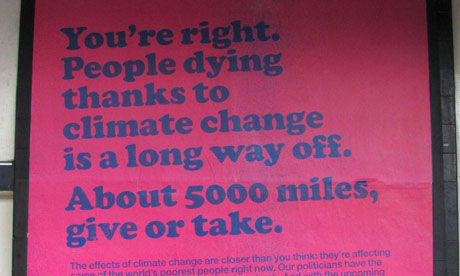
Hot Topic has frequently given credence and drawn attention to Oxfam’s reports on how climate change is already seriously affecting populations in developing countries.  (Some examples here and here and here.) It is therefore pleasing to see that a complaint to the UK Advertising Standards Authority (ASA) regarding an Oxfam poster has been rejected.

The poster stated “People dying thanks to climate change is a long way off. About 5000 miles, give or take… Our politicians have the power to help get a climate deal back on track… Let’s sort it here and now.” Four people challenged the poster on the grounds that it was misleading and could not be substantiated. They did not believe it had been proven that people were dying as a result of climate change.


Asked by the Authority to respond, Oxfam said research had been published by reputable organisations including the World Health Organisation (WHO), the Institute of Medicine (the health arm of the US National Academy of Sciences), the Lancet and University College London Institute for Global Health Commission that showed people had died, and were currently dying, as a result of climate change. In particular, they cited three WHO publications which they considered backed up Oxfam’s claim. In addition, they said Oxfam’s own experiences bore out ways in which climate change, manifesting as trends towards increased temperatures, disrupted seasons, droughts and intense rainfall events created additional health hazards for vulnerable populations in the countries in which Oxfam worked.

The ASA in its adjudication referred first to the IPCC and other national and international bodies with expertise in climate science and concluded there was a robust consensus amongst them that there was extremely strong evidence for human induced climate change. The ASA noted that the part of Oxfam’s claim that stated “Our politicians have the power to help get a climate deal back on track … let’s sort it here and now” made a link between human action and climate change.

The ASA then turned to the question of whether there was a similar consensus that people were now dying as a result of climate change. They referred to several WHO reports. One was the 2009 publication Global Health Risks – Mortality and burden of disease attributable to selected major risks [PDF], which stated “Climate change was estimated to be already responsible for 3% of diarrhoea, 3% of malaria and 3.8% of dengue fever deaths worldwide in 2004. Total attributable mortality was about 0.2% of deaths in 2004; of these, 85% were child deaths”.

Satisfied that there was a consensus that deaths were now being caused by climate change, the ASA finally noted that Oxfam’s claim was reasonably restrained in that it stated deaths were occurring at the present time as a result of climate change but that it did not claim specific numbers of deaths were attributable and it did not speculate about future numbers of deaths.

The ad was judged not misleading.  (The full text of the adjudication is on the ASA’s website.)

Oxfam is not pushing the envelope in its reports and claims of what climate change is already meaning for some populations in the developing world. It is well within the limits of the science. It may be a shock to some to realise that, and there are always those ready to discount it as alarmism aimed at increasing the organisation’s income.  But it is no more of an exaggeration to say that people are already dying as a result of climate change, than to say that people die as a result of tobacco smoking. Those of us who have lived long enough may remember how long and hard the latter conclusion was resisted by the counter-claims of the industry and the widespread public unwillingness to face the reality. Fifty years ago when as a young man I took up tobacco smoking for a period of some years I assumed the medical warnings which were beginning to be sounded were bound to be overstated. The very normalcy of smoking made it easy not to take them seriously. And there were plenty of assurances abroad that there was little to be concerned about. I shudder now to think how easily we blinded ourselves.

The analogies with the far greater issue of climate change are all too apparent. The efforts of Oxfam and others to puncture our complacency are justified and necessary. May they not have to wait decades to succeed.

[Wilco]

What a waste(land)

I was pleased to catch sight of the first two words of the headline on the Eco Issues page of the Waikato Times this week — “The Arctic”, it said, and I assumed thankfully that they were going to focus on the alarming developments there. And so they were, but not in the sense I presumed, for the headline continued “– site for an icy cold war?”  The article was all about the competition for seabed resources as the ice diminishes. Nothing at all about the threat to the global climate. The omission was compounded by another headline for an inset panel: “A frozen wasteland no more”. In other words, with the melting of the ice the Arctic is becoming useful.

Incidentally the word wasteland reminded of me how a few years ago the chairman of a local trust, a subsequent national president of the ACT party, opposed making a grant for wetlands restoration. “Wetlands are wastelands,” he said.


The terrible irony of referring to the Arctic as a wasteland is presumably lost on many Waikato Times readers. And not too many journalists are likely to question the focus on resource extraction. We can expect a plethora of journalistic analysis of the international tensions over the rights to natural resources from the Arctic as it moves inexorably to losing its sea ice. That appears much more likely to be the substance of reportage and discussion than the consequences for global warming. Political leaders will come alive on the issue. Indeed they already have. Vladimir Putin hosted an international conference last month on the future of the Arctic, and although he claimed development would be sensitive to the environment he also made it clear that he’s no believer in anthropogenic global warming, as reported in the Energy Tribune.  Expect much closer political attention to the exploitation of newly accessible mineral resources than to the implications for global warming.

It is obvious to anyone who follows climate science that a frozen Arctic is pretty well essential to the climate in which human civilisation has developed. The loss of Arctic sea ice and a diminishing Greenland ice sheet carry between them incalculable consequences for change which it is by no means clear we can manage.  That’s why apprehension is the most rational human response to what we are seeing, accompanied by a determination to stop making it even worse. But how much longer do we have to wait for apprehension to be manifest on a wider scale than is so far apparent?  Putin’s no help:

“Is it changing because of human influence or because of unavoidable changes in the planet’s development that humankind cannot prevent? Is it really disastrous for the planet? I don’t want to say that we should give up our efforts to combat global warming, but maybe it is happening regardless of our influence? It is most likely so.”

Nor is there any sign of awareness from the numerous Republican political candidates in the US who have become bogged in a mire of unreason as they variously deny the science altogether, or treat it as highly uncertain, or downplay it in favour of fossil fuel energy. It’s almost unbelievable to see the list of gubernatorial candidates, for instance, whose stances have been reported by the Wonk Room. There are many other articles in the Wonk Room climate section, by the way, reporting the sad story of a major political party’s descent into denial of the most pressing issue of our time.

Back here in Hamilton I shall write a letter to the editor pointing out that far from a wasteland the frozen Arctic is vital to life as we have known it since civilisation began.  I shall deplore the continuing failure of political leadership to come to terms with the reality of climate science, and urge readers to be concerned for their children and grandchildren in the world we are creating. A year ago I could have said this in a column, but the paper’s anxiety about ‘balance’ put an end to that. A letter will be better than nothing.

[I could be the ticket man at Fulham Broadway station…]

The Climate Show: Beta 1

[youtube]-9yr6L6tdDc[/youtube]

Introducing The Climate Show, the first (beta 1) stab at a web-based “radio with pictures” programme about climate news science, policy, politics and solutions. It’s the brainchild of KIWI FM’s Radio Wammo breakfast host Glenn Williams, one of the most innovative young broadcasters in New Zealand, and he’s roped me in to add, er, something or other… 😉

The show was recorded last week via Skype video conference, and we discussed new temperature records, the state of the Arctic, chatted with Kevin Cudby about his new book From Smoke To Mirrors, recommended the Skeptical Science web site and iPhone app, and then discussed some recent developments in solar photovoltaic technologies. It’s available at Youtube, as a podcast via iTunes, and will soon have its own site at theclimateshow.co.nz . You can follow the show on Twitter at @TheClimateShow. We’re aiming to record a programme every couple of weeks to begin with. All feedback welcome — what do you think of the show and what would you like us to cover? Any guests you’d particularly like us to feature (NZ and worldwide)? And if you like the show, tell your friends… Links to the stuff we talk about below the fold.

The Climate Show (audio)

Continue reading “The Climate Show: Beta 1”