The Climate Show #5: on a hot wet green roof

[youtube]-y_9KfxShPA[/youtube]

The Climate Show returns with the first show of the new year, and it’s a cracker. Our guest is Dr Brad Bass, an expert in “green” roofing who joined Glenn in the Auckland studio to discuss the many advantages of growing things (even trees!) on our buildings. John Cook from Skeptical Science gives us an eye-witness account of the Queensland flooding, and explains the climate and weather background to the event. We also discuss last year’s record setting temperatures, the fakery of Don Easterbrook, and an interesting breakthrough in solar power technology.

Watch The Climate Show on our Youtube channel, subscribe to the podcast via iTunes, or listen direct/download here:

The Climate Show

Follow The Climate Show on Facebook and Twitter, and (sometime soon, perhaps) at The Climate Show web site.

Show notes below the fold.

Continue reading “The Climate Show #5: on a hot wet green roof”

Why dealing with climate change is difficult (spinach tarts and ice cream)

[youtube]NOsl5-AUTv4[/youtube]

Let’s be clear about this: the failure to take adequate action to reduce emissions is not because of any weakness in our understanding of the science of climate. It has its roots instead in human psychology and sociology, as George Marshall explains in this series of three videos — The Ingenious Ways We Avoid Believing In Climate Change — a recording of a keynote address he gave to a conference in 2009. Marshall is a good presenter — he illustrates his points well (spinach tarts and ice cream feature prominently) — and provides a very good and concise overview of why many people prefer to ignore the climate problem. Whatever your views on the seriousness of the climate problem or how we should act to deal with it, you’ll find something in his talk to challenge your preconceptions. Parts two and three are below the fold…

Continue reading “Why dealing with climate change is difficult (spinach tarts and ice cream)”

Peruvian glacier melt challenges US security

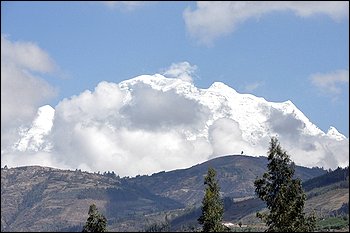
The melting glaciers of Peru have figured in previous Hot Topic posts such as the review of Mark Carey’s book In the Shadow of Melting Glacier and the report from Guardian journalist John Vidal’s Oxfam-sponsored Andean tour. I was therefore interested to come across an article on what the loss of the Peruvian glaciers implies for US national security. Not that the national security of America normally figures on my list of concerns about what climate change is doing to Peru, but I’m happy to add it if it is required to awaken more widespread US awareness of the realities of climate change. The fact that a version of the article appeared in last weekend’s Washington Post was testimony to that potential. US national security concern might also represent Peru’s best chance of getting much-needed assistance in the enormous adaptation measures facing them.


Heather Somerville, the article’s author, is a member of a team of graduate journalist students from Medill School of Journalism who have been investigating the effects of climate change on US national security in various parts of the world.

Said a former CIA Director:

“Think what it would be like if the Andes glaciers were gone and we had millions and millions of hungry and thirsty Southern neighbours. It would not be an easy thing to deal with.”

Somerville summarises the effects already under way in Peru:

“…glacier melt has begun to deplete crops, displace communities, cause widespread drinking water shortages, destabilize hydroelectric power, diminish trade and affect transportation and tourism. The trend is expected to cause regional conflict, economic crises, increased crime, broken infrastructure and food insecurity.”

Without substantial foreign assistance within the next five years the climate change advisor at Peru’s Ministry of Foreign Affairs sees the shrinking of the glaciers leading to a social and economic disaster.

If the US does offer assistance it is likely to be bound up with strategic questions.

“[The Obama administration] must decide whether to send money, development assistance and possibly even military help south to an important democratic ally on a continent where Chinese and Iranian influence is growing, and anti-U.S. sentiment permeates certain regimes.

“Other U.S. allies vulnerable to the impacts of climate change will be paying close attention to how the U.S. responds. Peru’s crisis could set a precedent for how the U.S. uses diplomacy, foreign aid and the military to address the climate change threats around the world.”

The State Department is taking an active interest in the impacts of climate change on the region, acknowledging it as a significant threat which the US must come to terms with in respect to the security challenges it poses. Some assistance has been forthcoming from Washington but the article reports frustration from Peruvian officials with what they see as poor coordination among US agencies, US disregard for the importance of global cooperation and an agenda that fails to address the urgent need in Peru.

Somerville makes it clear that the need is urgent. And it is by no means limited to the areas adjacent to the glaciers, serious though it is for them.

“Life on Peru’s coast depends on water from the Andes. Most of its agriculture production is on the arid coast, fed by water from the Andes. Glacier-fed rivers also support the nation’s largest hydroelectric plants, which provide 60 percent of the country’s electricity.

“Lima, the world’s second largest desert city, is almost totally dependent on Andean rivers fed by glacier melt. Water shortages are widespread there, and even worse in communities nearby that can’t compete with the capital for meagre water supplies.”

The Pentagon’s Southern Command (SouthCom), responsible for Latin America, has also been looking at the security aspects of climate change in Peru.  Their environmental security expert comments that there is some way to go to get a complete buy-in from the Department of Defense that this is a core military role, but Somerville comments that SouthCom probably won’t have a choice but to start planning for climate change. One of SouthCom’s primary missions is humanitarian aid and it has a history of being called on for disaster response in Latin America.

Not that Peru is sitting helplessly waiting for outside assistance. Somerville reports that it created a national strategy on climate change in 2003 and in 2008 set up a Ministry of Environment with oversight of climate change programmes. Work is being undertaken in conjunction with the US Agency for International Development and non-profit organisations to build water reservoirs in Andean communities and monitor water flow from the glaciers.

But resources are lacking, and the Peruvian Ministry of Foreign Affairs is asking Washington and other allies for at least $350 million every year through 2030 for reservoirs to collect runoff, dams to regulate water flow from the Andes and irrigation techniques. Said a spokesperson:

“If we don’t solve our problems … this will become a problem for the United States. When you have a dysfunctional country, you have a problem for the entire region.”

Whether national security concerns will drive significant aid for countries like Peru remains to be seen. But the concerns are clearly making some think seriously about what climate change is doing to the world. I found myself wondering about how this is going down with the climate change deniers so prominent among Republicans in the House. Presumably if climate change is not happening it can’t be posing a security threat to the US.  But what if you’re a politician who professes great concern about national security?  And what if that question comes close to home as it does in some of the other articles in the series to which Somerville’s belongs?  There’s an article on the threat to Houston. Another on the what sea level rise will do to military bases on the US coast. Another on the threat of climate change-related disease in the US as well as other countries.

A day must eventually dawn when denial becomes impossible to maintain even when it is bolstered by wealthy vested interests. If perceived national security threats will help bring about that day, then the more they are pointed out the better.
Easterbrook adrift: WWU geology dept issues statement on climate change

Word reaches me that the geology department at Western Washington University — home of emeritus professor and data fiddler Don Easterbrook — has adopted a position statement on climate change. The statement is supported by the entire geology department, and is clearly designed to distance WWU’s geologists from Easterbrook’s odd ideas and dodgy practices. Here’s what they say:

Decades of scientific research have shown that climate can change from both natural and anthropogenic causes. The Geology Faculty at WWU concur with rigorous, peer-reviewed assessments by the National Academies of Science (2005), the National Research Council (2006), and the Intergovernmental Panel on Climate Change (IPCC, 2007) that global climate has warmed significantly and that human activities (mainly greenhouse-gas emissions) account for most of the warming since the middle 1900s. If current trends continue, the projected increase in global temperature by the end of the twenty-first century will result in large impacts on humans and other species. Addressing the challenges posed by climate change will require a combination of adaptation to the changes that are likely to occur and global reductions of carbon dioxide emissions from anthropogenic sources.

Congratulations to WWU’s geologists for taking this stand. I wonder if Easterbrook will now withdraw his claim that most of the last 10,000 years were warmer than today, apologise for stealing and altering a graph from Global Warming Art and apologise for calling me a liar? But then he is a denier, and that means never having to say you’re sorry…

Stern at the frontiers of knowledge

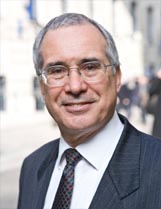
The cost of cutting back emissions is more than we estimated, but that is because the consequences of climate change are already here.” These words of Nicholas Stern’s are included in the announcement that he has just been awarded the 400,000-euro BBVA Foundation Frontiers of Knowledge Award in the climate change category. He elaborates:

“Emissions are rising rapidly, and the capacity of the ocean to absorb carbon is less than we thought. Also, other effects, particularly the melting of the polar ice, seem to be happening much faster. We need to take more drastic steps, so the costs will inevitably be higher”.


However this doesn’t alter the message of the 2006 Stern Review on the Economics of Climate Change for which Stern received the award, namely that failure to tackle climate change will exact a far higher economic cost than action to reduce greenhouse gas emissions.  This idea, the award announcement says, has “fundamentally changed the international climate change debate and stimulated action”.

Acting now, says Stern, not only saves far greater costs in the future but also represents an important economic opportunity:

“Climate change economics is the next industrial revolution. The countries who invest now in this new growth market will gain the advantage of a first mover. Those who don’t risk being left behind”.

He notes that China and some European countries, Spain among them, have woken up to the benefits of fostering a low-emissions economy. He urges Spain to stay the course. But the US and some other rich economies are advancing more slowly. There’s certainly little sign here in New Zealand of any great enthusiasm from the government to join the next industrial revolution. (My observation, not Stern’s). The Minister for Economic Development is still firmly stuck in the last one.

Stern sees climate change is a major economic opportunity which calls for investment. He’s also adamant that taking steps to mitigate climate change can help us to pull clear of the current economic crisis, implying that it is foolish on the part of some governments to use the downturn as an excuse for inaction.

The BVVA announcement provides a succinct summary of the economic understanding that Stern brings to the situation we have landed ourselves in:

“Stern warns that climate change may be the biggest market failure the world has yet seen, because the damages caused by greenhouses gases are not reflected in the prices of the goods and services whose production causes the emissions problem. The response, in his view, is to shift onto a low-carbon growth path based on three kinds of policies: a carbon pricing system based on taxation and development of an efficient market in emission rights, the right technology policy, and the removal of barriers to changes in social behaviour so energy saving habits are encouraged and rewarded.”

Nicholas Stern commented:

“I feel very privileged to receive a prize that is dedicated specifically to climate change research. It is certainly a very clear statement of the importance that the BBVA Foundation attaches to an area so vital for the future existence of human beings on this planet.”

Stern has no doubt about the realities of climate change. It is a mark of his writing that he takes the science with full seriousness and consequently orients his thinking to how it can be most adequately addressed. There’s no trifling with the issue. As the opening quotation of this post indicates he remains up with the play. His thinking is also marked by his sense of humanity. It was a striking feature of his 2009 book The Global Deal: Climate Change and the Creation of a New Era of Progress and Prosperity (US edition – UK title Blueprint for a Safer Planet) that he insisted throughout that combating climate change is inextricably linked with poverty reduction as the two greatest challenges of the century and that we shall succeed or fail on them together.  I reviewed his book on Hot Topic. He’s a worthy recipient of a significant award.