 At the end of last week, with the deadline ((Submissions close at 5.00pm on Wednesday 3 June 2015.)) for submissions on a post-2020 target for New Zealand emissions rapidly approaching, the Ministry for the Environment released a second set of economic cost estimates for various emissions targets. These cost estimates are substantially lower, the Ministry admits, than the costs in the consultation document issued by the MfE on May 7th. As it happens, neither the Infometrics modelling used in the consultation document or the newly-published Landcare Research is terribly helpful when considering policy options, as I shall discuss later, but for the time being consider the usefulness of a “consultation” process where the following is true:
- Announce a four week consultation period on May 7, starting then, to conclude four weeks later.
- Publish a consultation document that plays up the costs of action and plays down the costs of inaction — calculated by Treasury to be up to $52bn.
- Conduct a rushed series of consultation meetings around the country to which no ministers front up.
- Release the economic modelling relied on for the cost estimates in the consultation document 10 days after the process begins, well after the consultation meetings have started.
- Release a second economic modelling report showing costs to be less than the original document presents just over a week before submissions close.
If that’s not a prescription for a Mickey Mouse consultation process that’s designed to pay only lip service to public concern, a disgraceful political sham that should have officials — who are expected to be resolutely non-partisan and to serve the public interest — hanging their heads in shame, then I’m a maker of fine Low Country cheeses.
But it gets worse. An examination of the economic modelling commissioned by the MfE shows that the whole process was set up to exaggerate the costs of cutting New Zealand’s emissions.
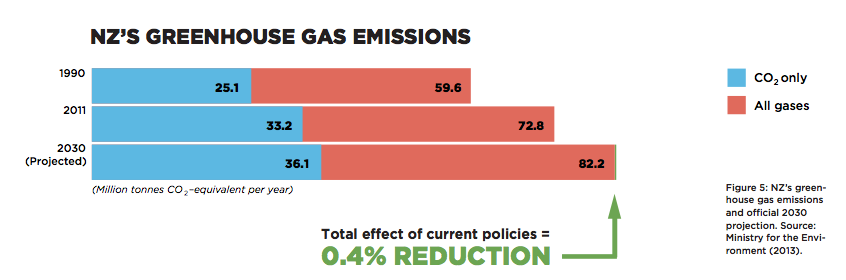
 Simon Johnson (aka MrFebruary) looks at how climate change minister Tim Groser and the National-led government intend to use creative carbon accounting to ensure that New Zealand meets its 2020 climate change target (a five percent reduction) in spite of emissions of greenhouse gases (GHG) projected to increase to 2020 and beyond.
 Today’s news that the US and China have agreed a long term policy to reduce carbon emissions is