
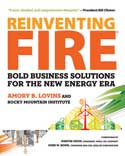
 Is there movement already under way in the world of industry which will outstrip the painfully slow progress of the political world in facing up to the challenge of climate change? Amory Lovins certainly thinks so and his recent book, Reinventing Fire: Bold Business Solutions for the New Energy Era, explains why. Lovins is the co-founder, chairman and chief scientist of the Rocky Mountain Institute(RMI), a well-staffed non-profit organisation established thirty years ago and active in research and consultation on issues relating to energy and the efficient use of resources. The book is the product of some years of work by many RMI staff. It focuses the Institute’s current initiative to map and drive the transition from coal and oil to efficiency and renewables.
Can the US realistically stop using coal and oil by 2050? And can such a vast transition toward efficient use and renewable energy be led by business? The answer the book gives to both questions is yes, based on painstaking exploration of existing renewable technologies and an assessment that they are already competitive with fossil-fuel-based industry for those who have eyes to see. The book is directed to the business world. It presents the energy transition as a major shift for a civilisation which has benefited greatly from fossil fuels but must now move from the old fire dug from below to the new fire which flows from above and works without combustion (save for a small amount of sustainable biofuel). It is a time of exceptional business opportunity for those prepared to recognise it and take it. The costs of oil and coal are rising as the price of renewables keeps on dropping. “The curves are already crossing. The endgames of oil and coal have already begun.” Lovins reminds readers that inattentive whalers in the 19th century were astounded to find they had run out of whale-oil customers before they ran out of whales.
 There’s no reason why facing up to the challenge of climate change should not result in wide benefits to human society, including economic benefits. That’s the argument of the multiple authors of Reframing the Problem of Climate Change: From Zero Sum Game to Win-Win Solutions. The book is based on papers presented at a 2010 international conference in Barcelona. They cover a wide range of topics and disciplines but centre around the proposition that it is a mistake to think of action on climate change as though gains can only be made at the expense of losses.
 A mild protest from the NZ Wind Energy Association arrived in my inbox recently. It was in response to the Ministry of Economic Development’s latest
  I liked the sub-heading to a Guardian article on Friday. “The theory that cutting carbon emissions costs us growth is bunk, in fact, it’s an economic opportunity.” The
  Academics