How “sceptics” view Arctic sea ice decline

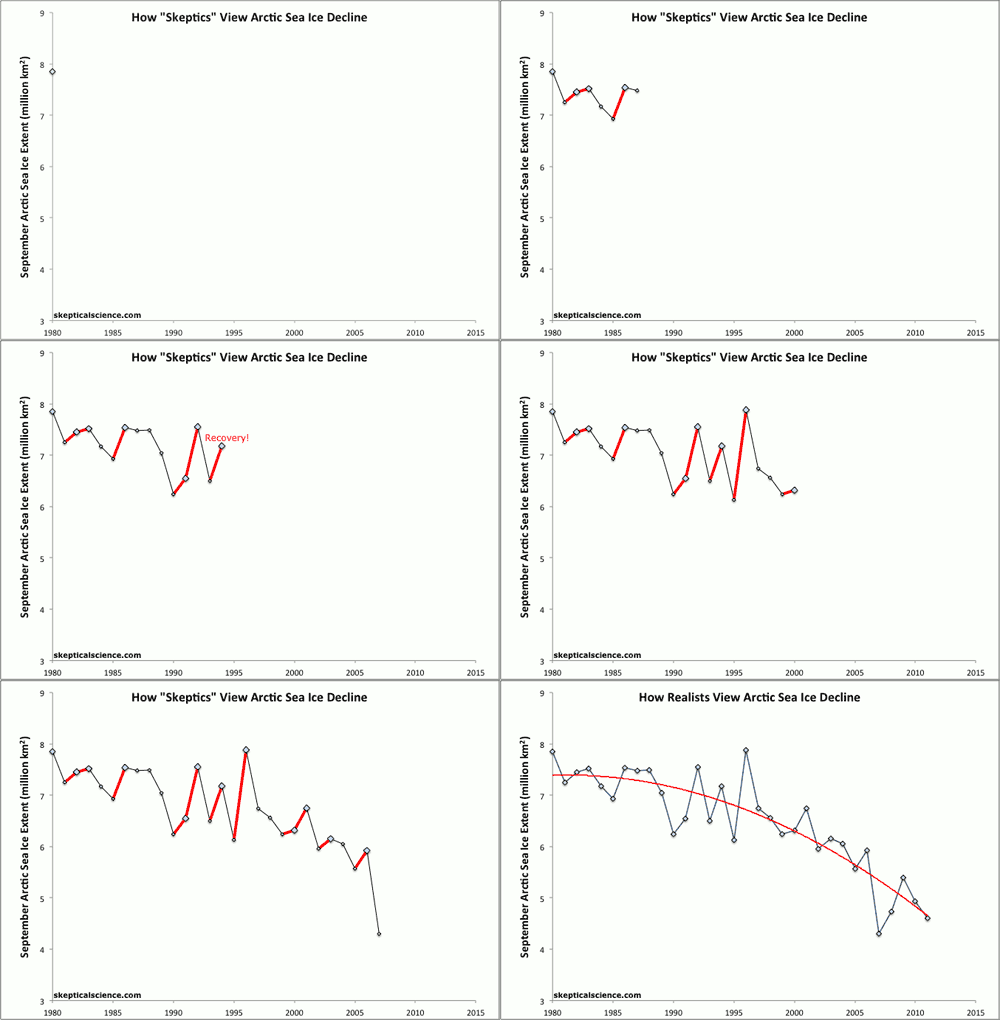
In the grand tradition of the Skeptical Science global temperature “escalator“, Dana Nucitelli has put together an animated graphic that shows how cranks/deniers/faux-sceptics tend to view the Arctic sea ice decline, contrasted with how the rest of the world sees it. Dovetails nicely with my projections of the response to the melt from the crank echo chamber. If next year’s minimum is higher than this year, you can guarantee there will be shouts of recovery…

How low can you go?

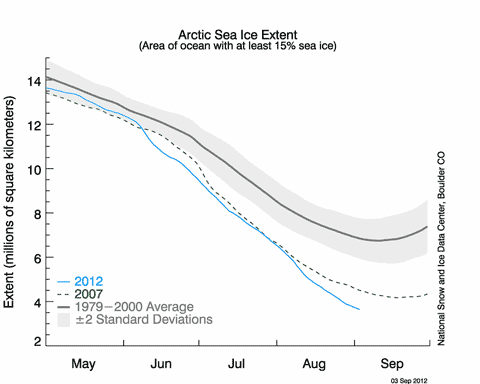
NSIDCextent20120903

Whilst the usual suspects provide compelling demonstrations of just how the motivated rejection of science works in practice, my eyes remain fixed on the far north, where the Arctic melt season is drawing to a close. Above is the current (Sept 3rd) NSIDC sea ice extent graph, tracking well down into record territory. And here’s what the anomaly for August as a whole looks like:
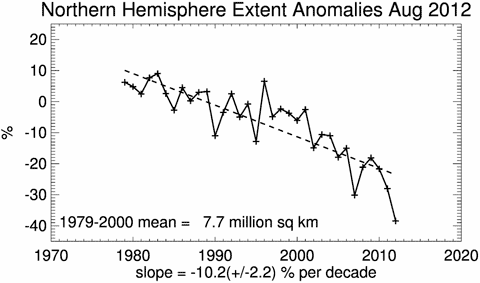
NSIDC201208anom

Reactions to the record-breaking melt around the denialist echo chamber have been tracking my projections rather nicely. I’ll have a roundup when the final accounting of the new record minimum is done. For further reading, check out Fen Montaigne’s article on Arctic tipping points for e360, David Spratt’s summary of the state of play at Climate Code Red and a similar overview from New Scientist, Dana Nucitelli at Skeptical Science with the perfect image that demonstrates why the late 30s were not the same as today, and Gwynne Dyer on the possible consequences. For my views on the ice, the winter, peach trees and The Aviator, Alex Smith interviewed me for his Radio Ecoshock show – embedded below…

[Update 6/9/12] The NSIDC has released its Sea Ice News summary of the August melt:

Following the new record low recorded on August 26, Arctic sea ice extent continued to drop and is now below 4.00 million square kilometers (1.54 million square miles). Compared to September conditions in the 1980s and 1990s, this represents a 45% reduction in the area of the Arctic covered by sea ice. At least one more week likely remains in the melt season.

How fast shall we drive over the cliff? NZ’s ETS watered down (again)

How fast shall we drive over the cliffSimon Johnson looks at the Government’s amendments to the New Zealand Emissions Trading Scheme and concludes we are arguing about what gear to drive in as we speed towards the cliff. The Government has kindly given us the opportunity to make a submission about how fast fast we should go over the emissions cliff. Time to fasten your seatbelts.
Back in July, Tim Groser announced more watering-down of the New Zealand Emissions Trading Scheme (NZETS). About a week ago, on 23 August 2012, Groser introduced the amending legislation – the Climate Change Response (Emissions Trading and Other Matters) Amendment Bill. Consistent with previous emissions trading scheme legislation, the bill will be fully and rationally considered by Parliament’s Finance and Expenditure Select Committee in an insultingly short period of time – ten working days. The closing date for public submissions is Monday, 10 September 2012.

What does this ETS amending bill do?

Continue reading “How fast shall we drive over the cliff? NZ’s ETS watered down (again)”

Low hanging fruit and lost opportunity

I hope the New Zealand Government feels shamed by the news that incandescent light bulbs can no longer be sold in Europe. It could have been so here but following the 2008 election, proclaiming the sanctity of consumer choice, one of the early actions of the then Minister of Energy Gerry Brownlee was to reverse the Labour Government’s decision to phase out incandescent light bulbs. Almost equally dismaying was the statement by the Leader of the Opposition Phil Goff in 2009 that the Labour Government decision was a mistake in the first place. “We’d stopped listening to what people’s priorities were,” he said.

It’s hard to make any sense of the reversal of former Government policy on incandescents other than in the most cynical of political terms. It is in direct contradiction to any concern they express to tackle climate change. Lighting has been estimated to use nearly 20% of the world’s electricity and six years ago the International Energy Agency produced a report which concluded that a global switch to efficient lighting systems would trim the world’s electricity bill by nearly one-tenth. It is a low-hanging fruit in the reduction of carbon emissions. Even the US is to phase out incandescents.

Continue reading “Low hanging fruit and lost opportunity”

Realism and risk: waiting for the bus

Climate Change Minister Tim Groser gave a substantial and intelligently argued speech recently to an informal meeting in Auckland of international climate negotiators met to discuss the  way forward to a new agreement in 2020. Groser makes the case for political realism in climate negotiation. He records his sense after attending a COP conference at Poznam a year before Copenhagen that the negotiation was not on track and that if more reality did not prevail Copenhagen might be a train wreck. It was, and he says that it was only some superb political leadership by the Mexican hosts at Cancun which got the UNFCCC process back on the tracks. “My conclusion is simple: negotiating scenarios which are developed without any political realism behind them cause great and unhelpful friction.”

The claim to political realism is always difficult to argue against, particularly with someone who has spent literally decades in difficult international trade negotiations, as Groser has. But those of us who aren’t negotiators or politicians can’t allow the question to be arbitrated only by those who are.

Continue reading “Realism and risk: waiting for the bus”