
 New Zealand’s new Minister for Climate Change, Paula Bennett, has just confirmed New Zealand will be “carrying forward” 127 million “Hot Air” emissions units (or offsets) under Kyoto Protocol rules. These units mostly do not represent a tonne of carbon dioxide equivalent reduced somewhere else and yet the Government intends to use them to allow New Zealand’s greenhouse gas emissions to continue to increase.
On Thursday 17 December 2015, Ms Bennett released a statement stating that New Zealand had met its 2008 to 2012 Kyoto Protocol emissions reduction target and was well on the way to meeting the 2013 to 2020 target.
The Minister’s statement linked to four reports on the Ministry for the Environment’s website;
- the Biennial report and net position snapshot 2015,
- the Biennial Report to the United Nations Framework Convention on Climate Change,
- the Report upon expiration of the additional period for fulfilling commitments by New Zealand and finally
- the updated Latest update on New Zealand’s 2020 net position.
In two scathing posts last week, blogger No Right Turn assessed the dubious use of the Ukrainian and Russian units derived from — of all things — coal stockpile projects; Climate change: A policy based on fraud and Climate change: How bad is NZ’s climate fraud?.
My previous estimate of the amount of surplus units likely to be used was 86 million units. The reports confirm the number to be 127 million units. I did a back-of-envelope calculation to relate the numbers of units cancelled (to match 2008-2012 emissions) and the numbers left over as ‘surplus’ which may be carried forward.
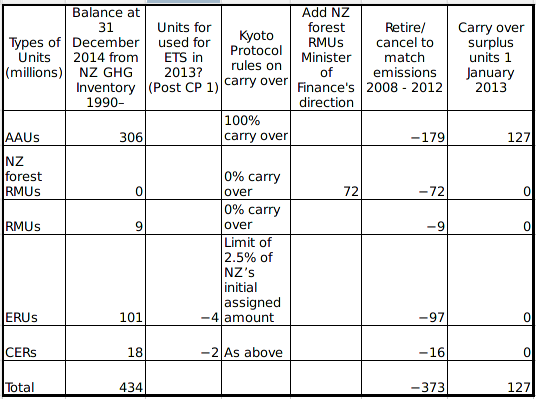
The updated Latest update on New Zealand’s 2020 net position explicitly confirms that New Zealand is ‘re-using’ the surplus units in assessing compliance with the 2020 target of a 5% reduction in emissions from a 1990 gross emissions base. So we will ‘meet’ the 2020 target in spite of projected increases in both gross emissions and net emissions. Gross emissions in 2020 are estimated to be 83 million tonnes, or 24% higher than 1990’s 67 million. Net emissions in 2020 are estimated to be 59 million tonnes, or 24% higher than 1990’s 38 million tonnes.
Manipulating accounting rules like this — so that an adverse trend is systematically misrepresented is as its opposite, a positive trend — is the text-book definition of creative accounting. I agree with No Right Turn that this is another example of New Zealand’s completely unethical climate change policy.
 What can I add to the millions of words in dozens of languages that have already been written by the thousands of journalists and commentators around the Paris Agreement? We now have a globally binding agreement that really looks like it could curtail the use of a fuel that has been central to our way of life for more than 150 years.
 One of the most beautiful things I saw on my facebook feed last week were some angels at Republique, the scene of the attacks last month. Those same angels appeared at the entrance to the UN zone at the climate talks out at Le Bourget the other day as we walked into the centre. Today it was the Greenpeace polar bear, Aurora, roaring at everyone. But whatever is set up to amuse us on the way in, there’s no getting around it: we’re heading to the pointy end of the Paris agreement, and it’s no longer really about pictures. It’s all about words. The text.
 I’ve been in Paris for over a week now, and the speed at which everything goes past, including time, is frightening. I think the 40,000 expected have now all arrived. I’m getting worried the only Eiffel Tower I’ll see is the one made of red folding chairs at the end of the “Champs Elysee” at the meeting.
 Sarah Thomson, the Waikato law student who