You don’t know what you’ve got ’til it’s gone

Biodiversity continues its steady decline. A team of scientists have this week published a study in Science confirming that fact.  Governments in 2002 at a summit on the Convention on Biological Diversity agreed to aim to halt biodiversity loss by the year 2010. When experts meet in Nairobi on May 10 it will be to face the news that they have failed.  For example, since 1970  the world’s animal population has decreased by 30%, mangroves and sea grasses have shrunk in area by 20%, and live-coral coverage has fallen by 40%. “The state of biodiversity is definitely showing a rapid decline,” says Matt Foster, one of the lead authors on the Sciencepaper. “And the pressure just keeps increasing.”

It’s not that governments have made no efforts. The amount of protected land has steadily increased around the world, as has the area of sustainably managed forests. Increased money is being spent on biodiversity aid. But we’re still shouldering other species out of our way. And in doing so we’re attacking our own well-being. “We all benefit from biodiversity and we all hurt when it’s lost,” says Foster.

Climate change is only one of the ways in which humankind is contributing to biodiversity loss.  But it’s worth reminding ourselves that it is seriously exacerbating the process. I’ve been re-reading a fine book by Michael Novacek, Terra, published in 2007. He’s a distinguished paleontologist, Provost of Science at the American Museum of Natural History.  He was involved in the splendid Darwin exhibition put together by the Museum of Natural History which I was fortunate to be able to see when it was brought to the Auckland Museum in 2007.  That’s when I bought his book.  It’s subtitled Our 100-Million-Year-Old Ecosystem –- and the Threats That Now Put It at Risk. I think some points from his chapter on how the current warming is contributing to biodiversity loss are worth recounting here.

He notes changes in the activity of 694 species whose life history data between 1951 and 2001 has been studied.  A 2003 review found on average the species were either breeding, blooming, or doing other seasonally related activities 5.3 days earlier each decade.

The warming trend has also set species in motion. Some move poleward. Other species have moved upslope. Some have simply contracted and their surviving, marginalised populations have been reduced to precariously low levels.

Novacek is interesting on the evolutionary processes at work in the organisms affected by rapid alteration of range. The hardy colonisers which often establish at the leading edge of the shift may have a very low level of gene diversity, leaving them susceptible to further environmental changes. The populations at the trailing edge of the migration may have more genetic diversity, but they will start to fragment as the environmental conditions break up their preferred habitats.  The rate of environmental challenge may determine how a population’s genetic makeup and evolution are transformed. Slow change may be easier for the species to maintain genetic diversity at levels that allow it to persist. Drastic and rapid change make it more vulnerable. Simply moving to a cooler habitat does not guarantee that the genetic composition of the migrating populations will be robust enough to sustain them.

It’s made more complex by the bewildering diversity of examples in nature. Some species, especially in tropical and mountainous regions, may be buffered by the amount of genetic variation already resident in their populations. Other genetic studies suggest that climate change has easily outrun the rate at which a given population can adjust.

Novacek  sees contemporary evidence that climate change in combination with other factors is killing off certain species.  It seems to be the coup de grace for some coral species.  Increasing ocean acidification also plays a part in the demise of coral and threatens the most abundant and ecologically important sea organisms, the coccolithophorids, foraminifera and pteropods which are vitally important food for many fish.

On land, organisms that live in lakes, streams, rivers, and other bodies of freshwater are highly endangered and are especially susceptible to climate change because they cannot escape its effects, being captive in their habitat.

Most threatened are the habitats and species at high latitudes, the northern tundra and polar deserts such as those on the Arctic islands and Antarctica as well as species inhabiting high Alpine or montane habitats at middle to low latitudes.

I liked the last sentence of his chapter. In the preceding sentences he noted what he regarded as encouraging signs of acceptance of the science of global warming.  He recorded, however, still encountering individuals normally open to the discoveries of science who find it beyond belief that humans could disrupt the balance of the planet in such an enormous way. The final sentence: “But science has eventually convinced us before of the unbelievable.”


Prosperity without growth

Prosperity without Growth: Economics for a Finite Planet

I paused for a while wondering whether a review of a book on sustainable economics had a place in a website devoted to climate change. But only briefly. One can’t worry about climate change for long without considering the economies which have given rise to it and wondering how they will survive under the low-carbon regime which they must now adopt.  Anyway carbon emissions figure frequently in the course of Tim Jackson’s book Prosperity Without Growth: Economics for a Finite Planet. Published last year it was based on a report he wrote earlier in the year as Economics Commissioner of the Sustainable Development Commission, the UK Government’s independent watchdog. Increasingly climate change has imparted a new urgency to sustainability thinking. It sits as one of many issues, but it underlines the seriousness of the need to come to grips with the finitude of the planet.

The prosperity Jackson writes of is our ability to flourish as human beings. It transcends material concern. It has to do with such matters as physical and mental health, access to education, relationships and sense of community, meaningful employment and the ability to participate in the life of society. He argues that in the developed countries we can (and must) have such prosperity without the economic growth paradigm that currently rules our thinking.

Jackson recognises the difficulties of the situation we have landed ourselves with.  On the one hand growth is unsustainable, at least in its current form. The burgeoning consumption of finite resources and the heavy costs being imposed on the environment are accompanied by profound disparities in social well-being.  But on the other hand “de-growth’ is unstable, at least under present conditions. Declining consumer demand leads to rising unemployment, falling competitiveness and a spiral of recession. It adds up to a dilemma, but one which we must face and think through.

Some economists place hope in our being able to decouple economic growth from growth in physical inputs and environmental impacts.  Capitalism’s propensity for efficiency figures strongly in these scenarios. Jackson doesn’t think either the historical evidence or the basic arithmetic of growth can support the decoupling notion.  The deep emission and resource cuts needed can’t be achieved without confronting the structure of market economics.

He takes a closer look at this structure. The engine of growth is driven by the ability of the profit motive to stimulate newer, better or cheaper products and services through a continual process of innovation and ‘creative destruction’. This is matched by expanding consumer demand for these goods. A complex social logic drives this demand. Consumer goods have come to play a symbolic role in our lives.  Somehow, beyond the simple material needs they meet, they can become vehicles for our dreams and aspirations, however much they fail in delivering. The economic structure thus combines with our nature to “lock us firmly into the iron cage of consumerism”.

What we need, claims Jackson, is a new ecological macro-economics.  It will still include a strong requirement for economic stability, but it will add conditions that provide security for people’s livelihoods, ensure distributional equity, impose sustainable levels of resource throughput and protect natural capital. New variables need to be brought into play to complement and affect those already part of economic thinking. They will reflect the energy and resource dependency of the economy and the limits on carbon. They might also reflect the value of eco-system services or stocks of natural capital. Ecological investment will be important, and will mean revisiting the present concepts of profitability and productivity and harnessing them to longer term social goals. He urges the abandonment of the infatuation with increasing labour productivity in favour of high employment in low-carbon sectors.

We will need to be weaned from our dependence on consumerism, but he provides evidence that a less materialistic society will be a happier one and a more equal society a less anxious one. Greater attention to community and participation in the life of society will reduce the loneliness and unsocial behaviour which has undermined the well-being of the modern economy.

He argues that there is a clear case today for an increased role for government.  We have already seen an acceptance of this in relation to the 2008 financial crisis. The principal role of government is to ensure that long-term public goods are not undermined by short-term private interests and to deliver social and environmental goods. This role has been diminished by the need in the growth economy to support the consumerism which keeps the economy afloat.

Jackson is leery of revolution, but he proposes steps through which to build change. They fall under three main categories. First, changing the limits. Here he writes of caps on resources and emission, considers the contraction and convergence model, discusses emissions trading schemes and ecological taxes and emphasises the need for support for ecological transition in developing countries.

The second category of steps for change is fixing the economic model. The ecological macro-economics discussed above will lower expectations for labour and capital productivity and account for the value of natural capital and ecosystem services. Ecological investment in jobs, assets and infrastructure will include retrofitting buildings, advancing renewable energy technologies, redesigning networks such as the electricity grid, building public transport infrastructure, maintaining and protecting ecosystems, developing public spaces.  There will be increasing financial and fiscal prudence, including regulation of financial markets.  A Tobin tax on international currency transfers may be considered. Banks will be required to hold higher asset reserves. National accounts will be revised to be more robust than the present rough and ready GDP.

The third category is changing the social climate. Working time may be reduced. Systemic inequality will be tackled. Better measurements of prosperity will be found. Social capital will be strengthened. The culture of consumerism will be carefully dismantled.

Utopia? No, he says firmly. A financial and ecological necessity.

In a final chapter he faces the question of whether this spells the end of capitalism. Certainly growth would be slowed – labour-intense activities mean slower productivity growth, and ecological investment means a lower and longer return on capital. There would also be a larger role for the public sector in taking some ownership stake in the longer-term less productive investments. But capitalist economies often have elements of public ownership.  There is a wide spectrum of possibilities in a capitalist system.  There’s no need to polarize the debate.

I thought the book was splendid. Jackson’s writing is lucid and well organised. He has a gift for the telling sentence. (It was not altogether surprising to discover that in addition to his academic life he is a professional playwright for BBC radio.) He is cautious and sensible, not pretending that the transition to low growth is a doddle.  But he holds firmly to the conviction that it can be made and that the society which emerges will be better than the one we currently inhabit.

Feel floes (gone by 2016)

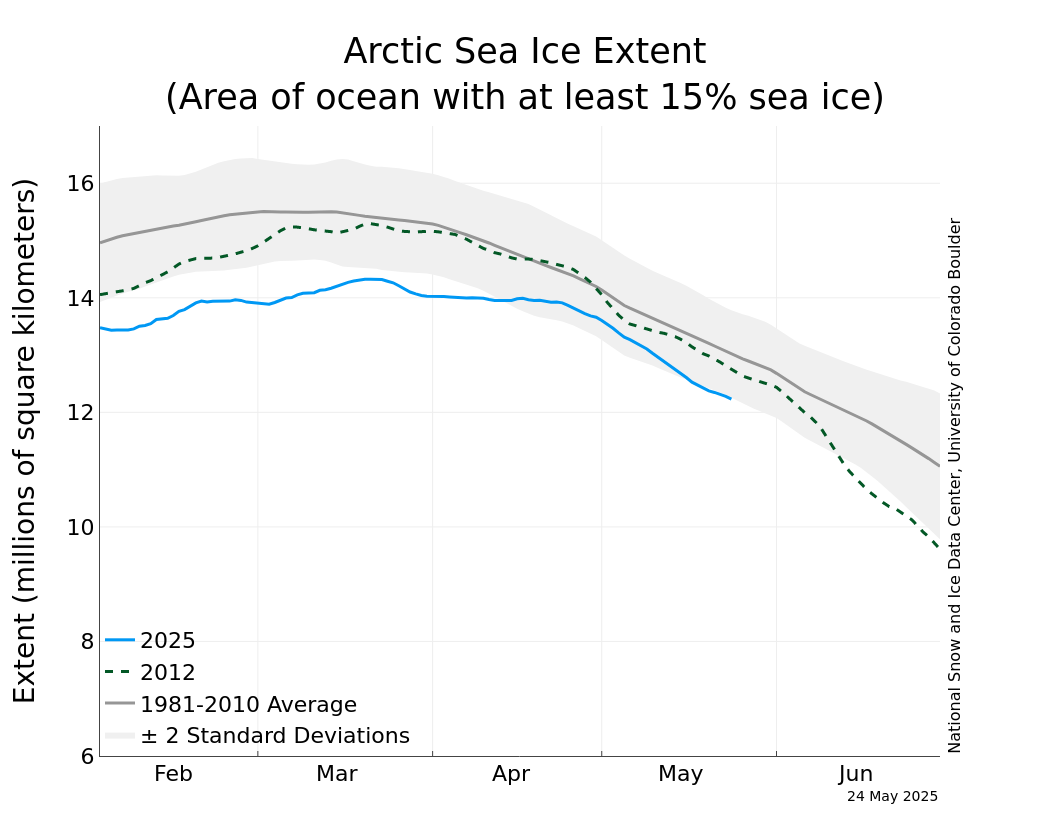
The usual suspects have been making much of the fact that over the last few weeks Arctic sea ice extent (NSIDC daily graph here) has been bumping around the 30 year average for this time of year. John Cook at Skeptical Science posted on the subject last weekend, making the important point that what matters most is not extent or area, but the total volume of ice that’s present — and that’s showing no signs of “recovery”. John’s post is well worth reading, but it set me off on a very interesting trawl through the references he provided — and drew my attention to a most useful graph of ice volume and trend. It also pointed me to research that suggests the Arctic could be effectively ice-free in summer within ten years — possibly as soon as 2013.

Continue reading “Feel floes (gone by 2016)”

There’s nothing quite as sexy as fossil fuels

[youtube]I0oqeJ7a_hE[/youtube]

Slightly off topic, but who can resist two of NZ’s sexiest women having a bit of fun with energy minister Gerry Brownlee, and his plans to mine national parks for more coal? Not me.

Leaked! – NZ talks at Heartland crankfest

BREAKING NEWS: A mole in the Heartland Institute has leaked details of presentations planned for the fourth “International Conference on Climate Change”, to be held in Chicago from May 16 – 18. Over the weekend a file containing a selection of emails between Heartland senior executives and their invited speakers was uploaded to a Russian server, and a link to the file posted in comments at Hot Topic (since removed, to protect the whistleblower). To give you a flavour of the explosive contents, here are extracts in which prominent New Zealand sceptics Bob Carter, Chris de Freitas and Bryan Leyland discuss the talks they plan to give.

Continue reading “Leaked! – NZ talks at Heartland crankfest”