Count to ten

[vimeo]13703209[/vimeo]

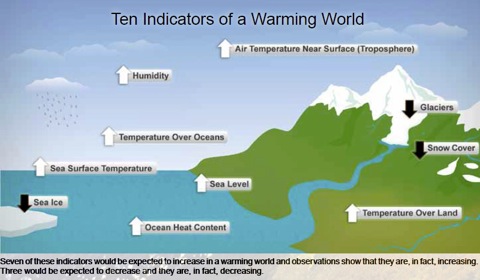
Heidi Cullen at Climate Central covers the highlights of NOAA’s State of the Climate: 2009 report, released yesterday (NOAA press release here). Key message: ten of the most important climate indicators, with multiple datasets for each, show that the planet is warming.

warmingindicators.jpg

It’s worth digging around at the NOAA site linked above — there are animated graphics of all the key datasets (such as sea surface temperature), and NOAA’s new ClimateWatch site also has some nifty graphics — a climate data dashboard — to play with.

The full report is a 110MB download (here) and covers 2009’s climate and weather events in detail, but there’s a 10 page summary for the impatient here. More coverage at Skeptical Science and the Guardian.

[Dusty]

No energy for change

Gerry Brownlee’s draft energy strategy for New Zealand is an interesting read, but not perhaps in the way the government intended. As Bryan discussed in his comment on the strategy, Brownlee puts mining and drilling up front and centre, and relegates environmental and carbon issues to a definite second place in government priorities. You might infer from the document that this is a “strategy” that has been designed to fit with what the government wants to do, rather than what is actually necessary. But what struck me most forcefully was the apparent lack of any well-thought out or detailed context for the strategy. Let’s see if we can supply some, and see where that leads us…

Continue reading “No energy for change”

Brownlee’s energy strategy: dig and burn

The newly released Draft NZ Energy Strategy (PDF, web) is a winding back of the clock from the substantial statement released under the previous government only three years ago. When announcing early in his term as Minister that a new strategy was required Gerry Brownlee complained of the old one:

“You need only read the foreword of the NZES. “Sustainability” and “sustainable” are mentioned thirteen times, “greenhouse gas” is mentioned four times, and “climate change” is mentioned three times. That is all very good, but security of supply rates only one mention. Affordability is not touched on at all. Nor is economic growth.”

Continue reading “Brownlee’s energy strategy: dig and burn”

The Carbon Challenge

The Carbon Challenge: New Zealand's Emissions Trading Scheme

Empty rhetoric.  That’s the verdict on the Emissions Trading Scheme (ETS ) from Geoff Bertram of the Institute of Policy Studies and Simon Terry, Executive Director of the Sustainability Council, in their searching book The Carbon Challenge: New Zealand’s Emissions Trading Scheme.

They present a picture of governmental processes captured by powerful groups pursuing their own interests at the expense of the rest of the community. Large industry and agriculture have won for themselves exemptions and delays of such an order as to make significant emissions reduction impossible in the first commitment period (CP1) of the Kyoto Protocol. At the same time the costs have been loaded disproportionately on to households and small industry. Those responsible for 30% of emissions will carry 90% of the cost. Agriculture with 49% of emissions will pay 3% of the costs.

The authors don’t accept the claim of the agricultural sector that there are few options open to them to reduce emissions. In fact they claim agriculture offers by far the biggest set of low-cost abatement opportunities. There are a number of options that are not only commercially available but profitable to undertake. They instance means for reducing nitrous oxide emissions – nitrification inhibitors, stand-off pads, new grasses, supplementary maize feed, improved soil drainage.  Selective breeding offers the possibility in due course of some reduction of methane as does the supplementary feeding of various plant matter. The processing of casual effluent from milking sheds through bio-digesters cuts both carbon dioxide and methane. Improved carbon storage in soils through pasture management appears possible as does sequestration through biochar burial. Meanwhile agriculture’s exemption from the ETS bolsters higher land prices. Nice for landowners, but subsidised by the community at large.

In the longer run the ETS exemption is against farmers’ own best interests. It is shielding them from likely winds of change in world markets. The authors instance large companies in other countries seeking low-emissions milk, as Cadbury is doing in the UK,  and point to the likelihood that New Zealand will surrender first-mover advantage to such countries if we continue with our present dogged denial.

There is self-defeat for large industry, also, in the favoured position they have gained for themselves. The ETS opens the possibility of production subsidies for high-emission industries by focusing on the intensity rather than the overall quantity of emissions. It is likely, for example, that Solid Energy would be entitled to subsidies for the manufacture of urea from South Island lignite, even though it would be the country’s biggest single industrial emitter of greenhouse gases after the Huntly power station. By this provision New Zealand could provide a welcoming environment for industries relocating from other Annex I countries, via ‘carbon leakage’ from those economies. Such production subsidies will invite tariff retaliation from other countries and could shut New Zealand exports out of key markets.

New Zealand will emerge from CP1 with a level of emissions considerably higher than the 1990 benchmark to which we are expected to have returned. The role of forestry as a carbon sink to offset the country’s emissions is the subject of close investigation in the book, which warns of the reckoning which must be faced when the trees are cut down. Potentially enormous costs could be faced by the next generation when the final accounting is made. Indeed, the costs may be so high as to raise questions about the country’s ability to meet them. This prospect may see other nations disallowing the plantation forest offsetting practice in successor arrangements after CP1. Permanent forests are a different matter, and the authors see these as a real key to balancing the country’s future carbon budgets. They lament the uncertainties and potential retrospective taxation the forestry sector faces by comparison with the government response to demands from large industrial operations.

The book’s discussion of forestry, as of many other aspects of the ETS, is complex and demanding for the general reader. But the ETS itself is highly complex and often difficult to follow. I can well understand the authors’ claim that it’s a reasonable guess that no more than a handful of MPs understood the detail of what they were voting on in 2008 and 2009. I often found myself struggling to get a proper hold on the ramifications of the various processes the book explores, even though the authors have been exemplary in the patience and thoroughness of their explanations.

It is the exhaustive care they bring to their task which makes the reader respectful of the summary statements which emerge from time to time in the course of their discussion, such as this one:

“The ETS has not been designed to promote economically efficient abatement.  It has been designed firstly to protect and promote the position of vested interests that are unwilling to shoulder asset write-downs required to recognise a price on carbon, and secondly to transfer the costs of this to future generations.”

However there are countervailing forces at work against the formidable clout wielded by agricultural and other major emitter lobbies. The authors nominate three domestic factors which could upset the current political equilibrium. One is the possibility that the lack of trust in the forestry regulatory regime may deter new planting in general and permanent afforestation in particular; this would increase pressure for reform of the ETS.  The second is that sections of the population and the economy will become more concerned about climate change and the lack of any effective action at home to reduce emissions. The third is that the recognition of the size of the carbon debt we are passing to future generations by using forest credits to cover excess emissions may become a moral issue.

They also point to international factors which will put our ETS under pressure. One is the pressure we will come under if international emissions targets move towards being set more on a per capita basis. It would be very risky for us to go forward with gross emissions far above any we could hope to defend in a global commons debate.  Another is the possibility mentioned above of changes to the rules relating to forestry in a CP2 period. A third is the risk of border taxes and other adjustments we could well face from other governments and from private-sector firms if our climate change policy is shown to be incapable of matching the climate change objectives it espouses.

In the ETS we have shied away from the present costs involved in serious action to reduce emissions. But in doing so we have laid up for ourselves the far greater costs which will be the result of doing nothing now. That is the basic warning of the book. New Zealand is part of the developed world and will not be able to escape its fair share of responsibilities as we appear set on trying to do.

Technology advances, politicians hold back

In the face of the utterly depressing final confirmation that the proposed energy bill has been abandoned in the US Senate in the face of Republican opposition, and the realisation that Obama has let the opportunity die without a fight, as Joe Romm puts it, I cast around for something cheering this morning.  I found it in an interesting article on Chris Goodall’swebsite Carbon Commentary. The article describes the world’s first molten salts Concentrating Solar Power (CSP) plant. It’s not the first to use molten salts, in that many of the newer CSP plants use molten salts storage to extend the plant’s daily operating hours, but it is the first to use molten salts not just to store heat but also to collect it from the sun in the first place. Normally, pressurised oil which heats up to around 390 degrees is used to collect the heat.

Molten salts can operate at higher temperatures than oils, up to 550 degrees, thus increasing the efficiency and power output of a plant. With the higher-temperature heat storage allowed by the direct use of salts, the plant can also extend its operating hours longer than an oil-operated CSP plant with molten salt storage, working, the article claims, 24 hours a day for several days even in the absence of sun or during rainy days.

This feature also enables a simplified plant design, as it avoids the need for oil-to-salts heat exchangers, and eliminates the safety and environmental concerns related to the use of oils.

Significantly, the higher temperatures reached by the molten salts enable the use of steam turbines at the standard pressure/temperature parameters as used in most common gas-cycle fossil power plants. This means that conventional power plants can be integrated – or, in perspective, replaced – with this technology without expensive retrofits to the existing assets. The first plant, a small one of 5 MW, located in Priolo Gargallo (Sicily), is fully integrated to an existing combined-cycle gas power plant.

A small comfort, perhaps. However the writer describes it as a top-notch world’s first, expensive at around 60 million euros but with overwhelming scope for a massive roll-out of the new technology at utility scale in sunny regions like Northern Africa, the Middle East, Australia, the US.

Solar power is certain to play a large part globally in a future of renewable energy, if we don’t destroy that future before it arrives, and the constant improvements in harnessing the power of the sun are highly encouraging.

Meanwhile back in New Zealand the government has today released a draft of its proposed new energy strategy, which Gerry Brownlee announced the need for shortly after becoming Minister of Energy because the previous one  was just “an idealistic vision document for carbon neutrality”.  I’ve only had a cursory look so far, but it certainly looks like the great step backwards that he signalled. In the section headed Areas of Focus the leading item is “Develop petroleum and mineral fuel resources.” This is what it means:

“The country already benefits substantially from the revenue gathered from the development and sale of petroleum and coal resources, and both are significant export earners.

“Further commercialisation of petroleum and mineral fuel resources has the potential to produce a step change in economic growth for the country.”

The document does move on to renewables:

“The Government retains the aspirational, but achievable, target that 90 percent of electricity generation be from renewable sources by 2025 (in an average hydrological year) providing this does not affect security of supply.”

But we’re not going to get carried away with aspiration:

“Achieving this target must not be at the expense of the security and reliability of our electricity supply. For the foreseeable future some fossil fuel generation will be required to support supply security.”

There is some useful stuff on renewables and on new technologies, but the minister is obviously unwilling to face the reality of what continuing to produce and burn petroleum and coal actually means for the climate. It means hell and high water, to use Joe Romm’s words in his book of that title. In that book Romm also said that the global warming problem is a now only a problem of politics and political will. Technologies advance, but politicians lag.