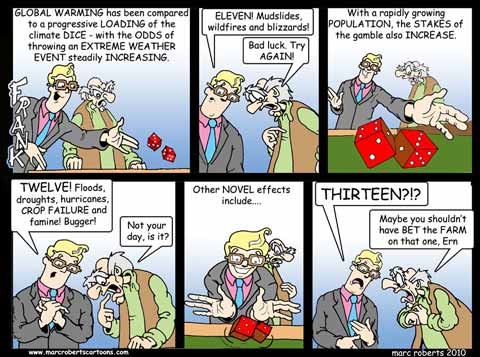
Tumbling dice

thirteen.jpg

Statement of Pakistan’s Foreign Minister, Mahmood Qureshi to the UN general assembly:

Climate change, with all its severity and unpredictability, has become a reality for 170 million Pakistanis. The present situation in Pakistan reconfirms our extreme vulnerability to the adverse impacts of climate change. It also complicates the reconstruction and rehabilitation scenario in Pakistan. Nature has made a graphic endorsement to strengthen the case for a fair and equitable outcome from the ongoing UNFCCC negotiations.

For more on the Pakistan flood disaster, see the Guardian, BBC and The Cost of Energy amongst many others, and for those wishing to donate, 350.org has a useful page of options. My own choice for disaster relief is Oxfam.

Worth noting too that Indonesia is experiencing “super extreme” weather at the moment, and that floods have also hit the China/North Korea border region.

[Hat-tip to Only In It For The Gold for the cartoon. Do you feel lucky? Well, do you punk?]

[Rolling Stones, Knebworth ’76]

Friday’s dust

The weekend’s coming, and so I’m clearing out some of the stuff that’s cluttering up my web browser. NIWA recently posted an excellent explanation of the carbon/greenhouse gas relationship in pastoral agriculture, taken from the July issue of their magazine, Water & Atmosphere: Why isn’t grass in, methane out, carbon neutral? Click on the image above to see the carbon flows in a typical paddock. The article’s a good overview of why agricultural methane’s important, worth a read.

Lord Nick Stern is giving this year’s Sir Douglas Robb Lectures at the University of Auckland (Sept 8 – 10, with live link to Wellington), on Managing the risks of climate change, overcoming world poverty and creating a new era of growth and prosperity: The challenges for global collaboration and rationality. Over three nights he’ll be considering how we can reconcile dealing with climate change while promoting development where its needed, the sorts of policies required, and the global context for action — developing themes from his book A Blueprint for a Safer Planet. I hope Key and co are paying attention…

Continue reading “Friday’s dust”

Challenged by Carbon

Challenged by Carbon: The Oil Industry and Climate ChangeOil industry geologists have hardly been noted for their readiness to accept the findings of climate science. The American Association of Petroleum Geologists, a large international organisation of 31,000 members, is non-committal in its 2007 statement, though that was admittedly an advance on their previous rejection of anthropogenic warming.  Bryan Lovell has worked as a BP geologist as well as an academic, but the title of his book is enough to indicate that non-committal is not for him: Challenged by Carbon: The Oil Industry and Climate Change.


In his acceptance of the case for anthropogenic global warming Lovell lays great stress on the evidence from the past, long before there were any of the human species to influence what happened. The Paleocene-Eocene Thermal Maximum (PETM), a warming event 55 million years ago, is his focus. It is preserved in the geological record and the changes it caused to life on the planet mark the boundary between the two epochs. First, a large quantity of carbon was released into the ocean-atmosphere over the geologically short period of some 10,000 years. Second, the temperature at the bottom of the ocean increased rapidly by more than 4 degrees over the same short period. Third, the oceans became notably more acidic. All this was accompanied by a general and significant global warming. It took some 200,000 years for the planet to return to something resembling the conditions prevailing before the massive and sudden release of carbon. Lovell remarks an ominously striking correspondence between the rate at which large volumes of carbon were introduced 55 million years ago and the rate at which large volumes are now being put into the atmosphere by us.

He considers the evidence of this event is more likely to carry weight with oil industry geologists than the computer-based models of complicated natural systems employed by climatologists. Geologists are “happiest when basing their predictions on the solid ground of rocks”. This may be a useful insight into the slowness of some geologists to take climate change seriously, but it left me wondering at the somewhat blinkered intellectual world which it suggests. I also wondered whether Lovell sufficiently appreciated the attention climatologists pay to the past in their predictions of what lies ahead. He acknowledges that the picture is somewhat mixed, but broadly sees climatologists focusing on predictions of the future, relying on a combination of past trends and computer modelling to make their forecasts, by contrast with geologists who look back in time. Is this contrast real? Leading climatologist James Hansen frequently stresses that his order of importance is first paleoclimate studies, then ongoing climate observations, with climate models in third place. Also detailed discussions of the PETM and other significant global change events in the past are common in books concerned with climate change.  However, if only the story told by rocks will suffice for oil geologists so be it. It has certainly brought Lovell on board.

“It is now plausible for the geological community at large, not least those in the oil industry, to join with the climatologists and conclude that if we continue to release carbon dioxide  into the atmosphere at the present rate we shall, this century, experience among other effects significant acidification of the world’s oceans and an overall global rise in sea level. Even at the lowest likely level these changes will have a significant adverse effect on our species and at their upper  likely levels would be disastrous for many of us. How will the oil industry react?”

Lovell comments that protestations of virtue concerning climate change by oil companies have become a commonplace this century. Some may maintain a degree of cynicism as they read his descriptions of how this plays out within the industry itself, but he makes a reasonable case that there has been some change in industry perception.  He acknowledges the contradiction in accepting the reality of anthropogenic climate change, yet predicting that fossil fuels will form an essential part of energy provision through to the middle of this century and beyond. He calls it not contradiction but paradox, as indeed it could prove if the serious industry investment in carbon capture and storage he urges were carried through to success.

It is this prospect which is the main burden of the book. Lovell sees little possibility of the world forsaking fossil fuels. “Lofty and high-level” arguments are unlikely to prevail in either the comfortable developed countries or the aspiring developing nations. They would need to be convinced that the rapid elimination of the oil and coal industries is really necessary. His book is not intended to offer such conviction.

What he does offer and advise is the engagement of the oil industry in carbon capture and storage. The scientific expertise it has gathered is highly relevant to the task:

“Petroleum engineers and petroleum geologists seek to understand the rocks beneath our feet, how fluids move through those rocks and how those elements may interact with the minerals lining the pore spaces and pore throats through which they travel. This understanding is just what is required to assess the suitability of any given location for the safe storage of carbon dioxide and to then store that gas securely within the rocks below.”

The details are followed through in some detail in a chapter headed Safe Storage: From Villain to Hero. Existing oil reservoirs offer useable opportunities, but not sufficient to satisfy the very large requirements.  For that the use of saline aquifers will be needed. Lovell reports studies on the feasibility of such storage, some of them dealing with the reaction of the reservoir rock to fluids made more acid by the addition of injected carbon dioxide. Careful assessment of prospective sites is required. He is cautious in his appraisal, but optimistic that carbon dioxide can be safely trapped in reservoirs over geological timescales. Along the way he acknowledges the work of Kelemen and Matter (reported here in Hot Topic) on the possibility of trapping carbon dioxide in a type of igneous rock – peridotite – with which it would react rapidly. The concern for him is the absence of natural seals in such a process, and he considers pilot ventures are likely to remain focused on sealed reservoirs.

Oil companies work for profit. That is why the issue of a carbon price is critical if the expertise of those companies is going to be harnessed to capture and store carbon.  The price, says Lovell, has to reflect a real understanding of the danger of not controlling the release of carbon dioxide. Increased government regulation is essential to set the scene.

The book is lively and engaging and well worth attention. Lovell straddles two worlds which often enough appear to have little intercourse. Carbon capture and storage gets a mixed press in discussions of climate change mitigation. But if it really is feasible, and if setting a price on carbon will make it doable by those with the necessary expertise and finance, it has the potential to be a significant contributor to emissions reduction. Even if we find ways to replace fossil fuel much more quickly than Lovell envisages we will still need to sequester some of the excess carbon with which the atmosphere is already overloaded.

[Purchase from Fishpond (NZ), Amazon.com (US), Book Depository (UK, free shipping worldwide)]

When warming burns…

Severe risks to human health will accompany the disturbed global climate which comes with global warming. We have only to consider the consequences of the heat waves, the flooding, the African droughts, of recent times to be alerted to that. Our experiences of climate change in New Zealand are unlikely to reach such extreme levels, but we would be wise to think and prepare ahead for the kind of human health hazards we may expect to encounter. Chapter 8 in Climate Change Adaptation in New Zealand (pdf download) is an attempt to sketch out measures we might prepare to take. Four of the five writers are from the Department of Public Health at the University of Otago and one from Victoria University.

The paper rehearses some of the widespread major impacts which will affect human health globally. Higher maximum temperature will lead to increased heat-related deaths and illnesses and contribute to an extended range of some pest and disease vectors. Droughts and forest fires will increase in severity and frequency. More intense rainfall will lead to slope instability, flooding and contaminated water supplies. More intense large-scale cyclones increase the risk of infectious disease epidemics (e.g. via damaging water supplies and sewerage systems) and the erosion of low-lying and coastal land through storm surges. Indirect effects include economic instability, loss of livelihoods and forced migrations.

We have early indications of what the changes are likely to be, and it’s important to be ready with a range of policies to address them rather than wait and react as they occur. Prevention is better than cure. New Zealand may not experience the extremes which will be felt in some parts of the world, but there is much that would wisely be given attention.

One eventuality for which we need to be prepared, and which the article highlights, is the possibility of New Zealand becoming a lifeboat to those living in more vulnerable Pacific countries who are displaced by the impacts of climate change. Particularly is this to be expected if a high carbon scenario prevails, as increasingly seems on the cards. Families forced to leave their island homes are likely to form a pattern of chain migration to New Zealand. Unless, under such circumstances, we recognise the need to build extended-family houses or generally increase the supply of low-income family housing to accommodate these immigrants, we are likely to see an increase in overcrowding in state houses and other low-income housing. This could mean a dramatic increase in the risk of a number of infectious diseases.

Infectious diseases are likely to become more prominent with climate change. Warmer temperatures and increased rainfall variability can increase food-borne and water-borne diseases. Vector organisms such as mosquitoes, ticks and sandflies are strongly affected by temperature levels and fluctuations. Hopefully the risk of dengue in New Zealand may remain below the temperature threshold for local transmission, but there is likely to be a potential for outbreaks of Ross River virus infection.

Flooding is another aspect of climate change to which the paper gives some attention. Adaptive responses, such as health and housing protection and provision during and after extreme events, should not increase health inequalities.  The spectre of New Orleans is invoked to illustrate this. The possible need for relocation of towns and even parts of cities looms in some areas of the world. In New Zealand the sustainability of Kaeo, flooded several times in recent years, has been questioned. But given low income levels and less disposable income for private insurance in such towns, government assistance is likely to be needed to facilitate relocation.

Other possible health impacts in New Zealand are touched on, including the effects of heat stress on outdoor workers, the exacerbation of asthma symptoms from increased amounts of allergen-producing pollens, the possibility of water charging by local authorities depriving lower income households of access sufficient to ensure general cleanliness.

Isolation and poor access to services puts people at increased risk. Severe mental health problems are identified as a likely risk in rural communities suffering the effects of extreme weather events. Such vulnerability extends also to low-income populations living in socio-economically disadvantaged, residentially segregated areas where there is less public transport and fewer people who own or have access to cars. The paper makes a good deal of the need for adaptation policies to be equitable and fair and inclusive.

Individual adaptive action can be hampered by lack of understanding, but may be attractive when there are co-benefits. An example is walking, cycling and taking public transport which can be presented as less a sacrifice of time and convenience and more an opportunity to socialise, keep fit, and do one’s bit towards a smaller carbon footprint.

At the community level the paper points to the critical role of local government. The progressive modification of urban form will be an important part of adaptation. Intensifying housing, for example, can reduce the vulnerability of dispersed communities and at the same time help build social capital that links together different social and ethnic groups, while reducing car dependence and energy use. Health and environmental benefits can flow from this.

New Zealand cities have little high density housing and a good many large sprawling suburbs. Some attention is beginning to be given to climate change adaptation issues. The paper focuses on dealing with storm-water run-off and urban heat island effects. Trees, parks and roof-top gardens and reduction of roads and parking lots are among the measures to reduce heat effects. Passive cooling of buildings through good design and the painting white of some surfaces also works to this end. Measures to slow storm water run-off, such as rooftop collection, replacement of hard surfaces by porous paving and well-vegetated low-lying areas can reduce risks. Steps to prevent the incursion of storm water into sewerage systems are important.

Enhanced social networks in cities and other local communities will be needed to provide closer monitoring of, and assistance to, vulnerable people and populations. Living behind locked doors with little neighbourhood contact is not a good preparation for the stresses climate change will bring.

Some needed changes require central government involvement. The paper mentions such matters as retrofitting houses to make them more energy efficient, raising standards in the Building Code, providing social housing. But it also notes that the government record to date shows little sign of advance, and that lack of government progress on mitigation makes adaptation more difficult.

Local government in New Zealand is already expected to take climate change into consideration in its planning, and is provided with useful information by the Ministry for the Environment for doing so. The kind of thinking about health impacts expressed in this paper fits well into the overall intention to “avoid or limit adverse consequences and enable future generations to provide for their needs, safety and well-being.”  Some of it overlaps with measures already recommended to councils. All of it is worth taking up in the discussions and reports that mark local government.  Central government seems trickier ground, more subject to the vagaries of ministers and politics, but one hopes that the good sense represented in papers such as this makes its way there too.

NIWA v cranks 3: the economics of truthiness

Bryan Leyland’s dissembling about the funding of the NZ Climate Science Coalition under direct questioning from Sean Plunkett on Monday morning’s Morning Report on RNZ National — he repeatedly asserted his ignorance of financial matters, directing Plunkett to Terry Dunleavy — puts him in an awkward position. Leyland is a trustee of the NZ Climate Science Education Trust (along with Dunleavy and Doug Edmeades), the body hastily established to request a judicial review of NIWA’s national temperature record. Before lodging papers with the High Court, the trustees should have held a properly minuted meeting and discussed how they intended to fund the action — both in terms of meeting any legal fees, or dealing with any costs awarded against them. This would be standard good governance practice in a charitable trust, and if such a meeting were held then Leyland must be fully aware of the NZCSET’s current funding, and how it expects to fund an expensive and risky legal action. If no meeting were held, or Leyland has no idea how the trust expects to fund the action, then he is failing in his duty as trustee. Perhaps this is an issue that Plunkett and Morning Report might like to follow up…

Listen to the Morning Report segment here:

Climate sceptics take NIWA to court over data

Some interesting dates: I understand that the Statement of Claim lodged with the High Court is dated July 5th, and refers to the NZ Climate Science Education Trust. However the NZCSET’s Deed of Trust (go here, and enter 2539286 in the organisation number search box) is dated July 30th so did not exist when the Statement of Claim was drawn up. The Statement of Claim also states that the NZCSET is a registered trust, but registration was not granted until August 10th. Minor administrative matters, I am sure, but hardly indicative of the creation of trust intended, as its deed says, to:

…promote a heightened awareness and understanding of, and knowledge about, the climate, environment and climate and environmental issues among scholars and researchers, members of the professions and members of the public… (Sec 4.1.1)

One might suggest that the cart was put a very long way in front of the horse. More reaction to this strange affair below the fold…

Continue reading “NIWA v cranks 3: the economics of truthiness”