Monckton: the final slapdown

Britain’s most bumptious climate crank, Christopher, Viscount Monckton of Brenchley, deputy leader of the UK Independence Party (a party so fringe it probably has a surrey underneath) and inventor of a cure for AIDS, multiple sclerosis, influenza, and herpes simplex VI, gave evidence to a US Congressional committee last May at the invitation of the Republican party. As Monckton watchers might recall, his testimony was riddled with errors, and now a team of top scientists (including the one he threatened to sue, John Abraham) have submitted a detailed rebuttal [Response to Monckton (PDF)] to Congress. Skeptical Science has all the details, and Leo Hickman at the Guardian covers the story here, but for connoisseurs of the potty peer, his email to Hickman responding to the rebuttal is a minor classic:

The scientists were unaware of my letter to Congress because they did not have the good sense or courtesy to contact me – or even to contact the vast majority of the scientists whose conclusions I had cited – before circulating to friendly news media their prolix, turgid, repetitive, erroneous and inadequate response to my testimony. From their calculatedly furtive approach, it is legitimate to infer that their exercise was motivated more by politics than by science. One of the lead authors is currently under criminal investigation for alleged fabrication of results: another has been caught out in repeated lies: a third admits to suffering a mental disability: and many of the scientists whom these lead authors invited to contribute are among the long-discredited clique of Climategate emailers. Accordingly, it is unlikely that Congress will pay much attention to their political rant, which displays a lamentable absence of quantitative detail and a pathetic reliance on fashionable but questionable forecasting techniques that have long been compellingly contradicted by hard data.

I’ve highlighted the best bits. Perhaps he was upset that the scientists point out that his testimony that ocean acidification could not be caused by CO2 provides “a compelling example of his lack of understanding of ocean chemistry”. I await his 400 page response with interest… In the meantime, let’s just revel in the breathtaking hypocrisy that has become the good Lord’s hallmark.

The politics of failure/the failure of politics

As an example of contradictory thinking it would be hard to better Energy and Resources Minister Gerry Brownlee this week. He was announcing that oil and gas exploration in New Zealand is to get a substantial boost in government resources, including funding to further the possible exploitation of deep-sea methane hydrates.

He made a plea for New Zealanders to consider the potential for an accelerated oil and gas discovery programme to be achieved in an environmentally responsible way.

“People need to shift their thinking on exactly this issue. The development of New Zealand’s natural resources and the protection of the environment are not mutually exclusive. It is only through a strong economy that New Zealand can afford the expenditure required to look after and improve our environment.”

Is it unfair to construe this as follows?

We need to mine more oil and gas, the burning of which will hasten dangerous climate change, in order to become rich enough to deal with dangerous climate change.

In fact of course, when Brownlee talks of the environment he is probably not thinking of climate change at all.  He gives very little evidence of ever thinking of climate change.


The contradictions of which Brownlee is an example are deeply embedded in the political scene in a great many countries. There is very little indication that governments are preparing to stop the mining of fossil fuels.  Indeed there’s every indication that they’re ready to increase it whenever it looks as if there could be an economic benefit in doing so. Even the monstrous environmental assault of the extraction of oil from the Canadian tar sands is justified by its proponents. American Senator Lindsey Graham, who once supported a US climate bill, announced recently on a visit to view operations that he was going to do all he could to make sure that the oil sands production was not impeded because of US policy. He remarked that its production “really blends in with the natural habitat”!

One risks being regarded as slightly mad in declaring that a rational New Zealand would leave any possible new oil and gas fields undisturbed, along with coal unless effective carbon capture and sequestration processes are in place. But that seems to me to be the sane view at this stage of our understanding of what greenhouse gas emissions are doing to the climate.

George Monbiot has been reflecting on gap between the grand announcements of governments about emissions reductions and the reality that they aren’t achieving them. In a bleak column this week he writes that the failure of the international political process to find a successor to Kyoto means that “there is not a single effective instrument for containing man-made global warming anywhere on earth.”

It’s not as if the warnings are getting weaker.  They are clearly mounting as the evidence continues to accumulate.  But “the stronger the warnings, the less capable of action we become.” We were mistaken to think that something might come out of the last 18 years of talk and bluster. Environmentalists tend to blame themselves, but there was no strategy sure of success. The powers ranged against us are too strong.

“Greens are a puny force by comparison to industrial lobby groups, the cowardice of governments and the natural human tendency to deny what we don’t want to see. To compensate for our weakness, we indulged a fantasy of benign paternalistic power – acting, though the political mechanisms were inscrutable, in the wider interests of humankind. We allowed ourselves to believe that, with a little prompting and protest, somewhere, in a distant institutional sphere, compromised but decent people would take care of us. They won’t. They weren’t ever going to do so.”

Monbiot concludes that we must stop dreaming about an institutional response that will never materialise and start facing a political reality we’ve sought to avoid. I guess here in New Zealand that means accepting that the juggernaut of “resource” exploitation is going to roll on and leading politicians are going to continue to talk as if they’re protecting the environment while they’re in the process of destroying it. It also means that only strong organised implacable challenge is likely to have any effect – there is a small ray of hope in the success of mobilised public opinion against mining in protected conservation areas, but whether that kind of mobilisation can be raised against fossil fuels remains to be seen.

It may be worth noting that another columnist this week found reason to sound more upbeat, though certainly not about his own country. Thomas Friedman, writing in the New York Times, lamented the failure of the US senate to pass the energy-climate bill but pointed to the seriousness with which Chinese Communists were by contrast tackling the climate change issue and turning it into an opportunity for the development of clean technologies.  Friedman is inclined to optimism, as was apparent in his book Hot, Flat and Crowded, but he provides some basis for it in the case of China.

He quotes Peggy Liu, chairwoman of the Joint U.S.-China Collaboration on Clean Energy, a nonprofit group working to accelerate the greening of China.

“China’s leaders are mostly engineers and scientists, so they don’t waste time questioning scientific data…China is changing from the factory of the world to the clean-tech laboratory of the world. It has the unique ability to pit low-cost capital with large-scale experiments to find models that work.”

Friedman points to the way China has designated and invested in pilot cities for electric vehicles, smart grids, LED lighting, rural biomass and low-carbon communities.

It’s perhaps not much to pin hopes on, especially as coal continues to be used for much new power generation in China. But it may well yet be the case that burgeoning clean technologies will take us further than politicians can. In my inbox this morning was information from the Earth Policy Institute on the continuing rapid growth of solar photovoltaic cell production, described as the world’s fastest-growing power technology. China, Japan and Taiwan are the leading manufacturers. The writer acknowledges that it remains more expensive than fossil fuel-generated power, but points out that its costs are declining rapidly. If fossil fuels ceased to receive subsidies and were required to incorporate their currently externalised costs their relative cheapness would be exposed as only apparent.

Which is good reason to argue in New Zealand for more even-handed government investment in renewables by comparison with fossil fuel extraction. The absurdity of offering so much support for fossil fuels and so little for the green technologies on which our future, if we have one, will depend might be realised by some in our government if we keep on insisting. But it remains a hard slog.

[Cream]

House by the sea (not a good idea)

The Royal Society of New Zealand has just published an interesting paper on sea level rise [pdf], the latest in a series on “emerging issues” of public concern. It’s a very good overview of the current state of our understanding of the risk of future sea level rises, reviewing the evidence that’s accumulated since the IPCC’s Fourth Report (AR4), and puts that information into the NZ context.

The paper suggests that as we’re learning more about the behaviour of the great ice sheets of Greenland and West Antarctica it’s becoming clear that there’s a risk of sea level rise this century much greater than the upper limits given in AR4 (which ignored increasing ice sheet melt). On the other hand, the extreme rates of sea level rise seen during the last deglaciation (4-5 metres per century at times) look less likely, with data from the last interglacial (LIG, aka the Eemian) suggesting 1.5 metres/century is more plausible.

The RS paper also includes a useful summary of various SLR planning guidelines issued around the world. New Zealand’s guidelines (Bryan’s take here), based on AR4, look to be on the low side, but speaking at the press conference to launch the paper, Prof Martin Manning, director of Climate Change Research Institute at Victoria University , suggested that in his recent experience Environment Court judges were taking care to stay abreast of current scientific knowledge. That’s important, because as NIWA’s Doug Ramsay pointed out at the conference, 12 of the 15 largest towns and cities in NZ are on low-lying coastal and estuarine margins, there’s been enormous pressure to develop on prime beachfront locations and large chunks of our road and rail infrastructure are within 5 metres of current sea level.

[Iron & Wine]

Ask me why

Sadly the Greenhouse Policy Coalition (GPC) welcomes the result of the poll they commissioned from UMR Research, as reported today in the Herald.  I’ll comment on the poll a little later in the post, but first a reminder of what the GPC stands for. It includes some of the largest emitters of greenhouse gases in its membershipwhich it describes as “a large and diverse range of New Zealand industry and sector groups covering the aluminium, steel, forestry (including pulp and paper), coal, dairy processing and gas sectors.”   They are described as responsible for 14% of GDP and 31% of total exports.

Note they do not deny the reality of human-caused climate change:

“The Coalition accepts there is growing evidence of a causal connection between observed changes in the global climate and human-induced emissions of greenhouse gases.  The Coalition considers there is sufficient scientific evidence to warrant the adoption of appropriate precautionary public policy measures.”

But their notion of what constitutes appropriate measures is severely constrained by their determination to protect what they call the competitiveness of all sectors of NZ industry. They urge a wait and see attitude when it comes to doing anything of consequence to reduce NZ emissions.

“Climate change public policy should … be moderate and measured until such time as it is appropriate, and justified, to be otherwise.”


Current government policy seems to fit their bill pretty well. Although they would have preferred a suspension of the ETS they have welcomed the relief the revised scheme offered to large businesses.

Given the tepid policies being advanced by the government, the results of the commissioned poll are probably not surprising.  45.8 per cent think climate change is happening and is caused by humans – up 1.6 per cent from previously.  32.7 per cent think the climate is changing but are uncertain as to whether it is caused by humans – down 3 per cent. 19.3 per cent think the problem doesn’t exist – up 1.8 per cent.

But although 45.8 per cent think climate change is caused by humans only 36.3 per cent think it is a serious issue – down from 42.6 per cent last year. Generally speaking numbers were down on all measures aimed at mitigating climate change. For example, the 23.4 per cent of people who agreed New Zealand should reduce its emissions, even if it meant reducing the standard of living was 11 per cent down on last year’s 34.9 per cent.

Last year climate change concern was eighth in order of importance. This year it is tenth.

The GPC’s executive director, David Venables, said the results of the survey reinforced the Government’s decision to moderate the impact of the Emissions Trading Scheme and the need to fine-tune it to keep in step with New Zealand’s main trading partners – which lagged in implementing their own schemes – and the rest of the world.

In other words, in the court of public opinion the government is on the right track.

But can reasonable judgment be delivered by public opinion at the present? Public opinion is not being informed of the seriousness of climate change.  The majority of our political leadership displays little or no sign of concern at the mounting dangers of increasing greenhouse gas emissions. The message they thereby deliver to the public is that the issue is not of great importance. The public gratefully receives this message and turns its mind to more immediate concerns. Whereupon the likes of the GPC point to lack of public concern as a sign that the government has got it right. It’s not too difficult to see a mutual ratcheting down process proceeding happily between politicians and the public until the folly of it becomes too apparent to ignore. And heaven knows how far off that might be.

One has to hope it will be the ineluctable science which interrupts the process and not the onset of severe events. But I have been hoping that for a number of years now, and there is little sign of full appreciation of the science in the political sphere, in the media, or in the leadership of many major companies. From where is the general public able to receive the message if it is excluded from the mainstream of political and economic life?

Real understanding of the scientific evidence would mean that David Venables would lament the result of the poll. It would see John Key and Phil Goff standing alongside each other and saying this public ignorance was dangerous and they wanted to help correct it. Tomorrow’s editorials would declare the same. Some hope.

Meanwhile all the directly measurable effects continue – global temperature rises inexorably, Arctic summer sea ice diminishes with unexpected speed, ice sheets in Greenland and Antarctica continue to lose mass.  And the less specific predictions of increased wildfires, floods and droughts show every sign of coming to pass. Positive feedback loops loom in the shadows.

“Climate change public policy should … be moderate and measured until such time as it is appropriate, and justified, to be otherwise.” And when might that be, David Venables and all those for whom you speak?

[Fabs in Hamburg]

Double dipping: It’s grim up north #3

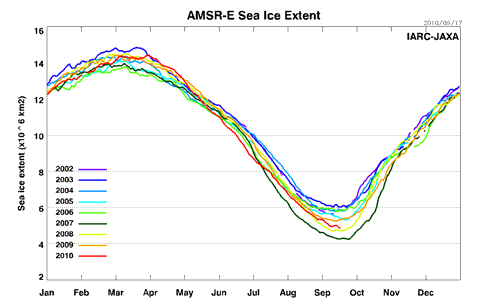
AMSRESIE100919.gif

Earlier this week, the National Snow and Ice Data Center (NSIDC) announced that the Arctic sea ice had reached its summer minimum extent, based on a four day run of extent increases. And then, like the fat lady in an overwrought opera refusing to die, trilling her agony and ecstasy to an appreciative audience, ice extent started dropping again. It was, as I suggested it might be at Neven’s Arctic Sea Ice blog, a double dip minimum — and as of this morning the extent (IJIS-JAXA graph above, but the NSIDC’s shows the same thing) is still dropping down towards 2008 — which holds second place in the record behind 2007. I still think it’s unlikely that the 2010 melt will do enough to pass 2008, but there’s a lot of thin ice and warm water up there, as I noted last Monday, and it will be interesting to see how the PIOMAS numbers for ice volume turn out — a new record low is definitely on the cards.

Attention will now turn to the autumn freeze-up, and the potential for the heat released by ice formation to impact northern hemisphere weather patterns. I’ve been reading a few papers on that subject, and will post a discussion as autumn up North progresses.

On a different tack, the future of the Arctic is becoming a popular subject for books. Robin McKie reviewed a selection for the Observer earlier this year (and from that selection I plan to read Charles Emmerson’s Future History of the Arctic, mainly because it seems to have arrived in southern hemisphere bookshops recently), but the book getting the most attention at the moment is Laurence C Smith’s The World in 2050: Four Forces Shaping Civilization’s Northern Future, due out this week (Science Daily). Smith summarises his vision in an article for the Wall Street Journal:

I imagine the high Arctic, in particular, will be rather like Nevada—a landscape nearly empty but with fast-growing towns. Its prime socioeconomic role in the 21st century will not be homestead haven but economic engine, shoveling gas, oil, minerals and fish into the gaping global maw.

That assumes, of course, that the “gaping maw” still exists…