 Interconnectedness is a major theme of Changing Planet, Changing Health: How the Climate Crisis Threatens our Health and What We Can Do about It. Jeffrey Sachs describes the book in his preface as “a scientific detective story of the first order, told with brilliance and relish by one of the world’s great ecological detectives”. The detective is physician and public health scientist Paul Epstein. He has co-authored the book with science writer Dan Ferber.
Category: environment and ecology
On Lignite: Elder not better
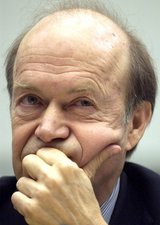 Since Don Elder thinks it inappropriate for the visiting James Hansen to comment on the morality of the proposed lignite development in Southland, let me, a fellow New Zealander, say that I find the morality of the development indefensible and all the special pleading offered by Elder doesn’t alter the case.
There is evidence that emissions of greenhouse gases from human activity are already causing hardship to some poorer populations of the world. There is little doubt that they will deliver today’s young and their children a world under pressure from immense and adverse changes which few of us would wish on them. That’s the basis of Hansen’s forthright comments on the morality of continuing to burn fossil fuels. If you want a more eloquent statement than he is accustomed to make have a look at what Norwegian novelist Jostein Gaarder said at a panel he shared with Hansen at the 2010 PEN World Voices Festival. I quoted him at some length in this post, but the essence of his speech was in these words:
“You shall love your neighbour as you love yourself. This must obviously include your neighbour generation. It has to include absolutely everyone who will live on the earth after us. The human family doesn’t inhabit earth simultaneously. People have lived here before us, some are living now and some will live after us. But those who come after us are also our fellow human beings…We have no right to hand over a planet earth that is less worth than the planet that we ourselves have had the good fortune to live on.”
Wegmangate: first blood
 Plagiarism by George Mason University professor Edward Wegman and his team — first revealed last year by John Mashey and Canadian blogger Deep Climate — has now been acknowledged by Computational Statistics and Data Analysis. The journal has retracted a paper (Social networks of author-coauthor relationships, by Said, Wegman et al, CSDA 2008) by Wegman’s co-author Yasmin Said and Wegman himself, citing — according to a report by Dan Vergano in USA Today — “evidence of plagiarism and complaints about the peer-review process”. Sections of the paper, itself based on the social networks section of the Wegman Report on the statistics of paleoclimate reconstructions, were copied and pasted from Wikipedia. It was rushed into print in a matter of a few days — extremely unusual in academic publishing.
Most interesting, however, is that Said et al seems to provide an example of an extremely rare beast: a self-refuting paper. Said, Wegman et al suggested that studies where scientists collaborated between institutions could be more liable to bias than papers where the “principal author tends to co-author papers with younger colleagues who were his students”. Said was a PhD student in Wegman’s department.
For the full story, refer to USA Today (original and follow-up), Deep Climate (one and two), with more at Deltoid, and especially at Stoat, where WMC provides an excellent dog/homework cartoon. Meanwhile, the world awaits GMU’s much delayed determination of the original complaints against Wegman and his report made last year…
Life Without Oil
“A gradual contraction into more sustainable patterns of resource use is not the norm for a society that is exploiting the environment. The norm is a last-ditch effort to maintain outward displays of power, and then a sudden, and dramatic, collapse.” That’s one of the foreboding statements with which Steve Hallett and John Wright punctuate their preview of past civilisations in the opening section of their book Life Without Oil: Why We Must Shift to a New Energy Future.
They consider we are at the peak of oil production and that we’re not facing that reality. There are late flurries to extend the discovery of further oil. Deep sea drilling, the exploitation of the Alberta tar sands and oil shale extraction are among them, the latter two causing horrendous environmental damage. But all they will produce is a temporary delay of the decline. The authors judge that around 2015 oil production will show a clear and convincing decline, and the world will be at the beginning of the end of what they call the petroleum interval. It’s an interval that will have occupied a couple of centuries in the long history of humanity. Oil has enabled the construction of a monumental global civilisation in which we have become dependent on the increased productivity and efficiencies of scale it can provide. As it diminishes and disappears we require an energy transition which the book considers we are not geared to make in good time. We therefore face a long global economic contraction as the price of oil escalates, a sequence of economic slumps which will continue until fundamental problems of energy availability, food production, water supply and population control are sufficiently well corrected.
Listener gets serious about sea level
 As I walked past the magazine stand at the supermarket this week my eye was caught by the front cover of the this week’s Listener (on sale last week). “Rising sea levels & extreme weather — why NZ needs to get serious,” it said. A cautious peek inside suggested Ruth Laugeson’s article might deserve a comment on Hot Topic so I parted with four dollars and brought it home to look more closely. It does indeed deserve mention here if only because it’s the sort of straightforward treatment of climate change that we should be able to expect of serious journalism. Laugeson has been reading Mark Hertsgaard’s book Hot: Living Through the Next Fifty Years on Earth, which I reviewed a few weeks back on Hot Topic. Hertsgaard argues that we must plan adaptation to the now unavoidable changes at the same time as working to avoid much worse and likely unmanageable change.