This week’s Sciblogs podcast is something of a climate special. The Science Media Centre’s Peter Griffin opens the show by talking to me about the High Court hearing of the case brought against NIWA by Barry Brill and his boys, and then discusses what we know about the state of the climate with Jim Renwick, now ensconced at Victoria University. Peter also talks to Dr Melanie Massaro about her paper Trapped in the postdoctoral void. You can listen to the podcast at Sciblogs, or subscribe via iTunes or Stitcher. Recommended.
Category: Climate politics
When asses go to court
 Perhaps the least interesting aspect of the High Court hearing which started today — the NZ Climate “Science Education” Trust (NZCSET) versus the National Institute of Water and Atmospheric Research (NIWA), before Justice Venning — is the ostensible casus belli, the construction of a long term temperature record for New Zealand. The law does not concern itself with trifles, and the minutiae of the techniques used to homogenise temperature records to account for site moves and instrument changes is nothing if not trifling with respect to the climatological big picture. New Zealand and the world have warmed significantly over the last 150 years, of that there is no doubt, and no amount of legal action will make warming go away and New Zealand’s glaciers recover the mass they’ve lost.
Nor has the the long term New Zealand temperature record been important to the formulation of government policy on climate change. That has relied on international diplomacy, the workings of the United Nations and the international consensus on the science of climate, all leavened with a healthy dose of local politics. The NZ temperature record played no part in either the design of the emissions trading scheme or its watering down.
So if this case is not about temperature records and their relevance to government policy, what is it about? We need to consider a few key questions.
- Who is bringing the action?
- Who is paying the lawyers?
- Who wins, and who loses?
The answers are bad news for the taxpayers and citizens of New Zealand — and perhaps the world.
Exclusive: Flat Earth Society appeal to NZ climate sceptics – join us!
 As New Zealand’s climate “science” coalition, in the guise of the NZ Climate Science Education Trust gets its day in court in its long running attempt to get the NZ temperature record declared invalid, a mole inside the Flat Earth Society has sent me the text of a letter being handed out to the CSET and its representatives outside the High Court in Auckland this morning. It is self-explanatory…
Updated 10-40am: By the miracle of modern technology, we have an image of the Flat Earthers in action, or perhaps inaction…
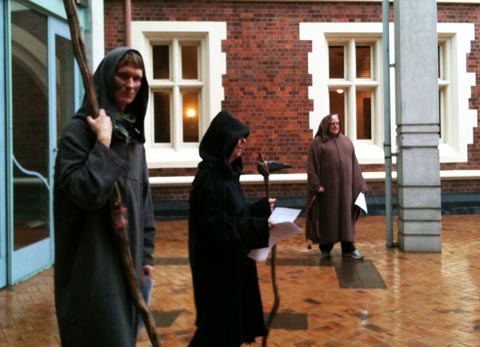
An Open Letter and Appeal to Lords Terence Dunleavy and Bryan Leyland of the Climate Science Education Trust.
On this day 16 July in the year 2012 in the Northern Township of Auckland, Middle Earth.
On the Occasion of the Lords’ Good Endeavours to Strike Down the temperature muddlings of the Dark Lords of the National Institution of Water and Atmosphere in the High Court of our Land.
Hear Ye Honourable and Esteemed Lords of Middle Earth.
We of the Flat Earth Society would like to extend to you a hand of friendship and solidarity.
For too long charlatans have used the black magic of peer-reviewed science to hide truthes from the public. They have falsified moon landings, spread the lie of global warming, and most dastardly of all, they say the earth is round! We at the Flat Earth Society have had centuries of experience in dealing with such fabrications.
At last, we have found another, like-minded group of lonely souls such as the Climate Science Education Trust who are bravely fighting the wave of charlatan science.
Continue reading “Exclusive: Flat Earth Society appeal to NZ climate sceptics – join us!”
Groser underplays the real risks
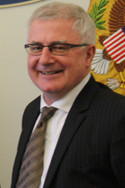 I listened to Climate Change Minister Tim Groser being questioned about the ETS on The Nation last weekend and explaining that the government’s position on climate change action is that we will play our part in the global effort, doing our fair share but not more. It confirmed my impression that Groser’s focus is on our negotiating position, not on the reality of the threat of climate change. He is intelligent and articulate in his exposition and it all sounds reasonable as far as it goes. The fact that in terms of realistically tackling climate change the global effort doesn’t go nearly far enough was not mentioned during the interview either by the questioners or the Minister.
The government doesn’t deny the science. It doesn’t refuse to participate in global action. What more is it reasonable to ask? A good deal more, as I see it. The complacency which attends Groser’s defence of the government’s position is not justified when one considers the reality of climate change which is already unfolding around the globe and is only going to intensify.
You’ll see with your own eyes
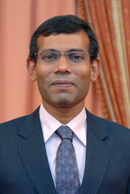 An interesting piece in the Huffington Post recently reported Mohamed Nasheed, former President of the Maldives, warning the United States: “You can’t pick and choose on science.” The Maldives is one of the most threatened nations in the world from the sea level rise accompanying global warming. While he was President, Nasheed worked to make the country carbon-neutral, as reported on Hot Topic a couple of years ago. That won’t save the Maldives, of course, but it will at least show willing to do what other much larger nations must do to keep climate change within manageable limits. With a population of 300,000-plus, he said his country needs to complete around 200 projects to reach that goal, a process he believes would take about 10 years.
He acknowledges the United States has a bigger challenge, but they need to face up to it.
“It’s going to be difficult for the U.S. to be a world leader unless they themselves embrace it.”
The population of the Maldives see all too clearly the effects of climate change, but Nasheed acknowledges that Americans may need the evidence of their own eyes. They’ll be getting it:
“You will probably see many aberrations in climate patterns. You’ll have to see that and you’ll have to experience that for you to take this thing seriously.”