
Signing up to nonsense: denialists plot letter to UN secretary general

People send me stuff. Imagine my surprise when this morning’s mail included the text of a round robin email from Tom Harris — the Canadian PR man who heads the Heartland-funded denialist lobby group the International Climate Science Coalition [full text here]. It gives an interesting insight to how these groups work behind the scenes. Here’s Harris appealing for signatures to a letter to UN secretary general Ban Ki-Moon:

Time is short if we are to mount a significant counterpoint to the scientifically invalid assertions already being broadcast by the 1,500 journalists and 7,000 environmentalists attending the UN climate conference now underway in Qatar.

Please find below our “Open Letter to the Secretary-General of the United Nations” to which we are inviting your endorsement. We have 61 qualified endorsers as of 9 pm EST, about 19 hours after we started to ask people.

Because we have an agreement with a major media outlet to publish the open letter on Thursday, I will need to know of your support within the next day if possible, please.

The denialist spin machine in action. The usual suspects queuing to sign up to a letter that’s going to be published — where? My guess would be the Wall Street Journal. Even more interesting is the nonsense these luminaries are so keen to endorse…

Continue reading “Signing up to nonsense: denialists plot letter to UN secretary general”
Doha notes: Random thoughts from the Middle East

Shelob

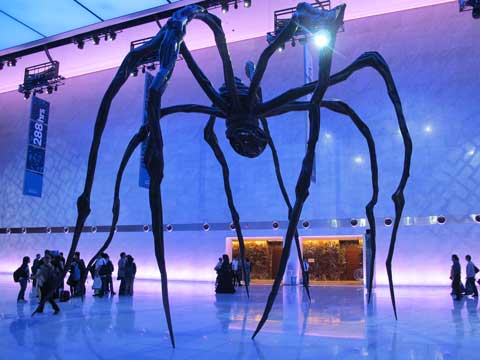
Shelob/Maman lurks over Doha delegates.

Every time I walk into a press conference it seems there’s more ‘cheery’ news. Yesterday it was UNEP releasing a science report on melting permafrost. Scary stuff. So scary that The Age in Melbourne gave it most of the front page and even some on the back page. (Meanwhile the NZ media was all about Hobbits).

According to the report, if the permafrost keeps melting like it has been, the gases it releases will make up 39% of emissions in 2100 (a combination of release of trapped methane and C02 from decomposing matter).

Then today it was the World Meteorological Organisation’s State of the Climate provisional report. 2012 was no exception to the trend of rising temperatures. “Global warming isn’t a future threat: it’s happening now,” intoned the official, pointing to this year’s Arctic melt as evidence.

These organisations save this stuff up for the climate talks, but sometimes one has to wonder why. I heard a UN official telling a newbie to the process that none of this would have any effect on the delegates at the talks. “They’re in a bubble – they’re totally immune to this stuff,” he said. And he’s right.

Some of these officials have been coming to the climate talks for more than 20 years and they don’t see anything beyond their negotiating tables. What might have an impact would be if they get home and their kids, having seen the permafrost or WMO stories, start giving them hell about it. I hope they do.

Continue reading “Doha notes: Random thoughts from the Middle East”

Tim Groser shuts the stable door after the Mickey Mouse carbon credits have bolted

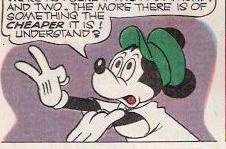
Mickey explains over supply in the offsets market

This week the Ministry for the Environment is consulting and seeking submissions on a proposal to ban some of the more ‘Mickey Mouse’ international carbon credits from the New Zealand Emissions Trading Scheme. Apparently this is because Climate Change Minister Tim Groser “wants to maintain the integrity of the ETS” (New Zealand Emissions Trading Scheme).

Thats really too much brazen and intentional cognitive dissonance, especially since Groser said that only five days after he indefinitely excluded agriculture from the ETS and only four days after he announced New Zealand would not sign up for a second commitment period under the Kyoto Protocol of binding greenhouse gas reductions.

I apologise if you had an extreme reaction to the close conjunction of the terms “Tim Groser”, “emissions trading scheme” and “integrity”. My apologies if you just coughed your coffee/beer/tea over your laptop or punched out your PC monitor.

Assuming you have cleaned up, I should provide the context for Tim Groser’s unintentional irony in claiming to be concerned about the integrity of an emissions trading scheme where emission units trade for less than $3 per tonne of carbon dioxide equivalent gas.

Here is the quote from Groser about the consultation.

Continue reading “Tim Groser shuts the stable door after the Mickey Mouse carbon credits have bolted”

Things we could only have dreamed of – and all that sand

Flying into Doha yesterday for the next round of international climate negotiations, landing in what seems to be a pile of white sand in the middle of nowhere, with high rise buildings sticking out of it. Is this where we’re going to stop climate change?

In a word, no.  Not by a long shot.  These talks, the 18th conference of parties to the UN Framework Convention on Climate Change, signed in 1992, will not stop climate change.

For me, the last few weeks have seen a number of  “things we could only have dreamed of” moments.  Back in 1991 when we were negotiating the UNFCCC, the meetings were peppered with almost daily International Chamber of Commerce press conferences where the likes of climate cranks Fred Singer, Patrick Michaels and Richard Lindzen questioned the science.  Big business and global institutions either ignored the issue – or were working to stop any agreement. Continue reading “Things we could only have dreamed of – and all that sand”

Kevin Anderson and the emperor’s underpants: beyond two degrees now inevitable

[youtube]RInrvSjW90U[/youtube]

If you have a spare hour, this lecture is something not to miss. Kevin Anderson, professor of energy and climate change at the University of Manchester gives this year’s University of Bristol Cabot Institute Annual Lecture, and rips into the comfortable assumption that limiting warming to two degrees is still possible. Can we stay within the “guardrail”? Only if you make a series of heroically unlikely assumptions, Anderson suggests. As we head into the Doha COP18 negotiations, this lecture provides a valuable antidote to the rose-tinted spectacles habitually worn by politicians — and, as Anderson points out — many scientists.