Climate Wars

Climate Wars

Gwynne Dyer’s new book Climate Wars explores the all-important political dimension of addressing climate change. Military history is Dyer’s speciality. One origin of this book was his dawning awareness that, in a number of the great powers, climate-change scenarios are already playing a large role in the military planning process. The other factor persuading him to write the book was the realisation that the first and most important impact of climate change on human civilisation will be an acute and permanent crisis of food supply.

He produces scenarios of his own to introduce each of the book’s seven chapters, positing in coming decades dangerous geopolitical developments in response to food shortages, with massive levels of human deaths. The scenarios range through many eventualities: dangerous confrontation on the Sino-Russian border;  nuclear conflict between India and Pakistan; the collapse of the European Union under the stress of south-north mass migration; a lethally effective border barrier between the US and Mexico with disastrous consequences for Mexico and the alienation of Hispanic-Americans within the US; a unilateral geo-engineering project gone wrong; and much else. His final scenario is different in that it looks much further ahead to a possible major extinction as a result of global warming effects on the oceans, drawing on the hypotheses in paleontologist Peter Ward’s recent book Under A Green Sky.

Dyer claims no certainty for his scenarios of course, but there is no denying their underlying credibility. As the main chapters of the book make apparent, the climate changes on which the scenarios are based are inescapable if we carry on with business as usual.  The book is as much about climate science as about the political and strategic consequences of climate change. Dyer is conversant with the major themes of  current science, and well understands the feedback mechanisms which threaten to accelerate the warming already under way.  He serves the general reader well in his this respect. He knows how to explain to lay people the complexities in which the experts deal.

He also spends a good deal of space canvassing mitigation possibilities and the likelihood or otherwise of their being adopted.  “We Can Fix This…” says one chapter, “…But Probably Not in Time” says the next, which is why he goes on to consider geo-engineering measures as an emergency fall-back option if the political process doesn’t deliver the goods on time.

As a respected journalist he has had access to numerous scientists, soldiers, bureaucrats and politicians. Extracts from their interviews are a core element of the book.  They lift his material clearly out of the realm of journalistic conjecture into the sober realms of the everyday working life of those he speaks with. The interviews have the further advantage of being recent and the book consequently takes us to where things stand right now. There is little doubt that they are worse than hitherto predicted.

Neither optimistic nor pessimistic, Dyer looks for realism. His final chapter centres partly on James Lovelock whom he sees as the most important figure in both the life sciences and the climate sciences for the past half-century; indeed he has him up there with a figure like Charles Darwin in the pantheon of scientific heroes.  But he finds the resolve to differ from Lovelock’s belief that irreparable damage has already been done. Dyer’s hope is that we will move sufficiently quickly towards decarbonising our economies to avoid the worst prospects of conflict and famine portrayed in his scenarios. He reflects on the small miracle that “at exactly the same time when it became clear we have to stop burning fossil fuels, a wide variety of other technologies for generating energy became available.”  But to make use of the opportunity we have within the next few decades, we will need, he concludes, the grown-up values of self-restraint and the ability to cooperate. One hopes this is not too much to ask.

Sitting in limbo

Parliament has risen for the summer recess, and New Zealand’s climate policy is reduced to a train wreck of repealed legislation and uncertainty about the emissions trading scheme. PM John Key confirmed under persistent questioning by Greens co-leader Jeanette Fitzsimons yesterday that the ETS would not actually be put on hold. From Hansard:

Jeanette Fitzsimons: With regard to those parts of the emissions trading scheme that came into force on 1 January 2008—relating to forestry—will the Prime Minister or will he not put on hold the penalty regime for deforestation during 2008, and the credits that foresters expect to claim in January 2009 for the carbon sequestered by their forests this year?

Hon JOHN KEY: The current legislation and rules about deforestation stay in place, pending the outcome of the select committee.

Jeanette Fitzsimons: In that case, what precisely is the Prime Minister suspending or putting on hold, given that nothing else is due to come in until 2010 and he is retaining the parts that are already in force; or is the Prime Minister saying that the forestry bit may be taken out of force later, which means they will have to give their credits back?

Hon JOHN KEY: That is exactly the point. Nothing is coming in until 2010 outside of forestry. The high-level select committee will have reported back. It is the hope of the Government that the legislation that will replace the existing emissions trading scheme legislation will be in place long before January 2010.

Fitzsimons take on the exchange at Frogblog is worth a read. Meanwhile, let’s run through a little history. When the ETS was first launched, National supported it. Then they withdrew support for the legislation in the run-up to the election, but campaigned on keeping the basic ETS structure while tinkering with (also known as watering down) the settings. Post-election, to pacify Rodney and his pack of cranks, the ETS was to be put on hold while a select committee considered, amongst other things, whether a carbon tax might be better. Now, on the last day of this session, we learn they’re not going to do that, and the legislation stands until amended.

If this seems like a government that doesn’t know what it’s doing, then I’m not the only one to notice. Brian Fallow in today’s Herald is withering in his criticism. He notes Australia’s new — and disappointing — targets for carbon dioxide reductions:

It ill behoves anyone on this side of the Tasman to be scornful about that, however. At least the Australians have an intermediate target. We have none. At least they have a climate change policy. Ours is in shambolic limbo.

Worse, Key considers that the Rudd government is on the right track, describing Aussie policy as “a very considered and balanced approach to climate change” in Parliament. As Fallow memorably concludes:

Given the countries’ different starting points, Australia’s mid-century target of a 60 per cent reduction in emissions from 2000 levels is similar to National’s 50 per cent from 1990 levels. But while Rudd is taking at least baby steps in that direction, Key is performing some kind of pirouette.

It’s an unedifying spectacle.

[Title reference]

The sound of failure/It’s dark… Is it always this dark?

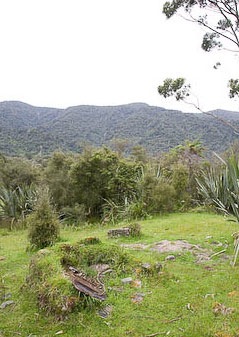
Mackenzie.jpgForgive me this riff on impermanence. Last Sunday morning, my little group of middle-aged winos and winemakers (plus a professor or two) left the lodge in Martin’s Bay and crossed a serene Hollyford River on a jetboat. We walked along the edge of the bush on the spit, looking at Maori middens, layering in sand dunes, native plants and the succession from pingao to rimu, pondering the most recent ice age — which carved out the Hollyford valley — and the potential for rising seas to change this wonderful example of coastal ecology. Eventually we arrived at the site of the Mackenzie homestead – built in the 1870s by hardy settlers determined to make their lives in this wet and wild corner of what was then a new land to Europeans. All that remains is the stone fireplace, overgrown with grass, the vague outline of the walls, and some imported trees — the gums are doing very well. I pondered the lives of the settlers in the Hollyford and the scratches they left on the landscape, while New Zealand and the world grasped at bigger issues…

Continue reading “The sound of failure/It’s dark… Is it always this dark?”

Hot, flat and crowded

The following column was written for the Waikato Times in October.  For the Hot Topic posting I’ve brought the final paragraph up to date,  recognising that Obama will head the new administration. Hopefully that will lend substance to Friedman’s optimism.

Thomas Friedman’s recently published book Hot, Flat, and Crowded offers ground for cautious hope in the crisis now upon us. A three times Pulitzer Prize winner, Friedman is well known as the foreign affairs columnist for the New York Times and for his previous best-selling book The World is Flat, which explored the realities of globalisation.

Friedman is an enthusiastic American. Some of his views on international politics have little appeal for me.  But this book, properly, is well beyond any political alignment.  It faces up to global warming and biodiversity loss, sees how real and dangerous they are, and urges nothing less than a green revolution in America as the only way out for that country and indeed for the world.

As a leading journalist Friedman has had access to many leaders in science and industry and finance.  The result is an energetic and credibly detailed account of how America can move to clean energy.  Friedman is comfortable with a market economy and sees it delivering what is needed, but he is equally sure that its success depends on clear directives and regulations being put in place by federal government. He urges business to see the green revolution as opportunity not threat.

It is easy to despair when considering America.  For eight wasted years the Bush administration has refused to take measures to combat the climate change for which it, of all countries, carries the most responsibility. In annual emissions America as a country may now have been overtaken by China, but its per capita emissions are far greater and its past contribution to the level of carbon dioxide now in the atmosphere dwarfs anything China has achieved. The administration’s neglect of the issue, fed by scientific ignorance and susceptibility to powerful lobbying interests, has been staggering.

Yet it is America which provides many of the leading scientists who have uncovered the complex processes of global warming.  American politician Al Gore has done more than any other person to alert the world to its dangers.  California, the world’s seventh largest economy, has committed itself to large emissions reductions.  Other states and cities are following suit. America’s potential to lead the world in a green transformation is enormous.  Its fine universities, its technological capabilities, its wealth, if harnessed for the purpose make the revolution conceivable. Friedman, aware of both the negative and positive aspects of American society, settles for a sober optimism about what can be achieved.

He considers a change in America will also be the answer to China’s current reliance on dirty fuels.  China will suffer dreadfully from climate change as droughts and floods increase and crop yields diminish.  They must be aware of this and will surely follow any lead America offers towards clean energy.  Friedman visits China regularly and has ferreted out evidence of moves there towards a greener economy even in the midst of the headlong rush to fossil fuel-powered growth. He reports encouraging developments which, though nowhere near enough, indicate that China could follow an American lead.

We know all too well in New Zealand how hard it is to get political traction on this most serious of matters. The modest emissions trading scheme has met fierce opposition and looks likely to be diluted even further. Only a few politicians treat the question with the gravity it deserves, and most of the electorate still seems unaware of what looms threateningly for our children and grandchildren.

Here’s hoping that Friedman’s sober optimism proves justified and that Obama will, as he has recently announced, prevaricate and delay no longer but take up the task on which the human future now urgently depends.

Don’t be a Rodney, John Key!

IanMcEwansmall.jpgDon’t be a Rodney, John, be a Barack on climate change. That’s the central message of the new Don’t be a Rodney, John Key! blog, created to promote a letter-writing campaign to our new leader, urging him to ignore ACT’s call for inaction and recognise that this is an issue that demands clear, consistent leadership. Blogger Morgan points out:

The world is watching. On Tuesday 18 November, Barack Obama made a powerful statement that was heard around the globe: “Now is the time to confront this challenge once and for all. Delay is no longer an option. Denial is no longer an acceptable response. The stakes are too high. The consequences, too serious.”

Delay? Denial? He’s talking about Rodney!

I wholeheartedly endorse Morgan’s campaign. Write a letter or send an email to Key (details of how on the site), politely urging action. Join the Facebook group. I’m going to write to Key, Nick Smith and my constituency MP, Colin King. I hope they’ll listen.

But I’m not holding my breath.

PS: Russell Brown covers the ACT denial deal in detail here. Worth a read (h/t Carol).

PPS: Jeanette Fitzsimons has a punchy post on Key’s options over at Frogblog.