
 TV3 news hit one of its lows last night. Reporter and presenter Samantha Hayes was in Aitutaki in the Cook Islands for the visit of Greenpeace’s ship the Esmeralda on its Pacific climate impact tour, with Sign On ambassador Keisha Castle Hughes on board [Greenpeace release]. I was watching the news item with interest when I thought I heard the reporter saying “while the science is far from settled…â€. Since my hearing is not reliable I checked on the TV3 news website. I had heard aright. Here is the full sentence: “While the science is far from settled, Greenpeace is convinced that Aitutaki is on the front line of climate change.â€
Category: Climate politics
Copenhagen 3: targets and timetables
 The third section of the Copenhagen congress synthesis report considers the global targets and timetables that will be necessary to keep warming to no more than 2 degrees. The report acknowledges that 2 degrees introduces considerable risk to human society and natural ecosystems. However global average temperature has already risen by 0.7 degrees, and inertia in the climate system makes 1.4 degrees inevitable. So 2 degrees may be the best we can hope for.
Deckchairs? We haven’t even got a boat…
Followers of Hot Topic’s new Twitter feed might have noticed this link, posted this morning. It’s a Guardian report of a select committee hearing in the UK Parliament, in which the director of the Tyndall Centre for Climate Change (at Manchester University) took the Labour government to task for the “dangerously optimistic” nature of the targets it has adopted.
Professor Kevin Anderson, the director of the Tyndall Centre for Climate Change Research, said the government’s planned carbon cuts – if followed internationally – would have a “50-50 chance” of limiting the rise in global temperatures to 2C. This is the threshold that the EU defines as leading to “dangerous” climate change. Anderson also said that the two government departments most directly involved with climate change policy, were like “small dogs yapping at the heels” of more powerful departments such as that run by the business secretary, Lord Mandelson. He said that the Department of Energy and Climate Change (Decc), run by Ed Miliband, should be given more power.
What are the British targets that so concern Professor Anderson? In the April budget, Gordon Brown’s government formally adopted the target suggested by the committee it established to advise on the matter — a 34 per cent cut in emissions by 2020 from a 1990 baseline. Anderson wants that tightened to 40% before the Copenhagen meeting in December, in order to get a reasonable deal out of the process.
… without more ambitious action he feared that a significant deal at Copenhagen would not be achieved. “No one I talk to thinks there is going to be anything significant to come out of Copenhagen,” he said. “We are going to come out and recover the deck-chairs in preparation for moving them as the Titanic sinks. We’re not even at the stage of rearranging them,” he added.
There’s a message here for New Zealand’s politicians and scientists, and it’s not a comfortable one for either group.
The moneygoround
 Back in March climate change minister Nick Smith decided it was time to sort out whether the Emissions Trading Scheme was a recipe for economic disaster, as ACT and big emitters were insisting (using figures from a shonky report by NZIER), or affordable, as Treasury modelling (conducted by Infometrics) showed. Smith commissioned both economic consultancies to work together to arrive at a consensus, which they were happy to do (at a cost of $79,200 + GST). The result of this ministerial banging of heads was released yesterday [PDF], and it is simultaneously interesting, encouraging and profoundly disappointing.
“Widespread climate-related impacts are occurring now and are expected to increase”
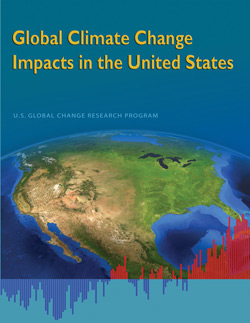 I think I was around eleven years old when I last thought it would be good to be an American. But I admit to a small twinge of envy as I read the report released yesterday by the Administration:  Global Climate Change Impacts in the United States.  This is a scientific report, backed by the government, telling the general public what is now known of global warming and what it will mean for the US. The sort of thing one would have thought is a core function of democratic government. Meanwhile in New Zealand a select committee is required to solemnly consider submissions from climate science deniers, a PM wants us to be ready in case the science deteriorates and the sceptics are right, and a leading climate scientist is sacked for what sound like trivial offences against management policy.