 The desperation that poorer countries are feeling over climate change was dramatically displayed at Barcelona this week when the African bloc walked out of the official negotiations towards a Copenhagen agreement. Their complaint, reports the Guardian, was that the rich nations’ carbon cuts were far too small to avoid catastrophic climate change. The demand is that the rich countries adopt the science-backed target of a 40% overall cut on emissions on 1990 levels. So far, rich countries have pledged an aggregate of less than 10%. The US, the world’s second biggest polluter, has pledged to cut around 4% on 1990 levels, or 17% on 2005 levels.
Category: Climate politics
Obama’s new pathways for power
 Barack Obama is matching his words with action. Four days after his MIT speech on renewable energy he has announced, under the Recovery Act, $3.4 billion in grants to improve the US electricity grid. The grants go to 100 partners with plans to install smart grid technologies in their area. The government money will be matched by industry funding for a total public-private investment worth over $8 billion.
The announcement was made in a speech at Arcadia, Florida, where he was visiting a solar energy centre to open a large-scale solar power plant. In a vigorous statement he explained why the improvement is necessary and what it will accomplish. Continue reading “Obama’s new pathways for power”
Finding better words
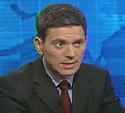 A sidelight to Gareth’s post about the 4ºC map launched in London last week is the strength of the language used at the event by the Miliband brothers — foreign secretary David (left) and climate change secretary Ed. The Times reported that David Miliband accused the public of lacking a sense of urgency in the face of the potentially devastating consequences of climate change. People have grown apathetic, he said, when they needed to be galvanised into action before Copenhagen.
“For a lot of people the penny hasn’t dropped that this climate change challenge is real and is happening now. There isn’t yet that feeling of urgency and drive and animation about the Copenhagen conference.â€
4500 ways in 174 countries to send a 350 message
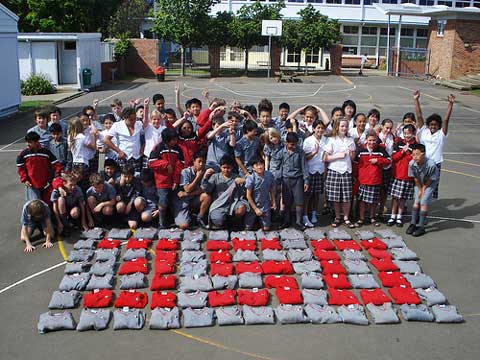
350.org‘s planetary day of action is well under way, with schools actions happening all over New Zealand — that’s Remuera Intermediate above, taking their jumpers off for climate action. Tomorrow’s the big day, with over 130 350 Aotearoa actions scheduled all round the country. You can find one near you at 350.org.nz. Lend a hand. Send a message.
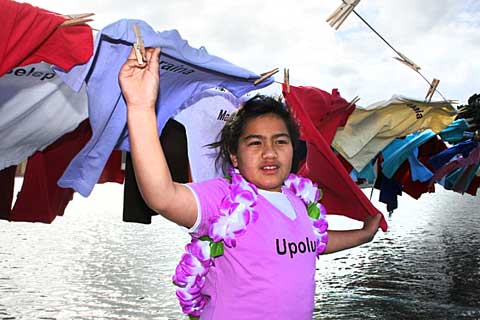
This is Jane Filemu, a 9 year-old Samoan girl taking part in 350 Islands For Change, an Oxfam-organised action at Takapuna beach in Auckland today. With Pacific Island nations being hung out to dry by the developed world, islanders waded out to a giant washing line and hung up 350 tee-shirts, each printed with the name of an island. Jane hung up the final shirt, recited a poem and then told the crowd:
“I have a choice to be one of many, to make a better world for the future of Aotearoa, Pasifika, our planet. Everyone has the power to choose wrong or right. Family, we can work together, we can make a change. Alofa, Aroha, Peace!â€
My action? Colin King MP is turning up to open Amberley Farmers Market’s summer season. I’ll be having a chat to him about climate reality. 350 words, at the very least (and the mayor won’t escape either). 😉
Four degrees too far
The British government has stepped up its pre-Copenhagen campaign for a global emissions deal, yesterday releasing this interactive map of what a 4ºC temperature increase would mean for the world. Click on the map to explore the impacts listed across the bottom. A larger (full page) version is available here, and background here and here. At the launch in the Science Museum in London, Ed Miliband, the Energy and Climate Change Secretary emphasised the urgency:
“Britain’s scientists have helped to illustrate the catastrophic effects that will result if the world fails to limit the global temperature rise to 2 degrees. With less than 50 days left before agreement must be reached, the UK’s going all out to persuade the world of the need to raise its ambitions so we get a deal that protects us from a 4 degree world.â€
The 4ºC projection can be thought of as a plausible worst case scenario – the sort of outcome that we have to take seriously when deciding on emissions reductions. Based on modelling done at the UK Met Office’s Hadley Centre (discussed at this recent conference, BBC coverage here), the map shows what could happen if global emissions continue to rise unchecked — but not when we would get there. Some model runs suggest it could be as early as the 2060s. One key point to note: a 4ºC rise in the global average does not mean a 4ºC rise everywhere. Some places (like NZ) will be shielded from the full warming by cool oceans, but in the Arctic, for instance, the rise could be as much as 15ºC, and over continental interiors such as the USA and Asia 6 – 8ºC. Large parts of central Australia will be 6ºC hotter — as will much of Antarctica. The planet will be radically transformed, and not in a good way. More coverage at the Telegraph, Independent and Guardian.