Pearced to the heart: Fred gets it wrong

I have been a reader of the Guardian newspaper for 55 years and was more than a little astonished when they ran a series of articles by prominent environmental journalist Fred Pearce on the stolen University of East Anglia emails. For that matter I was surprised that Fred Pearce wrote them. He is no climate change denialist, and makes it perfectly clear that the emails in no way alter the case that humans are warming the planet. But he seems to have taken them at the face value the hackers presumably hoped for, and drawn some unjustified and unfair conclusions. The Guardianobviously thought he was on to something significant. A “major investigation” they proclaimed, getting at the “real story”. Revelations and exposures abound.


Let’s take a closer look at one of the revelations. It’s an article claiming that the emails reveal “strenuous efforts by the mainstream climate scientists to do what outside observers would regard as censoring their critics”.  It was the one chosen for inclusion in the latest Guardian Weekly. As a reader of that paper I’d been quietly hoping we’d be spared the sight of any of the articles, but there it was, on the science page, with the lurid headline “Research red in tooth and claw.”

Pearce claims that there have been obvious cracks in the peer-review system for years, mentioning an open letter from 14 stem cell researchers to journal editors to highlight their dissatisfaction with the process, alleging a small scientific clique is using peer review to block papers from other researchers.

From there he jumps to the emails, where he claims “many will see a similar pattern.”  Phil Jones, as a top expert in his field, was regularly asked to review papers “and he sometimes wrote critical reviews that may have had the effect of blackballing papers criticising his work.”

Pearce quotes from a 2004 email in which Jones mentions that he had recently rejected two papers from people saying CRU (his climate research unit) has it wrong over Siberia.  “If either appears I will be very surprised.”   Pearce acknowledges that Jones doesn’t say why he rejected the papers (might it have been that they were poor science?).  Pearce also doesn’t know what the papers were, but announces that the Guardian has established that one of them was probably from Lars Kamel, a Swedish astrophysicist who analysed temperature records from parts of southern Siberia and claimed to find much less warming than Jones.

Pearce admits that Kamel’s paper could be criticised as being slight and lacking in detail about its methods of analysis.  However, he surmises, Jones would have known that Kamel called mainstream climate research “pseudo-science” and that publication of the article in a serious journal would have attracted the attention of professional climate sceptics. (Presumably suggesting that this would prejudice Jones in his estimation of the paper?) In spite of the paper’s inadequacy Pearce says that because it was a rare example of someone trying to replicate Jones’ analysis “some would have recommended its publication.”

So is Pearce suggesting that if a scientist of Jones’ stature considers papers to be lacking scientific rigour he shouldn’t say so, lest he might be instrumental in persuading an editor not to publish them?  Or is he suggesting that Jones deliberately sets out to prevent publication of anything which questions his own position?  He hardly makes himself clear, but succeeds, on the basis of much conjecture, in casting a slur on Jones’ integrity.

He later makes a good deal of Jones’ “harsh criticism” of the journal Climate Research for publishing papers he “disagreed with”.  It seems to me that Jones and others had every reason for their criticism. Chris de Freitas, the editor responsible for publishing the Soon and Baliunas paper, is our well known crusading climate change denier. He constantly seeks and gains publicity for standard denialist claims (one might not unreasonably say lies) that increases in carbon dioxide don’t dangerously change the climate, that there is no acceleration in sea level rise, that climate scientists exaggerate for the sake of money, and so on. If he accepted the paper against the advice of four reviewers there is every reason to suspect the quality of the journal’s editorship.  But no, Pearce manages to imply that Jones and Mann did something improper and damaging to the publication of scientific papers.

It’s one thing for Pearce to discuss the general question of the mechanics of peer review, but quite another to use Jones as an example of the abuse of the system. That’s a rush to judgment which I find hard to believe the Guardian allowed.

I was pleased to discover that the Guardian at least invited climate scientist Gavin Schmidt of NASA to comment on Pearce’s article.  If you click on the highlighted yellow sections of the article (linked to above) you can see his annotations.  He roundly rejects much of what Pearce has to say. I’m no scientist, but it seemed apparent to me as a general reader that Pearce was pushing the email material way beyond anything it justified.  It was good to have that view confirmed by a working scientist.

I’m left wondering why this sort of “investigation” was ever supported by the Guardian.  It pre-empts the independent review the University has arranged.  It treats stolen and possibly selected emails as evidence, though to do so it has to make all sorts of assumptions about what the authors might have meant. It is manifestly unjust to the scientists concerned and trivialises their work.

Note:  Jones has recently been interviewed by Nature and although there are aspects of the Climategate allegations that he is not able to comment on he defends himself against some of the accusations made against his work.
Egg/face interface for Hide and the climate cranks

What was it Richard Treadgold and Rodney Hide were saying? Here’s Hide, speaking yesterday in Parliament:

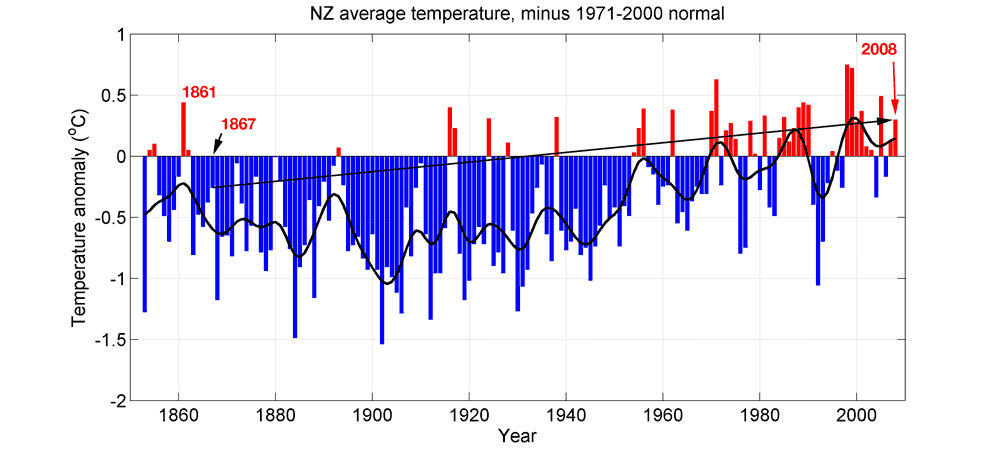
So, before Christmas, I asked NIWA to disclose the adjustments and their reasons. They said they would. But they have just told the Climate Science Coalition they don’t have the record of the adjustments.

And here’s Treadgold and the NZ Climate Crank Coalition:

This follows an admission by NIWA that it no longer holds the records that would support its in-house manipulation of official temperature readings.

Just to to provide a little balance, here’s NIWA, yesterday:

NIWA has added two new documents to its National Climate Centre web pages to outline how and why it made adjustments to its 7-station temperature readings in order to provide accurate and meaningful data to use in a time series of temperature information.

One document [PDF] lists all the adjustments made to the station records used in NIWA’s long term New Zealand temperature series, while the second [PDF] looks at one station, Hokitika, and explains in detail the rationale for that station’s adjustments.

I look forward to the prompt release of apologies from Rodney Hide, Richard Treadgold, Terry Dunleavy and the NZ Climate “Science” Coalition to NIWA, Jim Salinger and all the scientists involved in preparing and maintaining NZ’s climate records, but I won’t be holding my breath.

The annotated Rodney Hide: treating parliament with contempt

rodenymorph.gifHow far can a Minister of the Crown go in misrepresenting the facts of a matter before he is guilty of misleading the House? That’s not an easy question to answer, but any sensible reading of Rodney Hide’s speech in response to prime minister John Key’s statement to the House yesterday would suggest that if there’s a line to cross, Hide’s not just trodden on the chalk but taken a flying leap into touch.
Hide is certainly parliament’s highest-profile climate “skeptic” (his spelling), with a long track record of spouting the standard climate crank arguments, but yesterday Hide combined a complete misrepresentation of the so-called “climategate” affair with a scurrilous attack on the National Institute of Water and Atmospheric Research, based entirely on the discredited smear campaign emanating from the NZ Climate “Science” Coalition and Richard Treadgold’s “Climate Conversation Group”. Here’s the relevant section of Hide’s diatribe, annotated by me to show just how far from the truth he strayed…

Continue reading “The annotated Rodney Hide: treating parliament with contempt”

Sunday Times opens another gate

Jonathan Leake at the UK Sunday Times has been swift to hail another supposedly damaging inaccuracy in the IPCC report.  Africagate, the headline calls it.  It occurs in the Working Group II report, which deals with the question of impacts, adaptation and vulnerability. I’ve looked up the section, which is in chapter 9 of the report, looking at possible impacts in Africa. The section is headed Agriculture (page 447-448 of the chapter).  It opens with this sentence:

Results from various assessments of impacts of climate change on agriculture based on various climate models and SRES emissions scenarios indicate certain agricultural areas that may undergo negative changes.


There follows some closely referenced accounts of possible negative effects, as well as some possible positive effects. It’s in the course of the negative effects that the offending sentence is found:

In other countries, additional risks that could be exacerbated by climate change include greater erosion, deficiencies in yields from rain-fed agriculture of up to 50% during the 2000-2020 period, and reductions in crop growth period (Agoumi, 2003).

The Agoumi paper with which this sentence is referenced is apparently not peer-reviewed.  I’ve already pointed out in another post that it is not a requirement for IPCC authors that all references be to peer-reviewed material, and in the Working Group II and III reports it is likely that other literature will be cited as well. (Working Group III addresses mitigation possibilities.)  But not only is it not peer reviewed, it is a policy paper written in 2003 for the International Institute for Sustainable Development, a Canadian think tank. Professor Agoumi is Moroccan, and his paper apparently looks at prospects for Algeria, Morocco and Tunisia.

I don’t know what sort of weight the Agoumi report should be allowed. A lengthy blog on the British Democracy Forum website, which I presume provided the material for the Sunday Times article, presents a case for doubting its reliability. I’ll suspend judgment in the meantime, since the same blog triumphantly links the matter to “Climategate”, “Glaciergate”, and “Amazongate” and suggests together they spell the demise of the IPCC and Dr Pachauri.  I’ve already said what I think of “Amazongate”, and Gareth has written on “Climategate” here and here.  Granted the Himalayan glacier reference was an error, which has been acknowledged by the IPCC.

However, even if it turns out to have been a mistake to have included the findings of the Agoumi paper in the IPCC report it hardly warrants the hyped up attention Jonathan Leake gives it in his Sunday Times article (yes, the same Jonathan Leake whose sloppy journalism I wrote about here and here).  I don’t read the IPCC reports as revealed truth and it has never occurred to me to take the Working Group II report as anything other than an outline of the kind of effects we can expect to see increasingly as global warming takes hold.  Nor does the report itself claim anything remotely approaching certitude  – words like ‘may’ and ‘could’ in the above extracts are typical of its statements.

However, bit by bit the public is being told that alarming cracks are opening up in the credibility of the IPCC report and of climate scientists generally. Even the Guardian seems to me to have flirted with the possibility in the extraordinary time and attention it has given to the email saga.   And if recent public opinion polls are anything to go by some of the public is buying it.

Trifles are being magnified at the cost of proper attention to the overwhelming reality of climate science.  The great danger threatening the human future has not gone away because journalists and others find it more interesting to focus on the pedigree of a few references or the workplace character of a small group among thousands of scientists. Journalists and their editors might ask themselves how they can justify giving so much attention to comparative trivia and allowing public attention to be diverted from the mounting threat ahead.

For those of us who accept that the threat is real and present there is no option but to keep affirming and trying to communicate the science and to hope that the ground currently being lost in public opinion can be regained and strengthened before we run out of even more time.

Dominion Post editorial as shaky as Herald’s

When I was writing the post on the Herald’s acceptance of journalistic say-so in its editorial on the IPCC Gareth drew my attention to the fact that the Dominion Post had also produced an editorial claiming that the ethics and integrity of climate scientists is being called into question.  I was too engaged with the Herald to consider including the Dominion Postin the ambit of my attention at the same time, but now that I’ve had a closer look I rather wish I had.  The editorial is four days old, but still deserves taking apart.

The evidence the editorial draws attention to is first the publication of the stolen emails, suggesting, it claims, a conspiracy to hide data and play down information which didn’t fit the theories of the scientists concerned.  Then the Himalayan glacier error.  Nothing new here and comment familiar and predictable.

But the editorial had a  revelation (a different one from those offered by the Herald):


“Now it has been revealed that another IPCC warning –- that global warming could wipe out 40 per cent of the Amazon rainforest –- was extrapolated from an unsubstantiated claim by two green campaigners who had no scientific expertise.”

Looks pretty serious.  Where did the revelation come from?  It turns out from the same journalist as one of the Herald’s revelations.  Yes, Jonathan Leake in a different article in  the UK Sunday Times.

I’m relieved of the need to track down the details of Leake’s supposed exposure of yet another bogus IPCC claim by Tim Lambert of Deltoid who has a detailed analysis of the shady process by which Leake got to where he did. It turns out that Leake had been told by the scientist concerned, Dan Nepstad, that the IPCC statement was correct, but there had been an error in the citations listed in the WWF report (yes, WWF – no prizes for guessing who’s been trawling through the IPCC references looking for the letters WWF). I won’t try to cover the details of the account Nepstad has given to Lambert, which you can read on Deltoid, but the essential point is that Leake in his article concealed the fact that he had been told by the scientist concerned that the statement was correct. Presumably it would have made his story unnecessary. Why bother telling the truth when it would interfere with a story which opens like this?

A startling report by the United Nations climate watchdog that global warming might wipe out 40% of the Amazon rainforest was based on an unsubstantiated claim by green campaigners who had little scientific expertise.

The Dominion Post is as guilty as the Herald of uncritically passing round journalistic stories which drastically and groundlessly distort the work of the IPCC. Its editorial doesn’t draw the conclusion that climate change is not happening, but makes this extraordinarily sweeping and ignorant statement:

“Why trust a panel that confuses opinion and fact, wrongly attributes that opinion, tries to shout down critics and displays a determination to make the facts fit the theory rather than the other way around.”

Evidently in the editorial sections of our leading newspapers where the IPCC is concerned  ignorance and carelessness won’t be permitted to inhibit confident assurance.