
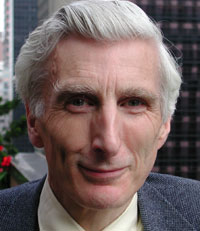
Rees: scientists are citizens too

The BBC’s HARDtalk interviewer Stephen Sackur engaged this week with the eminently reasonable Martin Rees, President of the Royal Society. The interview covered a range of topics, and climate change was among them.  It could hardly not be, given the seriousness with which Rees regards it.  Sackur chose to introduce the subject by suggesting that some of the confusion over climate change among the general public may be “because some scientists can’t decide whether they’re scientists – completely impartial, independent, guided only by data – or whether they’re campaigners”. Who he had in mind he didn’t say, or more likely didn’t know. Perhaps he was suggesting Rees falls into that category.

If so, Rees didn’t rise to the bait but took the opportunity to affirm that there is wide acceptance in the scientific community that climate change is a matter for serious concern and that nothing that has happened in the last year weakens the evidence for this.


He acknowledged, however, that there is plenty of scope for debate as to what we should do about it because we have to decide what sacrifices we make now in order to guard against risks of uncertain magnitude in the future.

Incidentally, when Rees mentions the uncertainties of future predictions it should be noted that he means that it is uncertain whether the level of warming this century will be two degrees or as much as a catastrophic five or more degrees.

Confronted with Monbiot’s latest fear that climate enlightenment is dead Rees replied that he wouldn’t go as far as that but hoped rather that the debate could be reinvigorated. At this point he mentioned the article he and Anthony Giddens have just written and which has now been posted on Hot Topic. Sackur pounced, asking how that can be done by scientists who must follow the data rather than campaign.

Rees patiently agreed that it is important to separate out the science, which is the basis for the policy decisions, from the policy decisions themselves. As a scientist “I see it as my job to ensure that the science with all its uncertainties is made available to politicians.”

But then came the telling aspect of scientific responsibility: “But as citizens I think we want to make sure that issues which are longer term and important don’t always get trumped by the urgent and immediate.”

“Scientists need to get noisier do they?” asked Sackur.

“Not just scientists, but many people who are concerned about the long-term future of the environment and the climate need to urge our politicians to give some weight to long-term issues.”

Behind the politeness and carefulness of Rees’s statements there is clearly a refusal to accept the foolishly simplistic notion that climate scientists should be corralled in the domain of their science and should leave the policy makers of the world to work out for themselves whether they are going to respond to the science and how. The fact of the matter is that politicians need to be constantly challenged to face up to the seriousness of the issue. And scientists are citizens with the same interest as the rest of us in an appropriate level of political response to a grave threat.

The dichotomy which Sackur used to get the discussion under way is a false one. It’s also a very tired one. I was surprised that an accomplished interviewer such as Sackur wasn’t ready with an approach which showed a more alert awareness of why scientists like Rees are impelled to sound alarms. It seemed to fit with a critical Climate Progress post from Joseph Romm recently on what he discerns as a decline in the BBC’s coverage of climate change. In the post he  reports hearing from a former BBC producer colleague that internal editorial discussions now under way at the BBC on planning next year’s news agenda have explicitly parked climate change in the category “Done That Already, Nothing New to Say”!

Reinvigorating the debate, Rees’s preferred path, is not going to be made easy. But we can be thankful that he and other scientists are committed to the effort.
Wake the world

This is a guest post by Anthony Giddens and Martin Rees. Giddens is a former director of the London School of Economics, a fellow of King’s College, Cambridge and the author of The Politics of Climate Change. Rees is president of the Royal Society.

This year has seen outbreaks of extreme weather in many regions of the world. No one can say with certainty that events such as the flooding in Pakistan, the unprecedented weather episodes in some parts of the US, the heatwave and drought in Russia, or the floods and landslides in northern China were influenced by climate change. Yet they constitute a stark warning. Extreme weather events will grow in frequency and intensity as the world warms.

No binding agreements were reached at the meetings in Copenhagen last December. Leaked emails between scientists at the University of East Anglia, claimed by critics to show manipulation of data, received a great deal of attention – as did errors found in the volumes produced by the UN’s Intergovernmental Panel on Climate Change. Many newspapers, especially on the political right, have carried headlines that global warming has either stopped or is no longer a problem.

Continue reading “Wake the world”

All around the world

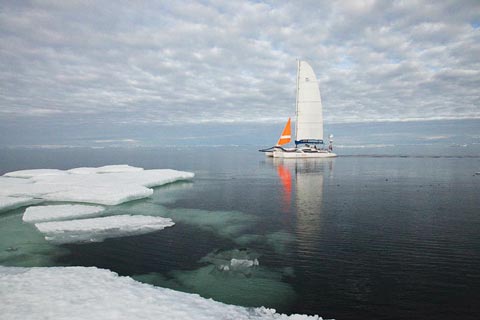
The Arctic Ocean has been circumnavigated by sailing vessels in a single season for the first time. The Norwegian trimaran Northern Passage reports that it has passed 74ºN, traditionally regarded as the eastern end of the NW Passage, and is now sailing into Baffin Bay heading for Pond Inlet. The Russian boat Peter 1is reported to be about one hour’s sailing ahead of them. In their blog post marking the milestone, Thorleif Thorleifsson and Børge Ousland provide this telling comment:

It is, unfortunately, the dramatic changes in Arctic sea ice conditions in recent years that have made this trip possible. On the time of Roald Amundsen it took five to six years to complete the same distance, due to the extremely difficult and demanding ice conditions. Now we have proven that it is possible to make the voyage in a 31-foot fibreglass sailing boat, equipped with a 10 horsepower outboard motor for emergencies. This shows how dramatic and how fast these changes are happening. The changes that we are witnessing will influence climate on a global scale, in addition to the whole range of animal life in the Arctic – especially seals and polar bears, whose lives are dependent on the sea ice.

It is our hope that our voyage will be seen as a strong, visible symbol of the scale and the speed of these changes.

Congratulations to both teams for their remarkable achievement. Given that the first circumnavigation by a sailing vessel was made by the French yacht Vagabond over two seasons as recently as 2002-2003, it’s clear that the pace of change in the Arctic is not slackening. Reflecting that, the Arctic Forum — a meeting of countries with claims to Arctic territory — is currently underway in Moscow. The Independent reports that the mood of the meeting is “conciliatory”, but the pressure to establish territory is growing as the rush to exploit oil, gas and mineral resources intensifies (see BBC for more).

[Updated] And to remind us that what’s at stake in the Arctic is a great deal more than a few billion barrels of oil, Yahoo News carries an IPS story on Arctic warming and the methane problem. If the average global warming is held to 2ºC (which doesn’t seem likely under present policy settings), the Arctic will warm much faster. NSIDC director Mark Serreze is characteristically blunt:

“I hate to say it but I think we are committed to a four- to six-degree warmer Arctic,” Serreze said.

If the Arctic becomes six degrees warmer, then half of the world’s permafrost will likely thaw, probably to a depth of a few metres, releasing most of the carbon and methane accumulated there over thousands of years, said Vladimir Romanovsky of the University of Alaska in Fairbanks and a world expert on permafrost. […]

That would be catastrophic for human civilisation, experts agree.

In other words, we have very good reasons to believe that settling for a 2ºC target would be to acquiesce in a global disaster. We can only hope for two things: that the climate commitment (the inevitable warming “in the pipeline”) does not push the Arctic into a huge release of methane, and that the world’s leaders wake up to the real scale and urgency of the problem. For all our sakes

[Oasis]

Tropical ice land: climate change hits Peruvians

It may not be strictly scientific, but anthropological observation like this is invaluable because in the end, people’s interpretation of the events they see around them count as much as or more than any peer-reviewed paper.” Guardian journalist John  Vidal has been with other writers on an Oxfam-guided tour of Peru and Ecuador  to see on the ground how changing weather is affecting human development in the Andes. He’s been blogging as he goes. No doubt there will be longer and more carefully constructed articles to follow, but these reminders that already people are suffering the effects of climate change, often severely, are worth immediate attention. I agree entirely with the quote from Vidal which opens this post, and last year welcomed a number of Oxfam reports which recounted many human stories from frontiers of climate change in Bolivia, Nepal, the Pacific Islands, and elsewhere.

 

Vidal reports meeting Julio Hanneco, “possibly the world’s greatest potato grower”. He grows 215 varieties of potatoes in the high Andean region of Peru.

“…folk like Julio and their extraordinary diversity of crops are critically endangered by the massive changes they observe taking place in the High Andes. When Julio was a boy, (he’s now in his 50s) a glacier was just two minutes walk from his door. Now it is a nine-hour hike away.”

In Julio’s own words:

“The seasons used to be very clear, we knew when to plant. Now we have less water. We used to get the water from the glacier. Now we have twice as many mosquitoes. We have no light from the glacier. I don’t understand what is going on. We feel very disoriented. I think that I will have no water and that will be the end of the world for us.”

Peru has more than 70% of the world’s tropical glaciers. Vidal reports most in rapid retreat, leaving behind devastated farmers and communities short of water.

In another blog post Vidal reports massive protest in the Espinar region. The Apurimac river “is about to be hijacked”. The Peruvian government has signed a memorandum of agreement with the neighbouring province of Arequipa, to build a giant reservoir from where the water would be used to provide hydroelectric power and irrigation. But it will not benefit the people of Espinar who stand to actually lose the little water they have. The benefit will be exported to rich farmers growing food for export on the Pacific coast.

Vidal’s group found a massive strike under way in the city of Yauri. They spoke with the leader who described it as a climate change strike.

“They are condemning us to a slow death. In the future we know we will have less water. We cannot trust the rainy season any more. Every year the water levels are diminishing. Climate change and global warming indicate in the next years we will have even less. You don’t need to be clever to see climate change is affecting everything here.”

Out in the villages in the hills, whose inhabitants expressed solidarity with the striking townsfolk, the story was the same.

“Here we had snow and ice on all the hills. We don’t any more. All these lands had water but no more. Our grandparents lived very differently to us. It used to rain from October to April, and May, June and July were frosty. We used to use the snow melt water. Now we have nothing. Before we could have 300 to 400 sheep and llamas; now we have 20 to 30 and no more.”

Oxfam and a local NGO partner are working to demonstrate adaptation measures to cope better with the semi-permanent drought which now afflicts the region. There are grounds for hope that these will be effective.  But civil unrest is rife, with numerous ongoing conflicts over water.

Vidal asks “Is this the future everywhere? Have the climate wars begun?”

[Fiery Furnaces]

The politics of failure/the failure of politics

As an example of contradictory thinking it would be hard to better Energy and Resources Minister Gerry Brownlee this week. He was announcing that oil and gas exploration in New Zealand is to get a substantial boost in government resources, including funding to further the possible exploitation of deep-sea methane hydrates.

He made a plea for New Zealanders to consider the potential for an accelerated oil and gas discovery programme to be achieved in an environmentally responsible way.

“People need to shift their thinking on exactly this issue. The development of New Zealand’s natural resources and the protection of the environment are not mutually exclusive. It is only through a strong economy that New Zealand can afford the expenditure required to look after and improve our environment.”

Is it unfair to construe this as follows?

We need to mine more oil and gas, the burning of which will hasten dangerous climate change, in order to become rich enough to deal with dangerous climate change.

In fact of course, when Brownlee talks of the environment he is probably not thinking of climate change at all.  He gives very little evidence of ever thinking of climate change.


The contradictions of which Brownlee is an example are deeply embedded in the political scene in a great many countries. There is very little indication that governments are preparing to stop the mining of fossil fuels.  Indeed there’s every indication that they’re ready to increase it whenever it looks as if there could be an economic benefit in doing so. Even the monstrous environmental assault of the extraction of oil from the Canadian tar sands is justified by its proponents. American Senator Lindsey Graham, who once supported a US climate bill, announced recently on a visit to view operations that he was going to do all he could to make sure that the oil sands production was not impeded because of US policy. He remarked that its production “really blends in with the natural habitat”!

One risks being regarded as slightly mad in declaring that a rational New Zealand would leave any possible new oil and gas fields undisturbed, along with coal unless effective carbon capture and sequestration processes are in place. But that seems to me to be the sane view at this stage of our understanding of what greenhouse gas emissions are doing to the climate.

George Monbiot has been reflecting on gap between the grand announcements of governments about emissions reductions and the reality that they aren’t achieving them. In a bleak column this week he writes that the failure of the international political process to find a successor to Kyoto means that “there is not a single effective instrument for containing man-made global warming anywhere on earth.”

It’s not as if the warnings are getting weaker.  They are clearly mounting as the evidence continues to accumulate.  But “the stronger the warnings, the less capable of action we become.” We were mistaken to think that something might come out of the last 18 years of talk and bluster. Environmentalists tend to blame themselves, but there was no strategy sure of success. The powers ranged against us are too strong.

“Greens are a puny force by comparison to industrial lobby groups, the cowardice of governments and the natural human tendency to deny what we don’t want to see. To compensate for our weakness, we indulged a fantasy of benign paternalistic power – acting, though the political mechanisms were inscrutable, in the wider interests of humankind. We allowed ourselves to believe that, with a little prompting and protest, somewhere, in a distant institutional sphere, compromised but decent people would take care of us. They won’t. They weren’t ever going to do so.”

Monbiot concludes that we must stop dreaming about an institutional response that will never materialise and start facing a political reality we’ve sought to avoid. I guess here in New Zealand that means accepting that the juggernaut of “resource” exploitation is going to roll on and leading politicians are going to continue to talk as if they’re protecting the environment while they’re in the process of destroying it. It also means that only strong organised implacable challenge is likely to have any effect – there is a small ray of hope in the success of mobilised public opinion against mining in protected conservation areas, but whether that kind of mobilisation can be raised against fossil fuels remains to be seen.

It may be worth noting that another columnist this week found reason to sound more upbeat, though certainly not about his own country. Thomas Friedman, writing in the New York Times, lamented the failure of the US senate to pass the energy-climate bill but pointed to the seriousness with which Chinese Communists were by contrast tackling the climate change issue and turning it into an opportunity for the development of clean technologies.  Friedman is inclined to optimism, as was apparent in his book Hot, Flat and Crowded, but he provides some basis for it in the case of China.

He quotes Peggy Liu, chairwoman of the Joint U.S.-China Collaboration on Clean Energy, a nonprofit group working to accelerate the greening of China.

“China’s leaders are mostly engineers and scientists, so they don’t waste time questioning scientific data…China is changing from the factory of the world to the clean-tech laboratory of the world. It has the unique ability to pit low-cost capital with large-scale experiments to find models that work.”

Friedman points to the way China has designated and invested in pilot cities for electric vehicles, smart grids, LED lighting, rural biomass and low-carbon communities.

It’s perhaps not much to pin hopes on, especially as coal continues to be used for much new power generation in China. But it may well yet be the case that burgeoning clean technologies will take us further than politicians can. In my inbox this morning was information from the Earth Policy Institute on the continuing rapid growth of solar photovoltaic cell production, described as the world’s fastest-growing power technology. China, Japan and Taiwan are the leading manufacturers. The writer acknowledges that it remains more expensive than fossil fuel-generated power, but points out that its costs are declining rapidly. If fossil fuels ceased to receive subsidies and were required to incorporate their currently externalised costs their relative cheapness would be exposed as only apparent.

Which is good reason to argue in New Zealand for more even-handed government investment in renewables by comparison with fossil fuel extraction. The absurdity of offering so much support for fossil fuels and so little for the green technologies on which our future, if we have one, will depend might be realised by some in our government if we keep on insisting. But it remains a hard slog.

[Cream]