On an island: coping with sea level rise

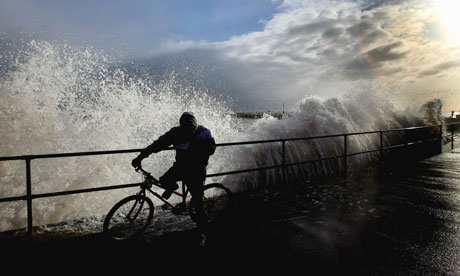
A recent Rowntree Foundation report on the vulnerability to the effects of climate change by mid-century of Britain’s coastal communities has attracted some media attention. It struck me as underlining the relevance of one of the chapters in the book Adapting to Climate Change which I recently reviewed on Hot Topic. The chapter, on adaptive governance for a changing coastline, noted a strategic shift in national coastal management policy in England away from investing in expensive ‘hard’ engineered defence towards designing a more naturally functioning coastline. This means that many coastal communities now face great unease and anxiety about their future, since the new policy preferences for retreat and realignment mean no future guarantees for protection.

[See end for comments by Gareth.]

Continue reading “On an island: coping with sea level rise”

The Climate Show #8: Kevin Trenberth and our shaky future

[youtube]yKF1w_ks_Vc[/youtube]

The Climate Show returns with a packed show, featuring one of the world’s best known climate scientists, NZ-born, Colorado-based Dr Kevin Trenberth — star of the Climategate “where’s the missing heat” emails. He’s been in New Zealand to visit family (experiencing the Christchurch quake in the process) and to attend a conference, and his comments on the state of our understanding of climate change should not be missed. John Cook of Skeptical Science returns with his new short urls and an explanation of why declines have never been hidden, and Gareth and Glenn muse on Arnie “Governator” Schwarzenegger riding to the rescue of climate science, cryospheric forcing and carbon cycle feedbacks from melting permafrost, and a new paper that suggests that current policies are pointing us towards extremely dangerous climate change. All that and hyperbranched aminosilica too…

Watch The Climate Show on our Youtube channel, subscribe to the podcast via iTunes, or listen direct/download here:

The Climate Show

Follow The Climate Show at The Climate Show web site, on Facebook and Twitter.

Show notes below the fold.

Continue reading “The Climate Show #8: Kevin Trenberth and our shaky future”

People talkin’ (open thread)

It’s been a little while since we had an open thread, and since a key feature of Hot Topic’s new comment policy (coming soon) is a requirement that comments should be relevant to the topic of the post, I’ll be making an effort to ensure that one is always available on the front page of the site. Over to you…

Adapting to Climate Change

Adapting to Climate Change: Thresholds, Values, GovernanceAdapting to Climate Change is a reassuring sounding title, but the content of this book makes it clear that there will be nothing straightforward or easy as human communities try to ready themselves for the coming climate crisis. Editors Neil Adger, Irene Lorenzoni and Karen O’Brien have been doing on research in the area for a number of years and worked closely together in the IPCC Fourth Assessment Report on adaptation. They convened a conference in 2008 at the Royal Geographical Society in London and the resulting papers are the basis of this book, now published in a paperback edition.

Continue reading “Adapting to Climate Change”

Zero net emissions by 2050 – preferably sooner

I’ve just sent my submission on the NZ government’s intention to make a formal commitment to a target of a 50 percent reduction in net greenhouse gas emissions by 2050 to the Ministry of the Environment — barely squeaking in before the published deadline. My original intention was to submit a closely argued case for a more aggressive target, but recent events militated against that. I settled for something a little more pithy, with an offer to back up my points with an oral submission if necessary. I’d also like to credit Bryan, whose incisive post on the recent “Beyond “dangerous” climate change” paper by Anderson & Bows makes a compelling case for a revision in the international received wisdom on acceptable targets. Full text below the fold…

Continue reading “Zero net emissions by 2050 – preferably sooner”