
 I have been reading the impressive court statement made by American climate activist Tim DeChristopher before receiving a two-year jail sentence for making fake bids at an oil and gas lease auction of parcels of public land in Utah in December 2008. The sentence was harsh but evidently not because the offence was particularly heinous. “The offence itself, with all apologies to people actually in the auction itself, wasn’t that bad,” said the judge. No, the serious matter was DeChristopher’s “continuing trail of statements”. The judge pointed to DeChristopher’s subsequent defiance and frequent assertions to reporters that civil disobedience is justified in fighting climate change. Previously the judge had refused to allow the trial defence that DeChristopher had been compelled to act, to prevent the greater evil of climate change. He also ruled out reference to the fact that most of the sales in the auction were later cancelled because of government doubts about the legality of the leasing plan. Continue reading “Imprisoned activist’s moving court statement.”
Category: Climate politics
America’s Climate Problem: The Way Forward
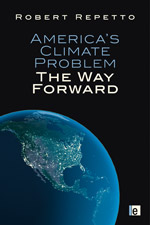 America is much better in technology than governance. That’s the sentence that leapt out at me and remained prominent throughout my reading of economist Robert Repetto’s book America’s Climate Problem: The Way Forward. I sought the book for review because, although its focus is on the US, what happens there will crucially affect the rest of us, in terms of both the level of greenhouse gas concentrations in the atmosphere and the likelihood of international agreement to limit them. The book doesn’t exactly inspire hope on either count, but it is constructive in the path it suggests for the US to follow and puts the ball squarely in the court of the policy makers.
It’s always good to read an economist who gets the full seriousness of climate change and Repetto certainly does that. In his opening outline of the problem he stands with the unequivocal statements of the National Academy of Science and uncompromisingly sets out the risks both globally and within the US, emphasising the scariness of reinforcing feedback mechanisms, some of which are already under way. America’s response must be to reduce greenhouse gas emissions by more than 80 per cent over the next forty years. Some measures are under way, he notes, but they are far from adequate to the task. Continue reading “America’s Climate Problem: The Way Forward”
Lessons from the Murdoch saga
 At best, and putting it kindly, there is incongruity in the Murdoch empire’s handling of climate change. Rupert Murdoch professed a few years back that he had become convinced of the seriousness of the issue, as his son James was, and wanted to contribute to its solutions. Yet Fox News endlessly churns out vitriolic denial and bitter attacks on scientists, Wall Street Journal editorials and op-eds are anti-science on climate change, and The Australian runs a war on the science, as well recorded by Tim Lambert at Deltoid. These three alone lend very powerful support to the vested interests which want to see no action on limiting the use of fossil fuels. I was therefore interested to read a blog reflection on the Murdoch saga by Camilla Toulmin director of the International Institute for Environment and Development (IIED). Toulmin is an economist by training and has worked mainly in Africa. Her latest book Climate Change in Africa was reviewed on Hot Topic. Climate change is one of the big issues IIED focuses on.
The absurd “moral superiority” of tar sands oil
 In a rational world the notion that Canadian tar sands oil is ‘ethical’ by comparison with oil from many other sources would be laughable. But I wrote earlier this year that the Canadian Conservation Minister Peter Kent used the term with some emphasis in his defence of the tar sands operation. This week I read that it’s now being vigorously promoted through a website EthicalOil.org launched by Alykhan Velshi, a neocon lawyer who until recently was the communications director for Immigration Minister Jason Kenney. He was also an important part of the Conservative Party election campaign operation.
Continue reading “The absurd “moral superiority” of tar sands oil”
Rash Brash and the potty peer’s PR pratfall
 The schedule for “potty peer” Christopher Monckton’s visit to New Zealand next week has now been finalised. He’ll be visiting Auckland, Wellington and Whangarei, but there’s no sign of any of the high-profile debates his sponsors were so keen to set up. ACT party leader Don Brash is joining in the fun, accusing the Greens of being “yellow” (geddit?) for refusing to debate with the good Lord:
Apparently the Greens are prepared to cripple our economy and condemn us all to subsistence living with dopey measures designed to stop the planet warming, but they’re not prepared to debate their reasons for doing so with a reputable opponent.
Brash considers Monckton reputable? Really? That reflects very poorly on Dr Don, unless he considers that a reputation for misrepresenting scientific research and calling his opponents Nazis or Hitler Youth is somehow respectable. Perhaps that sort of thing is now de rigueur on the extreme right…
One of the stranger aspects of Monckton’s visit is that the Public Relations Institute of New Zealand (PRINZ) is organising two of his appearances, in Auckland and Wellington. A little digging into the background of the PRINZ events reveals tantalising hints that fossil fuel interests in New Zealand could be tacitly supporting the potty peer’s short tour.
Continue reading “Rash Brash and the potty peer’s PR pratfall”