
 Here’s another open thread — your chance to expatiate, expound and expand on the climate-related topics of the day, whatever they may be, without risk of being declared off topic or otherwise out of place.
Author: Gareth
The billion dollar gap
 Dr Jan Wright, New Zealand’s parliamentary commissioner for the environment, today released her submission (pdf) to the Emissions Trading Review panel. It calls for a significant toughening up of the scheme that was so extensively watered down by the current government in 2009, in order to avoid a billion dollar per year cost to taxpayers. Wright’s recommendations make it clear that any further weakening of the scheme as the result of pleading by special interests can not be justified. She recommends that:
- both the price cap and the two-for-one deal expire on 31 December 2012 as currently legislated.
- a) a cap on the number of carbon credits freely allocated be put in place; and that
b) the phase-out rates for allocation be increased, not expressed as a percentage decrease of the previous year, and that the latest year in which allocation of free carbon credits must cease be specified.- the ETS is amended:
a) so that new industries that use lignite on a large scale are specifically excluded from receiving any free carbon credits;
b) to provide criteria for deciding which new activities are eligible to receive free carbon credits, including a requirement that the new activity will reduce New Zealand’s national net greenhouse gas emissions.- agriculture is brought into the ETS by 2015 as currently legislated.
The submission contains a picture worth at least a thousand words: this graph makes it very clear why the NZ ETS needs toughening up:
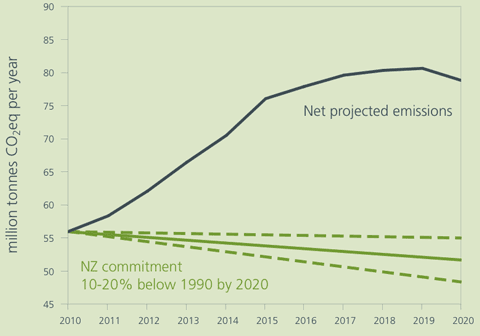
Current policy settings effectively guarantee that the government’s Copenhagen Accord commitment to a 10% cut in emissions by 2020 is nothing but an empty promise. The ETS is not delivering the goods — and it will be the taxpayers that pay the cost. Wright estimates that the “gap” between target and projected emissions “is likely to cost New Zealand over a billion dollars per year” by 2020.
Routefinding the future: reflecting on the climate futures forum
 Two busy days in Te Papa last week, and a lot to think about. The Climate Futures Forum organised by the Climate Change Research Institute at VUW was fascinating and disturbing in equal measure. Fascinating because it’s hard not to be interested when a lot of very smart people are feeding you information, and disturbing because they provided a stark reminder of how hard is the task that confronts us all. Below the fold: some reasonably random thoughts on the forum, interviews with some of the key speakers, and a summing up based on Jonathan Boston‘s remarks at the close of the forum.
Continue reading “Routefinding the future: reflecting on the climate futures forum”
The Climate Show #10: David Suzuki survives tech meltdown
[youtube]vgF8FaVRR5Q[/youtube]
Meltdown in the treacle factory (Glenn’s PC) means that episode 10 of everybody’s favourite Climate Show is only available in full by podcast. We’ve resurrected the video of our interview with David Suzuki, the great Canadian environmentalist and campaigner (above), but for the full goodness — a great climate change graphic, Russian heatwave analysis, thoughts on climate communication, John “Skeptical Science” Cook introducing the new politicians’ myths section on SkS and explaining the #1 skeptic delusion (no, it isn’t the sun wot dun it), plus a whole stack of solutions — tidal power, electric motorbikes, biochar for pasture and artificial photosynthesis — you’ll have to listen to the audio version (link below). That means you’ll have to do without the graphics we so lovingly describe, but… they’re all in the show notes below the fold… (Back, with luck with pictures, in two weeks).
Watch The Climate Show on our Youtube channel, subscribe to the podcast via iTunes, or listen direct/download here:
Follow The Climate Show at The Climate Show web site, on Facebook and Twitter.
Continue reading “The Climate Show #10: David Suzuki survives tech meltdown”
Umm, a Gummer and carbon nonsense
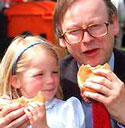 Twenty years ago I’d have crossed the street to avoid meeting John Selwyn Gummer, then agriculture minister in Margaret Thatcher’s government, chiefly famous for having attempted to feed his young daughter a beefburger at the 1990 Ipswich Boat Show to demonstrate his understanding of the risks of contracting bovine spongiform encephalopathy (aka mad cow disease) from contaminated meat. It has since killed 166 people in Britain, Cordelia Gummer not among them. I now find myself in the strange position of agreeing rather wholeheartedly with Baron Deben, as he is currently styled, in an article headlined Climate change doubters are endangering our common future published in The Australian (!) last week. And his musings on the politics of climate action provide a useful counterpoint to the astonishing submission on the NZ government’s intention to gazette a “50 by 50” target for carbon emissions made earlier this month by an Australian organisation calling itself The Carbon Sense Coalition.