Swell maps (again)

The US Energy Information Administration has just released its take on global carbon dioxide emissions in 2006 – and for the first time, China tops the list. The Guardian has the figures, and provides them in one the finest interactive maps I’ve seen in a very long time. The story also makes an excellent point about historical emissions:

The difference between China and the US is even more stark if you look at each country’s total historical contribution to global warming. According to figures from the WRI, the US has emitted 1088 tonnes of CO2 since 1850 for each of today’s Americans; this compared to just 68 historical tonnes for each living Chinese person.

That’s why they want the West to cut first, and cut deep.

Unlike markets, climate won’t bounce back soon

It’s my pleasure to welcome another guest writer to Hot Topic — Peter Barrett, professor of geology at Victoria University, deputy director of the Climate Change Research Institute and former director of VUW’s Antarctic Research Centre. He is also convener of the ANDRILL science advisory panel. Last week, the Dominion Post carried this challenging article from Peter, and as it is not available at the DP web site, he has kindly agreed to allow it to appear as a guest column here. I hope it won’t be the last.

The world economy appears to be heading into the worst recession in 60 years. The nominal wealth of global markets has almost halved in the last couple of months and the United States Government alone is shoring up its banking system with $US7.6 trillion. Commentators expect conditions will be difficult in the next few years and say we need to get the fundamentals right.

Severe downturns have happened before and our society has recovered. Each time, confidence and perception of wealth has grown to exceed tangible assets and credible wealth by a big margin, and the illusion could not be sustained. Each time we had to go back to the fundamentals.

At same time the global ecosystem has suffered from economic growth and rising population. The United Nation’s Millennium Ecosystem Assessment of 2005 found that more than 60 percent of the Earth’s ecosystem services were degraded by overuse and pollution. The importance of ecosystem services to our economic and social well being is now understood as fundamental, though progress is slow.

Continue reading “Unlike markets, climate won’t bounce back soon”

What have I Dunne to deserve this?

dunne.jpgPeter Dunne has been appointed chairman of the select committee being established to review climate policy, the Herald reports. Dunne, in an interview with Carbon News, indicated that he saw no reason to reconsider the science:

“The science is pretty clearly established,” Dunne said. “It’s somewhat ludicrous and arrogant to expect a New Zealand parliamentary committee to review the science which the IPCC, Stern (UK economist Lord Stern) and every notable committee in the world has adjudicated on.”

Today’s Parliamentary order paper lists the membership of the committee and the terms of reference [PDF]. Apart from Dunne, the 11 member committee consists of Craig Foss, Nicky Wagner, Dr Paul Hutchison, Hekia Parata, Rodney Hide, David Parker, Moana Mackey, Charles Chauvel, Jeanette Fitzsimons, and one member of the Māori Party. The full terms of reference are unchanged from ACT’s draft, with the exception of the science review — which has been dropped — and the terms set no time limit for the committee’s deliberations — though there have been indications that the report is expected by March.

Parker, Chauvel and Fitzsimons know this stuff inside out. It remains to be seen how the others perform. Nicky Wagner held an environment position under Don Brash, and flirted with scepticism at that time, but is now (she told me last year) happy to accept we need to act. It will be interesting to see how Rodney takes to being chaired by Dunne. Reaction from Don’t Be A Rodney here, while No Right Turn is resolutely sceptical, in the true sense of the word.

[Update 10/12: The order paper linked above omitted one particularly interesting new item in the terms of reference (see Government press release here):

– identify the central/benchmark projections which are being used as the motivation for international agreements to combat climate change; and consider the uncertainties and risks surrounding those projections

Rodney Hide seems hell bent on interpreting this as meaning he can have his crank fest. One hopes the rest of the committee will disagree. Meanwhile, a more rational interpretation of this item could lead to a very interesting discussion about targets – because the way I read it, “uncertainties and risks” could suggest the need for more stringent limits on emissions… 😉 ]

[Title reference]
Going, going, gone (by 2015)

One for the furry blogger with sharp teeth: the Winnipeg Free Press reports that University of Manitoba geoscientist David Barber is predicting that the Arctic will be ice free in summer in the next seven years.

“We’ll always have ice in the winter time in the Arctic, but it will always be first-year ice,” Barber said on Friday. He said he estimates the Arctic sea should see its first ice-free summer around 2015. “That has got industry very interested in the Arctic,” he said. “That will put more pressure there. The change is happening so quickly.”

Barber, who will be officially presenting his preliminary findings at the International Arctic Change 2008 conference in Quebec City next week, was the scientist in charge of the Circumpolar Flaw Lead System Study (CFL), a $40-million Arctic research project.

A newcomer to the form book, Barber’s track record is yet to be established. But he’s clearly a runner. And that sounds like a conference to watch…

(See also Spiegel Online – h/t S Bloom Esq)

[Title reference]

The cracks are showing #2 (polar notes)

wilkins26nov480.jpg

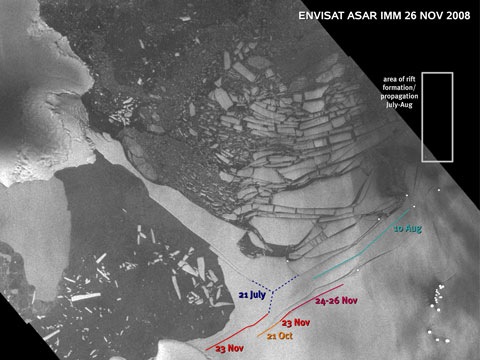
Summer’s arriving on the Wilkins ice shelf, and its disintegration continues. New cracks are threatening to destroy the ice “bridge” that’s been holding the ice shelf pinned between Charcot Island (top left) and the Antarctic peninsula. This picture, captured by the European Space Agency’s ENVISAT satellite on November 26, shows the new cracks (coloured lines) and the dates they first appeared (NASA version here). If the chunk of ice under “21 July” breaks away, the long thin bridge will lose support and follow suit, the ESA analysts say.

Meanwhile, a team lead by Richard Alley at Penn State has worked out that ice shelf calving – where icebergs break away at the edge of an ice shelf – is critically influenced by the rate at which the ice shelf is spreading out. The PSU release notes:

For iceberg calving, the important variable — the one that accounts for the largest portion of when the iceberg breaks — is the rate at which ice shelves spread, the team reports in the Nov. 28 issue of Science. When ice shelves spread, they crack because of the stresses of spreading. If they spread slowly, those cracks do not propagate through the entire shelf and the shelf remains intact. If the shelf spreads rapidly, the cracks propagate through the shelf and pieces break off.

When ice shelves break up, the glaciers that feed them can speed up noticeably, dumping more ice into the ocean. Over recent years, the role of water as a lubricant for glacier flow has been receiving a lot of attention (rubber ducks were recruited as under ice research tools in Greenland this year), and the BBC reports that a sub-glacial “flood” under the Byrd Glacier which feeds ice at the rate of about 20 billion tonnes a year into the Ross ice shelf caused that to increase to 22 billion tonnes over 2006. It has since returned to normal.

Up north, the NSIDC reports (Dec 3) that it continues to be warmer than average, even though the sea ice is now covering the whole Arctic ocean.