
 American environmentalist, writer, educator and founder of 350.org Bill McKibben is in New Zealand this month, and will be speaking at Wanaka’s Festival of Colour on Wednesday 29th April. Bill will be on stage for two sessions at the Infinity Crystal Palace, the first of which — at 10-30am on the impacts of global warming — will also feature me: Bill’s covering the big picture, and I’m providing the local colour. It’s an honour to share the stage with Bill, and I’ll be in the audience for his afternoon gig (2-30pm), where he’s going to address how we can deal with the problem. I hope I’ve finished Deep Economy by then…
Author: Gareth
A coral room
 Sea level rise is usually considered to be a relatively slow process, at least in human terms. Even a one metre rise over the next century (well within the bounds of possibility) is “only” one cm a year. It seems like a small number, even if when those small numbers start accumulating they bring big problems for coastal communities. Faster rates of rise are known from the past — up to a metre every 20 years during Meltwater Pulse 1A, a 5 metre sea level surge 14,000 years ago, as the great northern ice sheets broke up and the ice age ended. These sorts of rates are not generally considered likely for the near future, because we are in an interglacial and the most vulnerable ice melted a long time ago. However, a paper(*) in Nature this week suggests that a sea level surge of 2 – 3 metres 121,000 years ago, as the last interglacial was drawing to a close, could have taken place in as little as 50 years. Andy Revkin at the New York Times quotes from the study:
“The potential for sustained rapid ice loss and catastrophic sea-level rise in the near future is confirmed by our discovery of sea-level instability†in that period, the authors write.
The NYT is careful to point out that this new information is controversial, and will need confirmation before it’s accepted (see Revkin’s DotEarth blog post), but the most interesting feature of this sudden rise (if confirmed) is that it took place during an interglacial warmer than present, when sea level was higher, and when large parts of the Greenland and West Antarctic ice sheets are thought to have melted. In other words, melting ice sheets are prone to very rapid ice loss. The bounds of what’s possible in our future just took another step outwards.
(*) Rapid sea-level rise and reef back-stepping at the close of the last interglacial highstand, Paul Blanchon, Anton Eisenhauer, Jan Fietzke & Volker Liebetrau, Nature 458, 881-884 (16 April 2009) doi:10.1038/nature07933
Shaking the money tree
 NZ Incorporated has moved from a Kyoto deficit to a surplus, according to the 2009 Net Position Report [PDF] released today. A reduction in agricultural emissions due to the 2007/8 drought, and an upwards revision in forest carbon have produced an expected surplus of 9.6 million tonnes of carbon over the first Kyoto commitment period: 2008-12, worth $241 million at Treasury’s current carbon price of $25.
Announcing the figures, environment minister Nick Smith commented:
It is good news that we may exceed our Kyoto target but we need to be cautious of these projections given their volatility. It is difficult for the Government to make sound climate change policy when projections have ranged from a 55 million tonne surplus in 2002 to a 64 million tonne deficit in 2006 and when the figures over the past year have varied by 31 million tonnes equivalent to $787 million.
The volatility of the figures certainly doesn’t help the budget process, but has nothing whatsoever to do with making “sound climate change policy”. If you dig around a little in the FAQ [PDF], you find that the government’s only contribution so far has been to increase our liability as Section 2.3 on p2 points out:
Total energy and industrial emissions projections for 2008-2012 have not changed from the 2008 projection. There are reductions in the projected emissions from energy due to lower than projected energy demand during 2008, and the expected effects of a continued recession. However, these have been offset by the effects of removing the Biofuels Sales Obligation and the Renewables (Electricity) Preference, and a small increase in fugitive emissions from greater geothermal electricity generation.
The other fly in the ointment is that although the national carbon account may be positive, that does not necessarily mean that the government will avoid having to buy emissions unit on the international market. A key feature of the current ETS design is the “grandfathering” of heavy emitters by giving them allocations of free units to cover a large chunk of their emissions, and this could lead to the government having to buy units overseas, as Section 5 of the FAQ makes clear:
The net position is a simple balancing of New Zealand’s units assigned under the Kyoto Protocol (Assigned Amount Units (AAUs) and Forestry removal units) against our projected obligation under the protocol. ETS accounting considers how those units will be devolved domestically to participants, and balances up the flows of units from the Crown account. This means that under the net position New Zealand could have a surplus of units, but due to a generous allocation of units under the ETS, the Crown may still need to purchase units from overseas. The ETS accounting is a prediction of what units the Crown will receive from the sectors that have obligations under the ETS, and a prediction of allocation of units to sectors within the scheme. The two sets of accounting are very different as different sectors come into the ETS at different times, and have differing levels of allocation, while under the net position accounting, all of ‘New Zealand Inc.’s’ emissions are accounted for from 2008.
In other words, if the ETS Review proceeds with the expected softening up of the scheme for big emitters and agriculture, even if our national carbon account performs well the government could still end up shelling out taxpayer funds in subsidies to major corporates.
There’s a lot of material to plough through in the report, but here’s an interesting point that should make some of our farming advocates squirm: a chunk of the reduction in agricultural emissions — 4.1 mT, worth $100 million — comes from accounting for the use of nitrification inhibitors and emissions from urine and dung. So much for agriculture not being able to do anything to reduce emissions…
[Update: No Right Turn digs into the methodology changes behind the new figures, DPF at Kiwiblog posts an incredibly facile take on the issue, Business New Zealand want to use the new numbers as an excuse to do nothing (why am I not surprised?), while the Green Party want the government to commit to a 2020 target.]
Hows about telling a story
 Peter Dunne’s assurance that the ETS Review process won’t turn into a re-examination of climate science is set to run into a few problems. Looking through the full list of submitters who will make oral presentations to the committee (below the fold), I count no fewer than eleven (plus one “possible”) who will or have already argued the crank position — and remarkably, that includes two Hungarian scientists (Miklos Zagoni and Ferenc Miskolczi) who assert that the greenhouse effect doesn’t work the way we think it does, and that global warming is therefore not a problem — even though their views, and “calculations” have been extensively debunked. M&Z are effectively on the furthest reaches of the climate crank fringe, and yet they’ve been invited to give “evidence” to the ETS Review. I wonder who wangled that little feat, and if the chairman realises what he’s got in store?
You can watch Miskolczi and Zagoni in action in Heartland’s 2008 crankfest “proceedings“. Rabett Run and others comprehensively rebutted the Miskolczi paper last year, and even the ever-welcoming Heartland didn’t ask M&Z for a repeat performance this year. So why are they turning up in New Zealand? It appears that Zagoni is in Australia visiting relatives, so perhaps he’s just arranged a holiday for himself and his friend Ferenc to coincide with his submission date (set for May 4th). What a lucky coincidence! I wonder if they have had any help with their airfares? That would seem like a fair question for someone on the committee to ask, if they want to get to the Heart of why their valuable time is being so egregiously wasted.
The ETS Review crank list in full:
Bryan Leyland, Carbon Sense Coalition (Australia), Centre for Resource Management Studies (aka Owen McShane), Dr Ferenc Miskolczi, Dr Kesten Green, McCabe Environmental Consultants(*), Miklos Zagoni, NZ Centre for Political Research, NZ Climate Science Coalition, Dr R M Carter, Vincent Gray.
NZ attendees at Heartland conferences (2008 and/or 2009) underlined. Muriel Newman’s NZ CPR was one of this year’s “sponsors”, but she didn’t have to fork out any money for that privilege, just proselytize. (*) Not known. To see full list of submitters making oral presentations click on “now read on…”.
Bob’s big lie
 Time to revisit events at crank central. In the course of researching the NIPCC (at the behest of Peter Dunne), I popped over to the International Climate Science Coalition site, and then on to their Australian spin-off. The Aussie crank collective is greatly enriched by the presence of Prof Bob Carter, known here as “the great communicator” because of his accomplished presentation skills and ability to make outrageous nonsense sound almost plausible. The ACSC points to Prof Bob’s latest article for Aussie magazine Quadrant, and so — noting that one R M Carter is due to give evidence to the ETS Review committee at some point — I thought I ought to catch up on the great man’s current thinking. Prepare yourself for a jaw/desk interface event:
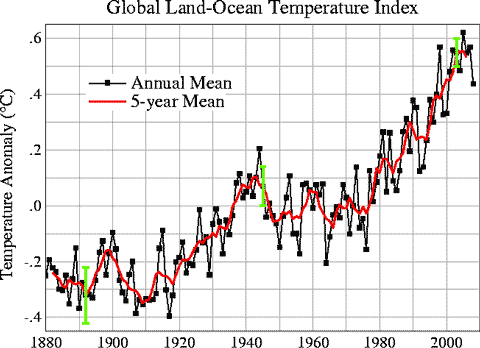
Get this. First, there has been no recent global warming in the common meaning of the term, for world average temperature has cooled for the last ten years. Furthermore, since 1940 the earth has warmed for nineteen years and cooled for forty-nine, the overall result being that global average temperature is now about the same as it was in 1940.
Global average temperature is now “about the same” as it was 69 years ago? Obviously, the “cooling since 1998” lie no longer cuts the mustard. Bob has to bend the facts beyond breaking point to bolster his case. Here’s the NASA GISS graph:
And here’s the Hadley Centre version:
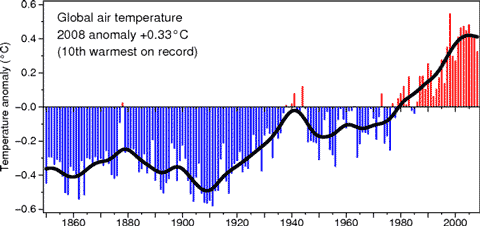
It is quite clear that global temperature is only “about the same as 1940” for definitions of “about the same” that consider variations ±0.5ºC to be inconsequential. You might as well say that because the world hasn’t warmed by 10ºC then it hasn’t warmed at all. But if you do that, then you can’t also insist that the world has cooled since 1998…
And how on Earth (or off it), did Research Professor Robert Carter of the James Cook University (Queensland) and the University of Adelaide work out that the world has warmed for 19 years but cooled for 49 since 1940? He must have a sophisticated statistical analysis to bring to bear on the topic. Or perhaps he has been counting all the little ups and downs in the GISS graph… Great science, by a great… something or other.