
This New Scientist video is a superb illustration of the tough emissions targets the world needs to be thinking about. More details in the NS story here. The basic premise is that if we take a 2ºC target seriously, then we have to limit our total emissions to 2050 to about 750 billion tonnes of carbon. Then divide that up by the current population of the world, and allocate countries a carbon budget, based on their population, that they can burn by 2050. Not good news for big emitters like the US, which would burn its total budget in about 12 years at current rates. As the presenter suggests, this is only a thought experiment not a model for policy, but it provides a realistic context for policy making. Required viewing.
Author: Gareth
National’s nine ways to stuff up: Oram on climate policy in NZ
Rod Oram’s column in yesterday’s Sunday Star Times so perfectly captures my own feelings on the government’s proposed watering down of the emissions trading scheme that I asked Rod if he would allow me to post it here as a guest blog. I’m glad to say he agreed…
To understand how the government is destroying the Emissions Trading Scheme, it’s important to remind ourselves why we need an ETS in the first place.
Governments representing a majority of people on the planet believe climate change is happening. So they’re taking steps to reduce their nation’s emissions of greenhouse gases. Some have entered into international commitments to do so. Many more will do so in coming years.
In 1997, New Zealand committed to cut its emissions during 2008-12 to its 1990 levels. However, they are currently 24% above. So the National-led government has upped the ante with two new targets: a 10-20% reduction below 1990 levels by 2020 and a 50% reduction by 2050.
To achieve them, we need to invest heavily in new energy and carbon efficient technology for electricity generation and transport and processes in industry and agriculture. And we need to maximise the potential for our forests to act as profitable carbon sinks.
To do that we need to:
Continue reading “National’s nine ways to stuff up: Oram on climate policy in NZ”
Climate change policy myopia
This is a guest post by associate professor Ralph Chapman, senior researcher Andy Reisinger, professor Jonathan Boston and senior associate Judy Lawrence from Victoria University of Wellington. It’s a succinct explanation of how and why the government’s climate policy is wrong-headed and ineffective, and is required reading for anyone following the policy debate in NZ. It first appeared in the Dominion Post on Sept 18th.
The deal between National and the Maori party over the emission trading scheme raises serious questions about strategic policy making in New Zealand. The agreement has positive features – a price on carbon will apply from mid-2010 in some sectors – but it raises major concerns about the capacity of our democratic institutions to serve the common good of New Zealand and avoid capture by vested interests.
The deal rests on four myths about climate change policy.
Third
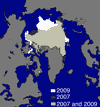 The National Snow and Ice Data Centre announced today that this year’s Arctic sea ice minimum extent was likely to have been reached on September 12. It’s the third lowest minimum in the record, behind 2007 and 2008. The image at left shows this year in white, compared with 2007 in darker colours. From the report:
On September 12, 2009 sea ice extent dropped to 5.10 million square kilometers (1.97 million square miles). This appears to have been the lowest point of the year, as sea ice has now begun its annual cycle of growth in response to autumn cooling. The 2009 minimum is the third-lowest recorded since 1979, 580,000 square kilometers (220,000 square miles) above 2008 and 970,000 square kilometers (370,000 square miles) above the record low in 2007. The 2009 minimum is 1.61 million square kilometers (620,000 square miles) below the 1979 to 2000 average minimum and 1.28 million square kilometers (490,000 square miles) below the thirty-year 1979 to 2008 average minimum.
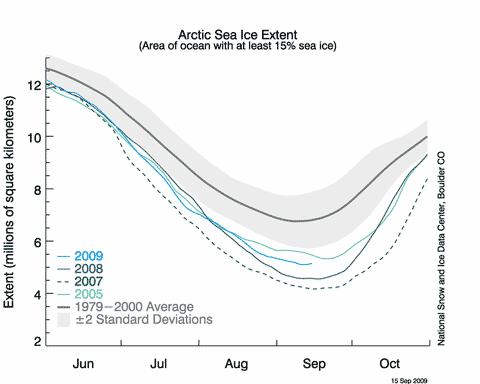
This NSIDC graph gives a very good idea of what’s been happening this year. 2009 has never looked much like beating 2007, but until mid-August it was giving 2008 a run for its money. However, a relatively cool summer and winds during August that dispersed the ice held the minimum extent above last year.
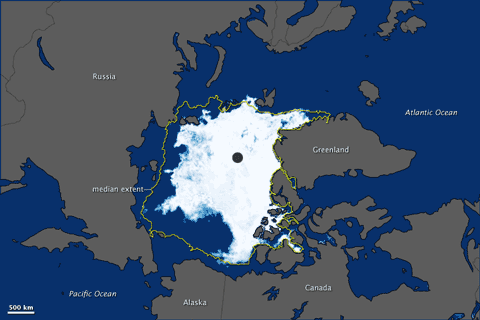
[Update 19/9] NASA’s Earth Observatory posts this graphic of the ice distribution on 12/9:
The usual suspects will no doubt trumpet this as a “recovery”, but the NSIDC team don’t think so:
National snub to Labour on ETS: part 2 – the fallout
 Carbon News has a special update tonight with the gory details of the government’s snub to the Labour opposition on negotiations to amend the emissions trading scheme. CN has also made available the full text of Labour’s proposed memorandum of understanding with the government (PDF) — which reveals that substantial incentives for agriculture were on the table. Commenting on the news of the deal with the Maori Party, a surprised Charles Chauvel told Carbon News:
“Negotiations with Nick Smith were … (pause) …I’m not sure now we had any discussions in good faith. We’d need to be very careful about whether or not we’d have any discussions with them at any time.â€
Labour leader Phil Goff accused National of a “major breach of faith” over the handling of the negotiations, and Chauvel indicated that ETS policy was now likely to become a political football.
Under Labour’s proposed Memorandum of Understanding, Carbon News reports that the agriculture sector would have been given:
…free units for emissions reductions made by farmers before the sector entered the scheme on January 1, 2013. The offer would be worth hundreds of millions and encourage early emissions cuts by farmers who would then have free units to trade on the international market.
[Disclosure: registered users of Hot Topic can claim a discount on subscriptions to Carbon News.]