
Twas the night before… the ETS

Tomorrow morning, a large chunk of New Zealand’s much debated Emissions Trading Scheme comes into effect. Forestry’s already been in it for two years, but July 1st is the day that the liquid fuels and electricity generation sectors start to have to account for their emissions, and it’s the first day that consumers might see a change in fuel and electricity prices that can be blamed on the ETS. Last week’s National Business Review had a pretty good overview of the state of play here. The scheme has also come in for some robust criticism in a new book, The Carbon Challenge, by Sustainability Council executive director Simon Terry and VUW economist Geoff Bertram (of which more in another post soon, I hope).

Federated Farmers have been out protesting in force — even though agriculture gets a free pass until 2015, and then gets 90% of its emissions “grandfathered” (effectively free). A few weeks ago Farmers Weekly editor Tim Fulton popped in for a cuppa and interviewed me about my views on climate change, agriculture and the ETS for an article that appeared a couple of weeks ago. Most of what I said won’t be news to Hot Topic readers, but I thought it worth passing on my thoughts on agriculture and the ETS to a wider audience:

Continue reading “Twas the night before… the ETS”

We call upon the author…

I must have been asleep last week when the IPCC announced its selection of authors for the Fifth Assessment Report (AR5), due in 2013/14. As usual, NZ scientists are making a significant contribution:

  • Tim Naish is a lead author for Working Group 1 (The Physical Science Basis) chapter 5, Information from Paleoclimate Archives.
  • Jim Renwick is a lead author for WG1 Chapter 14, Climate Phenomena and their Relevance for Future Regional Climate Change.
  • David Wratt is a review editor for Chapter 14 (as is Kevin Trenberth)
  • Phil Boyd (NIWA) is a lead author for WG2 (Impacts, Adaptation and Vulnerability), Chapter 6, Ocean Systems.
  • Alistair Woodward is one of the two Coordinating Lead Authors for WG2, Chapter 11, Human Health.
  • Andy Reisinger is a Coordinating Lead Author for Chapter 25, Australasia, Paul Newton (AgResearch) and Andrew Tait (NIWA) are lead authors, and Blair Fitzharris is a Review Editor.
  • Ralph Sims is a Coordinating Lead Author for Working Group 3 (Mitigation of Climate Change), Chapter 8, on Transport.
  • Harry Clark is a lead author for WG3, Chapter 11, Agriculture, Forestry and Other Land Uses (AFOLU).
  • Complete author lists: WG1, WG2, WG3.

Congratulations to all. Now the hard work starts…

And a plug: Jim Renwick is giving a talk on climate change at the Hurunui Library (yes, the one in the heat pump ads) in Amberley on Monday, July 5th at 7-30pm. All welcome. I’ll be heckling from the cheap seats…

[Thanks to Frogblog]

[Nick Cave]

Arctic sea ice projections: 6 billion dead within a year (it really is grim up North)

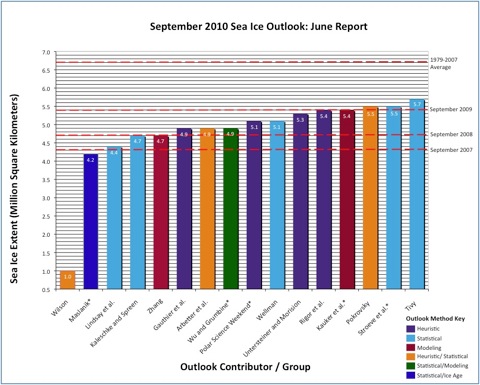
The first set of ARCUS/SEARCH projections for the September Arctic sea ice minimum have been released, and amid all the mundane statistical, heuristical, and modelistical musing there’s a remarkable effort — and I really do mean remarkable — by one Charles Wilson. Here’s the graphic showing all of the submitted forecasts. See if you can spot Mr Wilson’s offering:

ARCUS1006.jpg

Yes, that’s him on the left. He appears to have no affiliation to any academic institution, but he is not afraid to make a very definite projection. Download the full set of forecasts [pdf], and take a look. He expects a massive melt, leaving the Arctic Ocean more or less ice-free by September. That’s pretty scary, but here’s what he thinks this may bring for the northern hemisphere. Ocean current disruptions will bring 300mph winds to the northern hemisphere:

= Destruction of nearly ALL aboveground structures North of 10 Degrees Latitude = 99% Deaths in USA, Europe, etc. within 2 years. … In the Worst Case:
Immediate Action can create Clouds with: Airplane contrails, seawater mists, or high- altitude sulfur (e.g. heightening Smokestacks at Norilsk).
But it needs to be done in the next few Weeks – – – months before we can be sure an Early Melt WILL happen.

In a comment at µWatts he expands his point a little:

If the Great Melt Off happens = Warm Currents turn around = 300 mph Winds come February or so..
Currently I give it 15%
… times 6 Billion dead.

Now that’s what I call alarmist.

Continue reading “Arctic sea ice projections: 6 billion dead within a year (it really is grim up North)”

When the rain comes…

The extreme weather flavour of the moment is without doubt heavy rain and flooding. As I write, severe flooding has caused 132 deaths in southern China and 19 in Burma. The Var region in southern France is recovering from spectacular flash flooding that killed 25 people (watch the BBC video), Tennessee’s recovering from a 1000 year flood in May, and NZ hasn’t escaped. The Metservice blog reports that the flooding in Whakatane a few weeks ago was caused by rainfall of 89.8mm in one hour (with more heavy rain either side of that hour). As the blog notes, that’s tropical rain happening well outside the tropics. But what struck me at the time was a comment from a Whakatane resident included in the TV3 News coverage of that flooding. I can’t remember his precise words, but it was something along the lines of “should be a wake-up call for anyone who doesn’t think global warming’s an issue, because this is what global warming delivers…” Perceptive, I thought, because one of the more robust predictions of climate science is sometimes described as an intensification of the hydrological cycle.

Continue reading “When the rain comes…”

Still talkin’ (open thread #2)

Here’s another open thread, for discussion of anything not covered in recent posts. In response to a few requests, I have ditched the Intense Debate comment service, and reverted to the WordPress built-in system. I’ve installed a couple of plug-ins to allow comment editing and rating (which caused some weirdness with the blog theme and a late night for me until I worked out a temporary fix). I’ve also switched off comment nesting/threading, so your comments will appear in the order they’re posted. If you’re replying to a particular comment, please use the comment number or link to it (the link is under the number). As before, you’ll need to register and log-in to make a comment. If anyone has any problems with their log-ins contact me (gareth@ the site domain) and I’ll see what can be done.

A note on the comment rating scheme: four positive votes or three negative votes, or more than eight votes in total will give comments distinctive styles. Please try it out — I want to see what they look like! I could change this to make unpopular comments invisible, but only with tweaking. Let me know if it’s something you really want. Feedback on other aspects of the blog would also be welcome.